If you own a business incorporated in Delaware, understanding Delaware franchise tax is very important. Franchise tax in Delaware is a yearly fee that keeps your company in good standing with the state. Paying it on time helps avoid penalties and late fees.
Understanding the filing requirements and calculation methods is an important part of effective business taxation, helping companies avoid unnecessary penalties and compliance issues. Choosing the correct approach also helps reduce errors and ensures timely tax payments. Professional taxation services make the entire process simpler, more accurate, and stress-free.
What You Will Learn From This Blog
- What Delaware franchise tax is and why businesses must pay it.
- Which business entities are required to pay the tax.
- How Delaware franchise tax is calculated using different methods.
- Important filing deadlines and payment requirements.
- How professional taxation services simplify compliance.
- Common mistakes businesses should avoid.
- Benefits of staying compliant with Delaware franchise tax regulations.
- Practical tips to reduce filing errors and manage tax obligations effectively.
What is Delaware Franchise Tax?
Delaware franchise tax is a state-imposed fee that businesses pay for the privilege of forming or registering an entity in Delaware. It is important to note that this is not an income tax and is not based on a company’s profits or revenue.
The tax applies to businesses that are incorporated or registered in Delaware, including corporations, limited liability companies (LLCs), limited partnerships (LPs), and general partnerships (GPs). To remain in good standing with the state, eligible business entities must pay the required franchise tax and meet the applicable filing requirements.
Who Is Required to Pay Franchise Tax in Delaware?
Corporations
- All corporations formed in Delaware must pay the Delaware franchise tax.
- This applies even if the corporation does business outside Delaware.
- Corporations also need to file an annual report along with their franchise tax Delaware return to stay compliant.
LLCs, LPs, and GPs
- LLCs, LPs, and GPs pay a flat annual tax of $300.
- No annual report is required for these entities.
- Payment is due on or before June 1 each year.
Foreign Entities Registered to Do Business in Delaware
Foreign entities (businesses formed outside Delaware but registered to do business in Delaware) may also have annual tax obligations depending on their entity type and registration status.
Methods to Calculate Delaware Franchise Tax
Corporations have two main methods to calculate their franchise tax in Delaware as part of their overall business taxation compliance process:
Authorized Shares Method
- Base tax is $175 for up to 5,000 shares.
- For every additional 10,000 shares or part of 10,000, add $85.
- The maximum tax is $200,000 per year.
- Simple and easy to calculate, but it can be expensive for companies with many shares.
Assumed Par Value Capital Method
- Divide total gross assets by total issued shares to find the assumed par value.
- Tax is $400 per $1,000,000 or part of the assumed par value capital.
- Minimum tax is $400.
- The maximum tax is $200,000 per year.
- This method benefits companies with many authorized shares but few assets, making it a strategic option within business taxation planning.
Steps to Calculate Delaware Franchise Tax
Identify your business type
Determine whether your business is a corporation, LLC, LP, or GP before starting the calculation. The tax rules and filing requirements depend on your specific business entity type.
Choose a calculation method
Corporations can choose either the authorized shares method or the assumed par value capital method. Compare both methods carefully and select the option that results in the lower tax liability.
Gather needed information
Collect details such as total authorized shares, issued shares, and total gross assets, which are essential for accurate business taxation calculations. This financial and corporate information is required to calculate the franchise tax accurately.
Use the official calculator
Visit the official Delaware website and use the Delaware franchise tax calculator provided there. This helps ensure accurate tax calculations, timely payments, and full compliance with state requirements.
File your report and pay
Corporations must file an annual franchise tax report along with the required payment. Submit the report and pay the tax before the due date to avoid penalties and late fees.
Deadlines for Franchise Tax Delaware
- Domestic Corporations: Annual Report and Franchise Tax are due on or before March 1 each year.
- Foreign Corporations: Annual Report is due on or before June 30 each year.
- Limited Liability Companies (LLCs): Annual franchise tax payment is due on or before June 1. An annual report is not required.
- Limited Partnerships (LPs): Annual tax payment is due on or before June 1. No annual report is required.
- General Partnerships (GPs): Annual tax payment is due on or before June 1. No annual report is required.
How Professional Taxation Services Simplify Delaware Franchise Tax Compliance
Accurate Tax Calculations
Professional tax experts calculate Delaware franchise tax using the most suitable method for the company structure. Accurate computation reduces errors and ensures compliance with state regulations.
Timely Filing And Payment
Experts track all important deadlines and prepare required documents in advance, ensuring smooth business taxation compliance. Early preparation helps avoid penalties, interest charges, and late fees.
Complete Documentation
Tax professionals organize all financial and corporate records needed for filing. Proper record management reduces errors and speeds up the compliance process.
Filing Annual Reports Correctly
Annual reports undergo careful review before submission to ensure accuracy. Correct filing helps maintain the company’s good standing in Delaware.
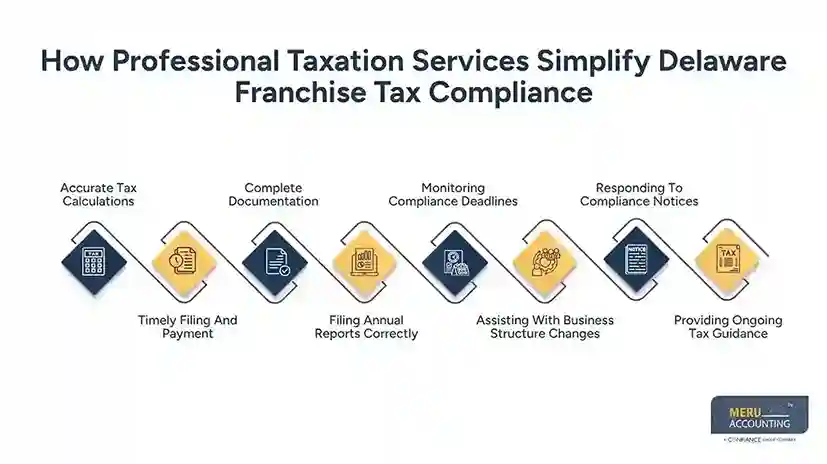
Monitoring Compliance Deadlines
Professionals maintain a full compliance calendar for all tax obligations. Regular reminders help ensure no filing or payment deadlines are missed.
Assisting With Business Structure Changes
Experts review changes like share issuance or restructuring to assess tax impact. Proper evaluation ensures all updates are correctly reflected in filings.
Responding To Compliance Notices
Tax professionals handle notices related to delays or missing information promptly. Quick responses help resolve issues before penalties increase.
Providing Ongoing Tax Guidance
Advisors stay updated with changes in tax laws and requirements. Continuous guidance helps businesses remain compliant throughout the year.
Benefits of Paying Delaware Franchise Tax
Keeps Your Business in Good Legal Standing
Paying the Delaware franchise tax keeps your business in line with state laws. This lets you run your business without legal trouble or interruptions.
Avoids Late Fees and Penalties
Paying on time stops extra charges. Late fees and interest can add up fast and hurt your finances.
Allows Legal Operations and Contracts
Paying the tax lets you run your business legally. You can sign deals and contracts without limits.
Protects Your Business Reputation
A clean tax record improves your image. Clients and partners see your business as reliable and professional.
Supports Future Growth
Being compliant with the franchise tax in Delaware makes it easier to grow. Investors and partners favor businesses with clear legal records.
Simplifies Financial Planning
Timely payment helps with budgeting. You can plan costs and avoid sudden money problems.
Reduces Audit Risks
Good records lower the chance of audits. Compliance makes reporting simple and stress-free.
Tips to Manage Franchise Tax in Delaware
Plan Ahead
Know your franchise tax due date and set aside funds well in advance. Early planning helps avoid last-minute stress, payment delays, and unnecessary penalties.
Maintain Clear Records
Keep accurate records of shares, assets, and previous tax filings throughout the year. Well-organized records simplify tax reporting and reduce the risk of costly errors.
Use Online Calculators
Estimate your franchise tax using reliable online calculators before filing your return. This helps you plan payments accurately and avoid unexpected tax liabilities.
Hire a Professional
Work with an experienced accountant to ensure accurate calculations, timely tax compliance, and better handling of business taxation responsibilities. Professional guidance can identify errors and legally optimize your tax obligations.
Pick the Best Calculation Method
Compare available calculation methods and choose the one resulting in lower tax liability. Selecting the right method can reduce annual franchise tax expenses significantly.
Review Your Taxes Regularly
Review your franchise tax filings and calculations carefully at least once every year. Regular reviews improve accuracy and help maintain ongoing compliance with regulations.
Stay Updated on Delaware Rules
Stay informed about changes to Delaware franchise tax laws and filing requirements as part of ongoing business taxation compliance. Keeping updated helps your business remain compliant with the latest regulations.
Common Mistakes Businesses Make
Missing the tax due date
Many firms pay late and face unnecessary fines and penalties. Mark the due date and pay on time every year.
Using the wrong tax method
Picking the wrong method can cost significantly more over time and create inefficiencies in business taxation planning. Check the applicable rules and use the correct method.
Wrong reporting of shares or assets
Mistakes in reporting shares or assets lead to higher tax liability. Keep clear financial records and check everything twice.
Ignoring penalties and interest
Late fees and interest charges grow fast over time. Pay on time consistently and avoid unnecessary extra charges.
Advantages of Delaware Incorporation Despite Franchise Tax
- Delaware offers business-friendly corporate laws that provide flexibility and strong legal protection.
- The state protects directors and officers from personal liability for many business decisions.
- Delaware corporations often find it easier to attract investors and raise investment capital.
- Many business entities benefit from greater privacy, as owner information is not always publicly disclosed.
- Despite the annual Delaware franchise tax, Delaware remains one of the most preferred states for business incorporation because of its legal and financial advantages.
Steps to Pay Delaware Franchise Tax
Visit the Delaware Division of Corporations Website
Start by visiting the official Delaware Division of Corporations website. Access the franchise tax section to begin the filing and payment process.
Log In with Your Business Details
Enter your entity file number and other required business information to access your account. Verify the details carefully before proceeding to the next step.
Select Your Entity Type and Tax Year
Choose the correct business entity type and the applicable tax year for your payment. Selecting the correct information helps prevent filing errors and processing delays.
Choose a Payment Method
Select your preferred payment option, such as a credit card, bank transfer, or check. Review any applicable processing fees before completing your payment.
Submit Your Payment
Complete the payment process after reviewing all the entered information carefully. Ensure the transaction is successful before exiting the payment portal.
Save the Confirmation
Download or print the payment confirmation receipt immediately after the transaction is completed. Keep a copy for your accounting records and future reference.
Verify Your Payment
Log in to your account later to confirm that your payment has been processed successfully. Check your business status to ensure there are no outstanding tax obligations.
Useful Tools for Delaware Franchise Tax Compliance
Delaware Franchise Tax Calculator
Use the calculator to estimate your franchise tax liability quickly and accurately. It helps businesses compare calculation methods and plan their payments effectively.
Official Delaware Division of Corporations Website
Use the official website to file annual reports, calculate taxes, and submit payments online. It also provides important filing deadlines, forms, and compliance information.
Professional Accountants
Professional accountants can help calculate your franchise tax and ensure accurate filings as part of effective business taxation management. They also provide guidance on compliance requirements and tax-saving opportunities where applicable.
optional anymore
on running the business
Delaware Franchise Tax Penalties and Interest
Late Payment Penalty
If you miss your Delaware franchise tax payment, the state charges 1.5% per month. This penalty grows fast if you wait many months.
Interest Charges
Interest is added to unpaid taxes from the due date. The longer you wait, the more interest you owe.
Importance
Paying on time avoids extra fees. It keeps your business in good legal standing. It also shows reliability to investors and banks.
Corporations vs. LLCs
Corporations face higher penalties for late reports and taxes. LLCs have a flat late fee. It is smaller but still adds to your total cost.
How Franchise Tax Affects Business Decisions
Incorporation Choice
Knowing about Delaware’s franchise tax helps businesses make informed incorporation decisions. Entrepreneurs can compare options before choosing the most suitable state.
Financial Planning
Estimating franchise taxes accurately supports better annual budgeting, financial planning, and informed business taxation strategy decisions. It also helps forecast business expenses more effectively.
Investor Relations
Companies that pay taxes on time build greater trust and credibility. This helps attract potential investors and lending institutions.
Entity Structure
Choosing a corporation or LLC directly affects your annual tax obligations. Select the right business structure based on your needs.
Delaware Franchise Tax for Startups
Startups with Few Shares
Using the authorized shares method may lower taxes slightly. It works well if a startup has few shares.
Startups with Many Assets
The assumed par value method may save money overall. This is useful if the startup has many shares issued.
Early Planning
Plan the share structure early in the process. This helps reduce franchise tax costs effectively.
Budgeting for Tax
Set aside money for franchise tax from the start to support better business taxation planning and budgeting. This avoids unexpected surprises later on.
Impact of Tax Rules on Foreign Companies
Foreign Corporations
Foreign firms only pay Delaware franchise tax if they are set up or registered in Delaware. This is true even if most business happens elsewhere.
Avoiding Penalties
Foreign firms must follow the rules to avoid extra fines. Late or missed payments can cost more and cause legal issues.
Annual Compliance
Even if a firm works outside Delaware, it must pay the tax each year if it is incorporated there. Meeting deadlines keeps the business in good standing.
Why Choose Meru Accounting?
Paying Delaware franchise tax is a required part of business taxation for all businesses operating in the state. You need to know the rules and pick the right method. Filing on time can help you save money. It also keeps your business in good standing.
Whether your business is a corporation, LLC, LP, or GP, planning ahead makes the process easy, fast, and stress-free. Meru Accounting makes the Delaware franchise tax process easy for your business.
Our skilled team ensures correct calculations, on-time filings, and full compliance with state rules. We help you pick the most cost-saving method, manage deadlines, and give support to avoid fines. By working with Meru Accounting, you can focus on growing your business while we handle all franchise tax tasks smoothly and reliably.
Our Expert Perspective
From our experience, many businesses pay more Delaware franchise tax than necessary simply because they use the wrong calculation method or miss important filing requirements. Reviewing your entity structure, sharing information, and filing obligations each year can help reduce unnecessary costs while ensuring full compliance. Professional tax guidance also minimizes errors, keeps your business in good standing, and allows you to focus on growth instead of administrative tasks.
Key Takeaways
Delaware franchise tax is an annual state fee required to keep eligible businesses in good standing.
Corporations, LLCs, LPs, and certain foreign entities may have franchise tax obligations.
Corporations can calculate tax using either the Authorized Shares Method or the Assumed Par Value Capital Method.
Filing on time helps businesses avoid penalties, interest, and compliance issues.
Maintaining accurate records makes franchise tax reporting much easier.
FAQs
Delaware franchise tax is an annual state fee that eligible businesses pay to remain in good standing with the state.
Corporations, LLCs, LPs, GPs, and certain foreign entities registered in Delaware may be required to pay franchise tax.
Domestic corporations generally file by March 1, while LLCs, LPs, and GPs must pay by June 1 each year.
Missing the deadline may result in penalties, interest charges, and loss of good standing.
No, Delaware LLCs only pay the annual franchise tax and generally do not file an annual report.