
Effective accounts receivable management leads to a strong and steady business. It helps firms get the money they earn on time. When managed well, it helps businesses grow fast. Poor handling of AR can hurt your cash flow and stop daily tasks. It may also lead to late fees, missed deals, or lost trust.
With clear steps and follow-ups, you can avoid risk and boost income. This blog shares the value of good AR work and how it shapes success.
Managing outstanding invoices is not only about collecting payments. It also helps build better customer relationships through clear communication and consistent payment processes.
Professional accounts receivable management services reduce delays, improve collection efficiency, and provide better visibility into cash flow. A structured approach helps businesses stay financially stable while allowing owners to focus on operations and long-term growth.
What You Will Learn From This Blog
- What accounts receivable management is and why it matters for every business.
- How poor AR management affects cash flow and business growth.
- The key benefits of professional accounts receivable management services.
- How timely invoicing and payment follow-ups reduce late payments.
- Best practices for improving collections and maintaining healthy cash flow.
- Common accounts receivable challenges and practical ways to overcome them.
- How outsourcing accounts receivable management helps businesses improve financial stability.
What is Accounts Receivable and Why Does It Matter
Accounts receivable are the money clients owe a business for goods or services. It is part of the sales done on credit. Firms give a time frame for payment. This amount shows up in the balance sheet as an asset. Timely tracking helps the firm collect money with ease.
Why does it matter?
- It brings in steady cash for smooth work.
- It helps plan future steps.
- It cuts the need for loans.
- It keeps the firm’s books clean and updated.
- It builds trust between the firm and its clients.
AR is not just a number. It helps the business stand strong and stay ready for growth.
Key Benefits of Strong Accounts Receivable Management
Effective accounts receivable management means the firm tracks and collects money on time. It helps in more ways than one. Let us see how it boosts business.
High liquidity available
- Nice management of the AR helps to minimize the bad debts. It increases the profit of the company.
- It eventually helps in increasing the liquidity available for the businesses that become important in acquisitions and other investments.
Control the Cash Flow
- In a company, the uneven expenses keep coming, which reduces the company’s cash faster. So, proper accounts receivable operations are helpful in accounts receivable performance and controlling the cash flow.
- Also, the inflow of cash from different sources can be well-managed through accounts receivable. The facility expansion with well-managed cash flow can be made in a very effective way through proper management.
Improved customer communication
- AR helps you get the proper view of the details of the transaction with the customer and the related due amount. You can give the proper insights into the overall amount receivable to the customer in a proper way.
- It will ensure that you get the amount from the customer faster in a hassle-free way. The AR helps to maintain the customer relationship in a better way.
Reduces the direct and indirect expenses
- A business firm has a lot of direct and indirect expenses, where there is a lot of cash flow. In some companies, indirect expenses are uncontrollable and drain the cash from the business faster.
- Here, if the AR is managed properly, then it becomes easier for the owners or management to make vital decisions to reduce the direct and indirect expenses.
Increase Cash flow benefits
- Well-managed accounts receivable can help you know more about taking the benefits of the cash flow. There are many ways through which businesses can take advantage of the cash flow for business improvement.
- Accounts receivable become useful for getting an advantage of the cash flow in the business.
How Poor Accounts Receivable Management Impacts Cash Flow
Cash flow is the lifeline of a business. If accounts receivable management is not handled well, cash stops coming in.
Delay in Payments
When you delay sending invoices or forget follow-ups, payments get delayed. This slows your income, limits daily spending, and affects future planning. Poor follow-up systems often lead to unnecessary stress.
Missed Duties
If cash does not come in on time, you may miss paying rent, taxes, or salaries. These missed payments lead to extra penalties and harm staff trust. It also slows your regular business activities.
Extra Debt
To fill payment gaps, some firms borrow money. Loans bring interest and fees, which reduce your profits. A strong receivable system avoids such extra costs and keeps operations self-funded.
Credit Rating Drop
Late payments and financial stress affect your credit score. Lenders and vendors notice this. A lower score means fewer credit offers and tougher payment terms from suppliers.
Lost Growth Plans
Future growth depends on available funds. When your cash is locked in unpaid bills, you delay hiring, marketing, or buying new stock. This stalls your ability to expand smoothly.
Smart accounts receivable management helps reduce these risks and keeps your business financially stable.
How Professional Accounts Receivable Management Reduces Late Payments
Professional accounts receivable management follows proven processes that improve payment collection while maintaining strong customer relationships.
Faster and Accurate Invoice Processing
The collection process begins with accurate invoicing. Professional teams prepare invoices immediately after products are delivered or services are completed.
Every invoice includes:
- Correct customer information
- Invoice number
- Due date
- Payment terms
- Itemized charges
- Accepted payment methods
Accurate invoices reduce confusion and encourage customers to process payments without delays.
Professional AR management also ensures invoices reach the correct decision-makers quickly.
Automated Payment Reminders and Follow-Ups
Consistent communication significantly reduces overdue invoices.
Professional receivables management services use automated reminder systems that notify customers before payment due dates and continue follow-ups when payments become overdue.
Typical reminder schedules include:
- Reminder before the due date
- Reminder on the due date
- Follow-up after the due date
- Escalation for long-overdue invoices
Automation reduces manual work while maintaining professional communication with customers.
Businesses receive faster payments without spending hours making follow-up calls.
Credit Evaluation and Customer Risk Assessment
Professional accounts receivable management helps businesses evaluate customer creditworthiness before extending payment terms.
Credit assessments may include:
- Reviewing payment history
- Checking credit ratings
- Evaluating financial stability
- Setting appropriate credit limits
Customers with higher risk profiles can receive shorter payment terms or lower credit limits.
This proactive approach reduces future collection problems and strengthens AR management.
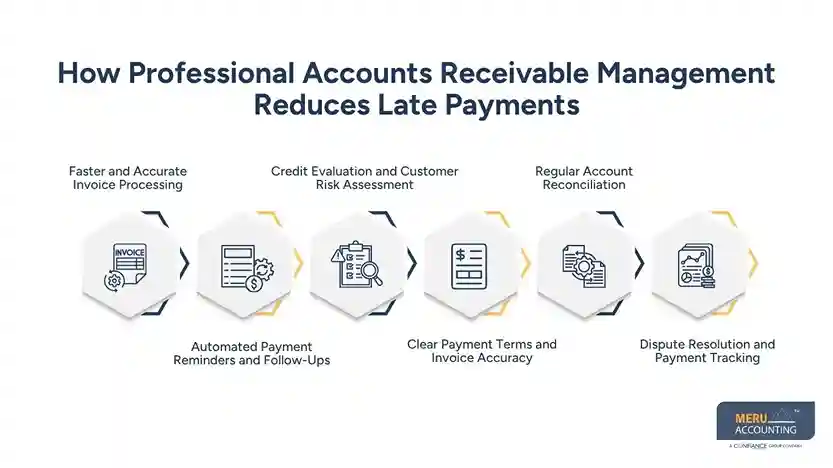
Clear Payment Terms and Invoice Accuracy
Many payment delays occur because customers do not fully understand payment expectations.
Professional accounts receivable services help businesses create accurate invoices and establish clear payment policies before transactions begin. Clear billing practices reduce confusion and encourage customers to pay on time.
Businesses clearly communicate:
- Payment deadlines
- Credit terms
- Early payment discounts
- Late payment penalties
- Accepted payment methods
Customers who understand payment expectations are more likely to pay on time.
Clear communication also reduces billing disputes and collection delays.
Regular Account Reconciliation
Accurate financial records are essential for successful collections. Professional receivables management includes regular account reconciliation by matching invoices, customer payments, credit notes, and outstanding balances. Keeping records up to date helps businesses resolve issues before they affect collections.
Regular reconciliation helps businesses:
- Identify missing payments
- Correct accounting errors
- Detect duplicate invoices
- Maintain accurate customer balances
- Improve financial reporting
Well-maintained records make collections more efficient and improve customer confidence.
Dispute Resolution and Payment Tracking
Invoice disputes should be resolved quickly before they affect payment schedules.
Professional accounts receivable management teams investigate customer concerns promptly and coordinate with internal departments to resolve billing issues.
At the same time, they continuously track:
- Outstanding invoices
- Collection status
- Customer communication
- Payment commitments
- Aging reports
Continuous monitoring allows businesses to identify overdue accounts early and take appropriate action.
Effective AR management keeps collections organized while protecting valuable customer relationships.
Common Challenges in Managing Accounts Receivable
Managing AR may sound easy, but it has many bumps. Many firms face these problems often.
Late Client Payments
In accounts receivable management, clients may delay payments for many reasons. Some face cash issues, while others forget. These delays disturb your plans and reduce available funds for business use.
Poor Follow-up
When firms lack a proper reminder system, they miss out on timely payments. Clients often delay payments if no one checks in or follows up politely and consistently.
Errors in Billing
Errors in invoices create confusion. Clients hold back payments until the bill is corrected. These delays harm trust and slow down the payment process, affecting your cash flow.
Lack of Clear Terms
If you don’t set clear credit terms, clients take it easy. They might delay payment or skip it entirely.
No Tracking System
Without a proper system to track overdue payments, it’s easy to miss unpaid invoices. Over time, small missed amounts grow, hurting your overall income and business plans.
Staff Shortage
If your team is too small, follow-ups, tracking, and corrections get delayed. This can result in unpaid bills, reduced cash inflow, and missed chances to grow your client base.
Firms must spot and fix these issues fast to stay strong.
Best Practices for Effective AR Management
To get the best from your accounts receivable, you need clear steps. These best practices can make a big change.
Set Clear Payment Terms
Make your credit rules simple. Share them at the start. Clients must know when and how to pay.
Send Bills Fast
Don’t wait to bill clients. Send invoices right after completing work or delivering goods. The sooner they receive it, the sooner you get paid.
Use Good Software
Accounting helps you track what’s paid and what’s due. It reduces mistakes, sends auto-reminders, and saves your time for more important tasks.
Follow Up Often
Send friendly reminders before and after due dates. A simple message or call can speed up payments. It shows clients that you track dues seriously.
Offer Many Payment Modes
Let clients pay by card, net bank, or wallet. More options mean quicker payments. More options mean faster payments and fewer excuses.
Reward Prompt Payers
Give small rewards for quick payments. It builds a habit and keeps clients happy.
Review Accounts Often
Regular accounts receivable management includes a weekly review of pending and overdue payments. Check follow-ups, identify overdue accounts, and adjust your strategy. Weekly tracking avoids surprises and supports cash flow.
Why Choose Meru Accounting for Accounts Receivable Management Services
Managing receivables requires accuracy, consistency, and timely follow-up. At Meru Accounting, we provide reliable accounts receivable management services that help businesses improve collections and maintain healthy cash flow.
Our experienced professionals monitor outstanding invoices, send timely payment reminders, reconcile customer accounts, and generate detailed receivable reports.
We use cloud-based accounting solutions and proven AR management processes to reduce overdue invoices while maintaining positive customer relationships. Our team works as an extension of your business, allowing you to focus on growth instead of chasing payments.
Whether you are a small business or a growing enterprise, our customized solutions help improve collection efficiency, reduce bad debts, and strengthen your financial position.
optional anymore
on running the business
Our Expert Perspective
Strong accounts receivable management is essential for maintaining healthy cash flow and long-term business stability. Professional AR management improves invoice accuracy, ensures timely follow-ups, reduces payment delays, and provides valuable financial insights that help businesses make better credit decisions, strengthen customer relationships, and support sustainable growth. It also minimizes bad debt risks, improves cash flow forecasting, and allows business owners to focus on strategic growth instead of managing overdue payments.
Key Takeaways
- Accounts receivable management helps businesses receive payments faster and maintain healthy cash flow.
- Professional AR management reduces late payments through timely invoicing and automated follow-ups.
- Clear payment terms and accurate invoices minimize disputes and improve collection success.
- Regular account reconciliation keeps financial records accurate and strengthens reporting.
- Credit evaluation reduces payment risks and improves collection efficiency.
- Effective accounts receivable management supports business growth by improving liquidity and reducing bad debts.
- Outsourcing accounts receivable management to experienced professionals like Meru Accounting saves time, improves collections, and allows business owners to focus on core operations.
FAQs
Accounts receivable management is how a business tracks what clients owe and collects payments. It helps keep cash flowing, supports daily costs, and avoids late or missed payments that cause delays.
Managing receivables improves cash flow, reduces late payments, and keeps operations steady. It helps you cover business expenses on time and makes sure you’re ready to take growth steps without extra loans.
Problems include late payments, billing errors, unclear payment terms, and weak follow-ups. These slow down cash inflow, hurt trust, and cause financial stress that affects staff, vendors, and business goals.
Frequent overdue invoices, slow cash inflow, rising bad debts, limited staff for collections, and inconsistent payment tracking are common signs that outside support may be beneficial.
Software like QuickBooks, Xero, and Zoho Books helps track payments, reduce errors, and send reminders. These tools support planning, improve accuracy, and give better control over your receivable process.