


In the construction world, money moves fast. Projects run for months, sometimes years. Materials are purchased in bulk. Labor costs shift every week. Payments arrive in stages. Because of all this, accounting for construction companies is not as simple as regular bookkeeping. It demands structure, discipline, and strong internal controls.
When internal controls are weak, risks quietly grow. Billing errors go unnoticed. Cost overruns stay hidden. Fraud can creep in through payroll, vendor payments, or project misreporting. Over time, these small gaps can create serious financial damage.
This is why understanding both accounting for construction companies and strong internal systems is essential. Businesses that master construction accounting basics tend to experience fewer disputes, stronger cash flow, and better profit visibility. In many ways, solid accounting practices act like the foundation of a building. If the base is unstable, everything above it becomes vulnerable.
In this blog, we will explore how internal controls protect construction businesses, how fraud typically happens, and how applying basics can reduce financial risk.
What You Will Learn From This Blog
By the end of this blog, you will understand:
- Why accounting for construction companies is different from traditional accounting
- The importance of construction accounting basics in reducing financial risk
- Common fraud risks faced by construction firms
- Practical internal control strategies
- How professional support can strengthen accounting for construction companies
This guide is written to help owners, managers, and finance teams build safer systems that reduce uncertainty and improve clarity.
Construction Accounting Basics: The Foundation of Strong Internal Controls
Before discussing fraud prevention, we need to understand construction accounting basics. These principles shape how accounting in construction companies should operate.
Job Costing
Job costing is central to accounting in construction companies. Every project has its own budget, labor cost, material expense, subcontractor payments, and overhead allocation. Tracking costs by project ensures accurate profitability analysis.
Without job costing, expenses blend together. It becomes difficult to identify which project is profitable and which is draining resources. Basics emphasize clear job level tracking to prevent confusion.
Percentage of Completion Method
Revenue recognition in accounting for construction companies often follows the percentage of completion method. Revenue is recognized based on project progress, not simply when payment is received.
Construction accounting basics require accurate measurement of progress. If revenue is overstated, financial reports become misleading. If understated, cash planning suffers.
Retainage Tracking
Retainage is common in construction contracts. A portion of payment is withheld until project completion. Properly recording retainage is part of basics.
If retainage is not tracked correctly, accounts receivable may appear inaccurate. This can distort financial statements and cash flow forecasts.
Work in Progress Reporting
Work in progress reporting shows the financial status of ongoing projects. It compares budgeted costs with actual costs and recognized revenue.
Strong accounting for construction companies relies heavily on accurate work in progress reports. Construction accounting basics ensure that these reports reflect reality rather than assumptions.
When these fundamentals are ignored, financial risk increases. Internal controls become ineffective because the underlying accounting structure is weak.
Understanding the Unique Challenges in Accounting for Construction Companies
Accounting for construction companies comes with challenges that other industries rarely face.
Project Based Operations
Each project is unique. Different clients, timelines, budgets, and risks. This variability complicates forecasting and cost control.
Fluctuating Costs
Material prices can rise suddenly. Labor availability can shift. Equipment repairs may occur unexpectedly. Construction accounting require constant monitoring to avoid sudden budget overruns.
Complex Contract Terms
Contracts often include progress billing, retainage, penalties, and change orders. Mismanaging these elements increases financial exposure.
Decentralized Operations
Construction work happens on job sites, not in offices. This separation between field and accounting teams creates communication gaps. Without proper internal controls, these gaps can lead to inaccurate reporting.
Because of these challenges, accounting must be more structured and controlled than standard business accounting.
Common Fraud Risks in Accounting for Construction Companies
Fraud risks can appear in different forms. Many cases start small and grow over time.
Payroll Fraud
Ghost employees or inflated hours are common risks. When field supervisors approve timesheets without verification, payroll expenses may rise artificially.
Construction accounting needs proper time tracking and independent payroll review.
Vendor Fraud
Fake vendors or inflated invoices can slip into the system. If the same person handles vendor setup and payment approval, fraud risk increases.
Strong accounting separates these responsibilities to reduce temptation and opportunity.
Change Order Manipulation
Change orders, adjust project scope and cost. If not properly documented, they can be used to hide overruns or inflate revenue.
Applying construction accounting ensures all change orders are recorded accurately and approved formally.
Misreported Job Costs
Project managers may delay reporting cost overruns to avoid scrutiny. This leads to inaccurate financial statements.
Accounting must include transparent job cost reporting and management oversight.
Equipment Theft
Equipment is expensive and often stored on open job sites. Without proper tracking, assets may disappear without immediate detection.
Internal controls help track asset movement and maintenance records.
Fraud rarely happens in companies with strong controls. It tends to appear where oversight is weak and responsibilities are unclear.
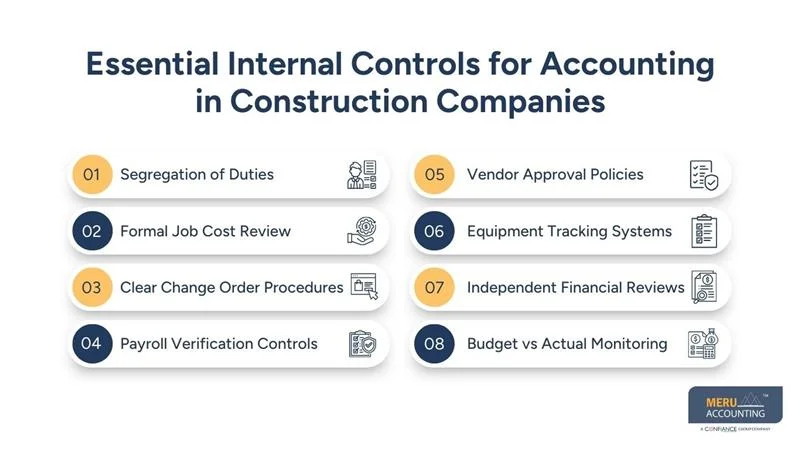
Essential Internal Controls for Accounting in Construction Companies
Internal controls are policies and procedures that protect financial integrity. In accounting for construction companies, these controls must address both office and field operations.
Segregation of Duties
No single person should control vendor setup, invoice approval, and payment processing. Dividing responsibilities reduces fraud risk.
Construction accounting supports structured approval workflows.
Formal Job Cost Review
Regular job cost reviews ensure that project performance aligns with budget. Monthly work in progress reports should be reviewed by management.
Accounting in construction companies becomes more reliable when job performance is monitored consistently.
Clear Change Order Procedures
All change orders must be documented, approved, and recorded before work begins. Informal agreements create financial exposure.
Construction accounting requires written authorization for scope changes.
Payroll Verification Controls
Use time tracking systems and supervisor approvals. Random audits of payroll data reduce manipulation risk.
Strong accounting for construction companies includes payroll oversight beyond simple processing.
Vendor Approval Policies
Establish formal vendor onboarding procedures. Require documentation before adding new vendors.
Construction accounting emphasizes documentation and independent verification.
Equipment Tracking Systems
Maintain asset registers and conduct periodic physical verification. This reduces theft and improves asset management.
Independent Financial Reviews
Periodic internal or external audits provide additional oversight. Reviews ensure compliance with construction accounting and highlight control weaknesses.
Budget vs Actual Monitoring
Compare actual costs with project budgets regularly. Investigate significant variances immediately.
Accounting in construction companies improves when discrepancies are addressed early rather than ignored.
How Technology Supports Internal Controls
Modern accounting software can strengthen accounting for construction companies. Automated workflows reduce manual errors. Real time dashboards improve transparency.
Construction accounting can be integrated into software systems, allowing automated job costing, progress billing, and retainage tracking.
However, technology alone is not enough. Internal controls must still be designed and enforced by management.
Meru Accounting’s Accounting for Construction Companies
At Meru Accounting, we understand the complexity of accounting for construction companies. Construction businesses operate in dynamic environments where even small accounting gaps can lead to significant financial risks.
Our team focuses on implementing strong internal controls based on construction accounting basics. We help businesses establish accurate job costing systems, structured revenue recognition practices, and reliable work in progress reporting.
We also assist in reviewing internal processes to identify weaknesses that may expose companies to fraud or misreporting. Our approach to accounting for construction companies combines compliance, transparency, and strategic insight.
With Meru Accounting, construction companies gain more than bookkeeping support. They gain a structured financial framework that supports sustainable growth and risk reduction.
Key Takeaways
- Accounting for construction companies requires specialized systems due to project based operations.
- Construction accounting basics such as job costing and percentage of completion are essential foundations.
- Weak internal controls increase fraud risk in payroll, vendor payments, and change orders.
- Segregation of duties and structured approval processes reduce financial exposure.
- Regular job cost reviews and work in progress reporting improve transparency.
- Technology supports but does not replace strong internal control systems.
- Professional support strengthens accounting for construction companies and enhances financial stability.
FAQs
Tracks income, expenses, payroll, and project costs for construction businesses. Helps contractors manage finances and maintain accurate, steady cash flow.
Records invoices, payments, and expenses promptly for accurate cash visibility. Allows contractors to plan payments and prevent cash shortages effectively.
Delayed client payments and retainage create gaps in available funds. High upfront costs and project expenses make cash flow unpredictable.
Provides accurate financial records, faster invoicing, and proper job costing. Supports better decisions and helps maintain steady cash flow reliably.
Weekly review of financial records ensures cash flow and expense tracking. Regular monitoring prevents surprises and supports timely payment planning.


