



Bookkeeping for manufacturing company operations is a critical part of ensuring financial accuracy and operational efficiency. By integrating ERP systems with your bookkeeping processes, manufacturers can streamline data management, reduce errors, and gain real-time insights into their financial and operational performance.
This blog explores how combining ERP systems with bookkeeping for manufacturing company functions can transform how you manage your business finances.
With the right ERP integration, manufacturers can connect production, inventory, and financial data in one place, eliminating silos and improving decision-making.
This integration not only simplifies bookkeeping for manufacturing company operations but also helps identify cost-saving opportunities, optimize resources, and maintain accurate records for audits and compliance.
What You Will Learn From This Blog
- Understand the importance of bookkeeping for manufacturing company in tracking costs and managing finances.
- Explore the typical accounting challenges encountered in production-based businesses
- Explore how ERP systems work and their benefits for industrial bookkeeping.
- Get a step-by-step guide to integrating ERP with bookkeeping for manufacturing company.
- Learn best practices for accurate bookkeeping and mistakes to avoid after ERP integration.
- Explore key features to look for in an ERP system for manufacturing bookkeeping.
- Understand how ERP integration improves overall efficiency and decision-making in manufacturing.
Introduction to Bookkeeping for Manufacturing Company
Bookkeeping for manufacturing company involves recording all financial transactions related to production, including raw materials, labor, production costs, and overheads.
Accurate manufacturing bookkeeping ensures that every cost component is tracked properly, helping businesses measure profitability, control expenses, and make informed decisions about inventory and production planning.
Compared to traditional bookkeeping, this method involves closely monitoring work-in-progress and finished inventory while properly assigning labor and overhead costs to maintain financial accuracy.
These detailed financial reports are essential for informed decisions around pricing, production planning, and resource management.
Additionally, proper bookkeeping ensures compliance with tax regulations, audit requirements, and financial reporting standards, giving manufacturers confidence that their financial operations are both accurate and legally compliant.
Common Challenges in Bookkeeping for Manufacturing Companies
Complex Cost Structures
Manufacturing companies deal with multiple cost types such as raw materials, labor, and overhead, which complicate bookkeeping for manufacturing company operations. These costs often vary by production batch, making accurate tracking even more difficult.
Managing Inventory
Tracking inventory levels, wastage, and production inputs can be difficult without proper systems. Inaccurate inventory records can lead to stockouts or excess stock, creating major challenges for bookkeeping for manufacturing company finances.
Time-Consuming Processes
Manual bookkeeping consumes significant time and increases the risk of errors. Repetitive tasks like data entry and reconciliations can slow down financial reporting and decision-making.
Lack of Real-Time Data
Traditional bookkeeping often provides delayed insights, making it harder to respond to operational issues quickly.
Without timely data, manufacturers may struggle to optimize production or control costs effectively through bookkeeping for manufacturing company decision-making.
Data Integration Issues
Combining data from production, sales, and finance can be challenging without an integrated system. Disconnected systems often result in duplicated efforts and inconsistent financial records.
Understanding ERP Systems in the Manufacturing Industry
ERP (Enterprise Resource Planning) systems are software platforms that bring together core business processes such as finance, production, inventory, and human resources into a single system.
In the manufacturing industry, ERP systems play a crucial role by helping businesses track production schedules, manage raw materials, and optimize the allocation of resources efficiently.
Manufacturers can choose from different types of ERP systems, including cloud-based, on-premise, or hybrid solutions, depending on their operational needs, budget, and scalability requirements.
ERP systems also offer strong integration capabilities, allowing seamless connection with other software, including bookkeeping and accounting platforms, to streamline business operations.
With real-time reporting, ERP provides continuous visibility into both financial and operational data, enabling manufacturers to monitor production progress, control costs, and make informed decisions quickly.
By centralizing information and providing timely insights, ERP systems greatly improve the efficiency and accuracy of manufacturing bookkeeping.
How ERP Systems Can Enhance Manufacturing Bookkeeping
Automated Data Entry
ERP systems reduce manual entry by automatically importing financial and operational data, improving accuracy in bookkeeping for manufacturing company. This also frees up staff to focus on analysis and decision-making instead of repetitive tasks.
Cost Tracking
With ERP, manufacturers can track costs for raw materials, labor, and overhead accurately, supporting manufacturing bookkeeping. It also helps identify areas of overspending and opportunities to optimize production costs.
Inventory Management
ERP integration helps maintain correct inventory levels and links them directly to financial records. Accurate inventory tracking prevents stockouts, overstocking, and unnecessary carrying costs.
Financial Reporting
ERP systems provide detailed financial reports, making industrial bookkeeping more transparent and actionable. These reports allow managers to quickly assess profitability and make informed business decisions.
Error Reduction
Automation through ERP reduces human errors in bookkeeping for manufacturing company, ensuring accurate records. It also minimizes the risk of compliance issues caused by incorrect data entry.
Better Cash Flow Management
ERP systems help monitor cash inflows and outflows, allowing manufacturers to plan budgets and payments efficiently. Real-time visibility into cash positions improves financial planning and reduces liquidity risks.
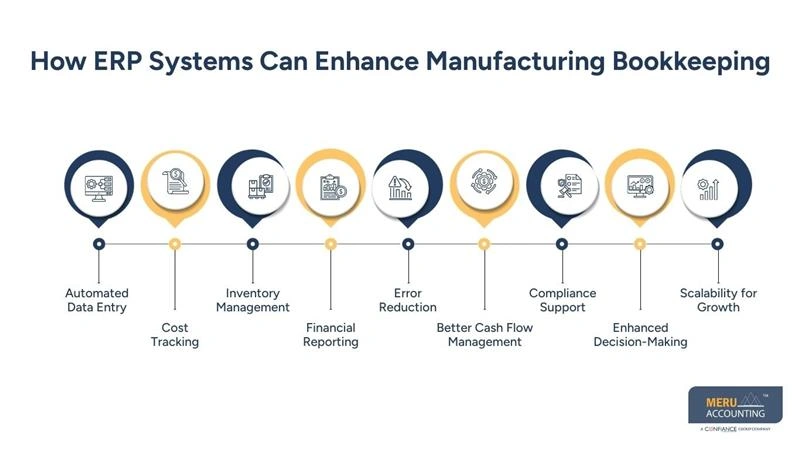
Compliance Support
ERP tracks financial transactions and generates reports that make it easier to meet tax and audit requirements. This ensures manufacturers stay compliant with accounting standards and regulatory guidelines.
Enhanced Decision-Making
By consolidating operational and financial data, ERP provides insights that improve production planning and cost control. Managers can make faster, more informed decisions based on accurate, up-to-date information.
Scalability for Growth
ERP systems grow with your business, supporting more complex bookkeeping and production processes as manufacturing operations expand. This ensures the system remains effective even as transaction volumes and operational complexity increase.
Key Features to Look for in an ERP System for Bookkeeping
Accounting Module
Ensure the ERP has a robust accounting module to manage all financial transactions. This module should support accounts payable, accounts receivable, and general ledger functions effectively.
Cost Management Tools
Look for features that support tracking production costs, labor, and overhead. These tools enable detailed cost analysis to support better decision-making.
Inventory and Material Tracking
ERP should allow real-time inventory updates linked with financial records. It also helps prevent stock discrepancies and reduces unnecessary carrying costs.
Reporting and Analytics
The system should provide detailed reports to simplify bookkeeping for manufacturing company. Analytics tools can identify trends and highlight areas for cost optimization.
User-Friendly Interface
Choose an ERP that is easy to navigate, so staff can manage manufacturing bookkeeping efficiently. A simple interface reduces training time and minimizes errors.
Step-by-Step Guide to Integrating ERP with Bookkeeping for Manufacturing Company
Assess Current Bookkeeping Processes
Start by reviewing your existing production bookkeeping methods and identifying areas for improvement. Understanding current gaps ensures a smoother ERP integration.
Choose the Right ERP System
Select an ERP that aligns with your production scale, bookkeeping requirements, and budget. Consider software that can scale as your business grows.
Data Migration
Carefully transfer your financial and operational data into the ERP system. Validate the data during migration to prevent errors in your bookkeeping.
Set Up Integration Points
Connect your ERP with your bookkeeping software to ensure seamless data flow. Proper integration avoids duplication and maintains data consistency.
Staff Training
Train your accounting and production teams to use the ERP system effectively. Ongoing support helps staff adapt quickly to new workflows and processes.
Test the System
Run a trial to identify and fix any errors in data integration before going live. Testing helps catch discrepancies early and ensures smooth operation.
Benefits of Integrating ERP Systems with Manufacturing Bookkeeping
Improved Accuracy
Integration ensures that data from production and finance is consistent, reducing errors in production bookkeeping. Accurate data also helps in preparing reliable financial reports.
Time Savings
Automation reduces manual tasks, allowing staff to focus on analysis rather than data entry. This increases productivity and speeds up financial reporting.
Better Financial Insights
ERP provides real-time insights into costs, profits, and inventory, enhancing bookkeeping for manufacturing company. Quick access to insights helps managers make informed decisions.
Cost Control
By tracking expenses accurately, ERP helps manufacturers identify areas where costs can be reduced. This also improves profitability and resource utilization.
Scalability
ERP systems grow with your business, supporting increasingly complex manufacturing bookkeeping needs. You can add new modules as operations expand without disrupting current processes.
Best Practices for Maintaining Accurate Bookkeeping After ERP Integration
Regular Reconciliation
Reconcile ERP data with bank statements and invoices to ensure accuracy. This prevents discrepancies and keeps financial records up to date.
Consistent Record Updates
Keep financial and operational data up to date in the ERP system. Timely updates improve reporting and overall financial control.
Staff Accountability
Assign roles and responsibilities for bookkeeping for manufacturing company to ensure accountability. Clear responsibilities reduce errors and improve efficiency.
Periodic Reporting
Generate regular reports to review financial health and production efficiency. These reports help track progress and identify areas for improvement.
Continuous Improvement
Evaluate ERP performance periodically and update processes for better manufacturing bookkeeping. Continuous monitoring ensures the system evolves with your business needs.
How ERP Integration Can Be Managed Effectively
Expert Consultation
Consulting with ERP experts ensures proper planning and smooth integration with bookkeeping for manufacturing company. Professional guidance helps avoid common pitfalls.
Custom ERP Solutions
Tailored ERP solutions can meet unique manufacturing bookkeeping needs and optimize workflows. Customization ensures the system aligns with your business processes.
Data Migration Support
Careful handling of financial data during migration prevents errors and ensures accuracy. This step is crucial for maintaining reliable bookkeeping records.
Training and Support
Providing staff with training and ongoing support helps them use the ERP system effectively. Well-trained staff ensures accurate and timely bookkeeping.
Ongoing Monitoring
Continuous monitoring of ERP integration maintains accuracy in bookkeeping fora manufacturing company. Monitoring also helps identify opportunities for further improvements.
How Meru Accounting Can Help With ERP Integration
Professional Guidance for Smooth Integration
Meru Accounting provides expert advice to plan and execute ERP integration efficiently. Our guidance ensures the process avoids common errors and aligns with your bookkeeping needs.
Tailored ERP Setup
We customize ERP systems to match the specific requirements of your industrial bookkeeping. This ensures workflows, cost tracking, and reporting functions fit your business perfectly.
Accurate Data Transfer
Our team manages the migration of all financial and operational data into the ERP carefully. Validating and organizing the data prevents errors and maintains accuracy.
Comprehensive Staff Training
We provide hands-on training so your team can manage the integrated ERP system confidently. Staff learn to handle bookkeeping tasks accurately and efficiently.
Continuous Oversight and Optimization
Meru Accounting monitors ERP performance after integration to maintain precise bookkeeping. Regular oversight also helps identify improvements to enhance financial and operational efficiency.
Key Takeaways
- Bookkeeping for manufacturing company is more complex than standard accounting due to production costs and inventory.
- ERP systems streamline manufacturing accounting and bookkeeping by automating processes and providing real-time insights.
- Careful ERP selection, proper integration, and staff training are essential for accurate manufacturing bookkeeping.
- Avoid common mistakes like neglecting data accuracy, insufficient testing, and poor staff training.
- Meru Accounting provides specialized services to ensure smooth ERP integration and accurate manufacturing accounting and bookkeeping.
FAQs
ERP connects finance, inventory, and production data in one system. This connection improves accuracy in bookkeeping for manufacturing company.
Manual work reduces while cost and inventory tracking improves. Manufacturing accounting and bookkeeping becomes faster and more accurate.
ERP helps small manufacturers manage costs and inventory better. Better control supports bookkeeping for manufacturing company growth.
Common problems include data errors and poor staff training. These issues can reduce manufacturing bookkeeping accuracy.
Small manufacturing companies may need a few weeks. Larger operations may require several months for production bookkeeping setup.


