


Contractors often feel tax stress because construction business accounting gets ignored during busy project schedules. Daily work with crews, materials, and clients feels urgent, while accounting tasks are delayed until tax deadlines approach.
Without strong construction business accounting, contractors lack clear visibility into profits, costs, and tax exposure. This gap causes unexpected tax bills, cash strain, and frustration when numbers finally surface at year end.
Solid accounting helps contractors track real income, control expenses, and plan taxes ahead. When records stay updated, tax season becomes predictable instead of stressful.
What You Will Learn From This Blog
- This blog explains how poor financial tracking leads to unexpected tax bills.
- This blog highlights how small accounting gaps grow into serious tax problems.
- The impact of job costs on taxable income and reported profits.
- Clear signs that show when professional support becomes necessary.
- Practical steps that improve construction business accounting without complexity.
- Ways better records reduce stress during tax season.
- The role of an accountant for construction company in effective tax planning.
Understanding Construction Business Accounting
Construction business accounting involves tracking labor, materials, equipment, and job overhead for each project. It connects all job-related data with financial reports, ensuring contractors have a clear picture of income, expenses, and overall profitability.
Unlike standard bookkeeping, construction accounting requires attention to project-specific details and ongoing cost changes throughout the job.
Many contractors mistakenly assume basic bookkeeping is sufficient, but construction work demands deeper cost control. Each project needs separate income and expense tracking to ensure accurate reporting.
Proper construction business accounting directly affects tax calculations, as incorrect records can lead to unexpected tax payments and financial stress.
Construction business accounting also relies heavily on job-based tracking to monitor costs and profits in real time. By keeping each project’s income and expenses separate, contractors can identify overruns, control budgets, and make informed decisions.
This detailed approach not only ensures accurate reporting but also helps prevent costly mistakes and surprises during tax season.
Common Construction Business Accounting Mistakes That Lead To Tax Problems
Ignoring Job Cost Reports
Many contractors fail to review job cost reports during ongoing projects. This often hides financial losses until tax calculations are prepared incorrectly.
Recording Income At The Wrong Time
Payments are sometimes recorded in the wrong accounting or tax period. Incorrect timing causes taxable income to appear higher than it actually is.
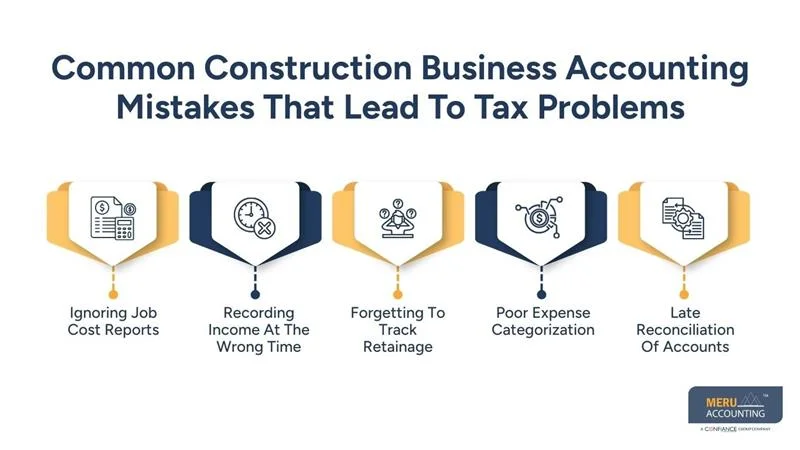
Forgetting To Track Retainage
Retainage income is often delayed but reported incorrectly on taxes. Construction business accounting must carefully track retainage for proper reporting.
Poor Expense Categorization
Expenses are frequently grouped incorrectly or completely omitted from records. This mistake artificially increases taxable profit on paper at year-end.
Late Reconciliation Of Accounts
Bank and credit accounts are left unreconciled for several months. Unreconciled accounts hide errors until tax preparation reveals major problems.
How Poor Job Costing Impacts Construction Business Accounting
Job Costing Shows True Project Profit
Without proper job costing, project profit numbers remain inaccurate consistently. Construction business accounting relies on precise job data for correct reporting.
Labor Costs Are Often Miscounted
Overtime and payroll taxes are frequently missed or incorrectly allocated. These errors distort project profitability and accounting accuracy significantly.
Material Cost Overruns Stay Hidden
Material waste and extra costs are rarely tracked during projects. Job costing helps expose these losses early for better financial control.
Equipment Costs Are Ignored
Equipment usage and maintenance costs often go unrecorded in reports. This reduces accuracy in construction business accounting and tax calculations.
Job Costing Supports Tax Planning
Accurate job costs help reduce taxable income legally and effectively. Proper costing prevents unexpected tax obligations at the end of the year.
The Role Of Cash Flow Mismanagement In Construction Tax Problems
Cash Flow Differs From Profit
Positive cash flow does not always reflect actual project profit accurately. Construction business accounting separates cash and profit to show true results.
Late Client Payments Create Confusion
Delayed client payments distort financial records and planning for contractors. This makes estimating taxes correctly much more difficult and stressful.
Overpaying Vendors Early
Paying suppliers too early can unnecessarily drain a contractor’s available cash. This often leads to borrowing funds and incurring extra interest costs.
Poor Tracking Of Progress Billing
Mistakes in progress billing affect income reported in accounting records. Incorrect progress billing can increase taxable income unexpectedly for contractors.
Cash Flow Forecasting Prevents Panic
Proper forecasting helps contractors plan for upcoming tax obligations efficiently. Construction business accounting supports accurate forecasting and reduces year-end stress.
Why Mixing Personal And Business Finances Hurts Contractors
Personal Spending Clouds Business Records
Mixed accounts make tracking business expenses confusing and inaccurate. This situation makes calculating taxes correctly much more difficult.
Lost Deductions Increase Tax Bills
Personal expenses often hide legitimate business deductions from records. As a result, taxable income can increase unnecessarily at year-end.
Audit Risk Increases Significantly
Mixing finances raises red flags during tax audits and reviews. Maintaining separate accounts protects contractors and keeps records compliant.
Time Spent Fixing Records Increases
Accountants must spend extra time sorting mixed financial transactions. This adds to accounting costs and prolongs tax preparation work.
Separation Simplifies Construction Accounting
Keeping business and personal accounts separate improves accounting accuracy. It also saves both time and money during tax season.
How An Accountant For Construction Company Helps Prevent Tax Surprises
Construction Knowledge Matters
An accountant for construction company understands complex job-based income patterns. This expertise ensures taxes are calculated accurately and appropriately.
Regular Financial Reviews
Monthly financial reviews help identify issues before they escalate. Early detection prevents unexpected tax liabilities at year-end.
Proper Tax Planning Throughout The Year
An accountant for construction company plans taxes proactively for contractors. Estimated payments and planning reduce the risk of sudden liabilities.
Accurate Job Cost Oversight
Professionals regularly review job costing reports for each project. This practice strengthens construction business accounting and prevents errors.
Compliance With Tax Rules
Construction tax regulations change frequently and require careful monitoring. An accountant for construction company stays updated to ensure full compliance.
Construction Business Accounting Systems Every Contractor Should Use
Job Costing Software
Job costing software automatically tracks costs for each individual project. This improves accuracy in construction business accounting and reporting.
Cloud-Based Accounting Tools
Cloud accounting systems provide contractors with real-time financial visibility. Access to current data supports faster and better decision-making.
Payroll Systems Built For Construction
Specialized payroll systems manage union rules and overtime accurately. This prevents errors in payroll taxes and ensures compliance.
Expense Tracking Applications
Digital expense tracking helps contractors avoid missing legitimate deductions. Accurate expense records reduce taxable income and improve financial control.
Financial Reporting Dashboards
Dashboards summarize cash flow, profits, and project performance clearly. They make construction business accounting easier to monitor and manage.
Why Contractors Choose Meru Accounting?
Construction-Focused Expertise
Meru Accounting specializes in construction accounting services. Our team has deep knowledge of job costing and tax requirements.
Dedicated Accountant Support
At Meru Accounting, every client is assigned an accountant for construction company. This ensures personalized guidance for managing finances and taxes effectively.
Accurate Monthly Reporting
Financial reports are delivered consistently and presented clearly to contractors. This keeps contractors fully aware of their financial position at all times.
Year-Round Tax Planning
Meru Accounting plans taxes proactively throughout the year for clients. Ongoing planning prevents unexpected tax bills and financial stress.
Affordable Outsourced Solutions
Outsourced services cost significantly less than hiring a full in-house team. Construction business accounting becomes simpler, accurate, and stress-free.
Expert Advice On Job Costing
Meru Accounting provides guidance on tracking labor, materials, and equipment. This improves accuracy and helps prevent costly accounting mistakes.
Secure your finances with Meru Accounting’s expert construction business accounting services. Contact us today and let our accountants for construction company keep your taxes stress-free.
Key Takeaways
- Strong construction business accounting helps prevent sudden tax problems and stress.
- Accurate job costing protects profits and taxes while revealing potential issues early.
- Proper cash flow management reduces confusion and supports better financial planning.
- Professional guidance from an accountant for construction company minimizes costly mistakes.
- Using reliable systems improves long-term control and simplifies construction business accounting.
- Keeping personal and business finances separate ensures accurate records and deductions.
- Regular financial reviews help identify issues early and prevent year-end surprises.
FAQs
Many contractors ignore regular construction business accounting throughout the year. Missing records and mismanaged expenses often cause unexpected tax bills.
Accurate accounting tracks income, expenses, and job costs consistently. This ensures taxes are calculated correctly, avoiding unpleasant surprises.
Mixing personal and business finances or ignoring job costs are common. Late payments and missed expense tracking also raise taxable income.
They review job costs, manage expenses, and plan taxes properly. Professional guidance prevents errors that lead to costly tax surprises.
Contractors should begin tracking from the first project to monitor costs. Early adoption makes tax season smoother and reduces financial stress.


