



How to Calculate Your Tax Using UK Tax Brackets
Working out your tax in the UK may feel difficult, especially when you’re trying to understand UK tax brackets and how the UK tax rate applies to your income. These UK Tax Brackets form the foundation of the UK income tax system. Many people feel lost because the rules look like a long list of numbers, bands, and terms. The tax system in the UK uses income bands, and each band has its own rate. This method makes sure that people pay tax in a fair way based on what they earn.
Once you understand how the bands work, you can check your tax with more confidence. This blog explains how you can use tools or simple steps to calculate your tax. You will also see how each part of the process fits into the full tax picture. With the right steps, the process becomes smooth, steady, and far less stressful than it may seem at first.
What UK Tax Brackets Are
UK tax brackets are groups of income ranges set by the government. Each group has a tax rate that applies to the amount of income inside that group. The idea is simple. Instead of taxing the full income at one single rate, each part of your earnings is taxed at the rate that matches that band.
This means the more you earn, the more your income moves into higher bands, but you never pay the higher rate on your full income. Many people think that once they cross into a new band, all of their income is taxed at that higher rate. That is not true. Only the slice above the limit moves into the higher rate. This is what makes the UK system progressive. Each pound is taxed in a fair step-by-step way. This ensures the UK Tax Rate is applied progressively rather than all at once.
These brackets help the government collect money in a balanced way while still allowing people with low or moderate income to keep most of what they earn. It supports fairness, clarity, and steady growth for workers, families, and small firms.
How Income Is Divided Into Tax Bands
Income in the UK moves through UK Tax Brackets in a slow climb. You start with the personal allowance, which has no tax. This is the starting point before any UK Tax Rate comes into effect. Once your income crosses that limit, the next part moves into the basic rate band. If your income rises further, it moves into the higher rate band. Only very high earnings reach the top additional rate band.
A clear example helps here. Imagine you earn a yearly income. The first slice up to your allowance has no tax at all. The next slice up to the end of the basic band is taxed at the basic rate. If you earn more, the part above that moves into the higher rate. If your pay keeps rising, only the part beyond the higher band enters the additional rate band.
This step system prevents any sudden jump in tax bills. It keeps the transition smooth and predictable. Each band has a role, and each moves in a natural order. This is why your tax rises in a gradual climb instead of a big shock at the next rate.
Current UK Tax Rate Structure
Personal Allowance
The personal allowance is the part of your yearly income that is free from tax. No UK Tax Rate applies until your income exceeds this threshold. Most people receive this amount by default. You do not pay any tax until your income rises above this limit. It helps workers and self-employed people keep more of their pay and supports those with lower earnings.
Basic Rate
The basic UK tax rate applies to the next part of your income after the allowance. A large number of workers sit in this band, and it forms the core of the UK tax system. It is the most common band and the first one where tax is charged. The tax in this band is steady and clear, which is why many people understand it well.
Higher Rate
The higher rate applies once your income crosses the basic rate band. The rate here is higher, yet it still only applies to the amount above that basic band. This band covers middle to upper income earners. Many experienced workers, professionals, and small business owners fall into this group.
Additional Rate
The additional rate is the top band in the UK system. This applies only to high income earners. The rate is the highest in the tax structure. Yet even here, the rule stays the same. The rate applies only to the part above the higher rate limit. It does not change the tax on the lower parts of your income that sit in the earlier bands.
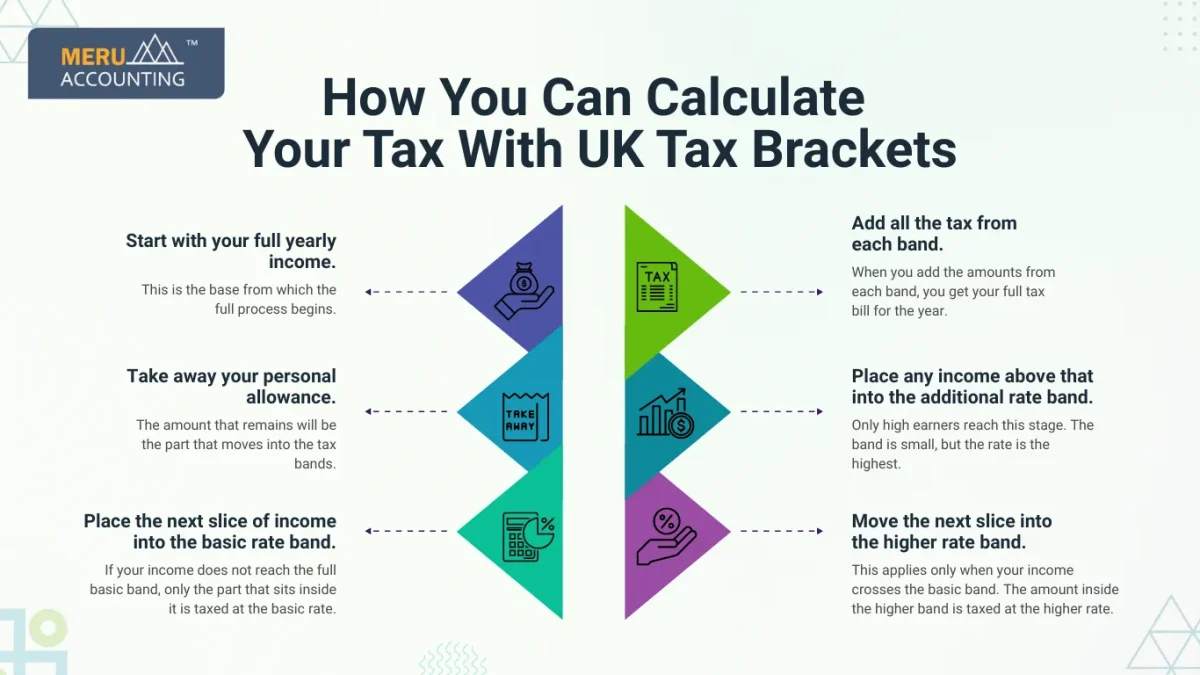
How You Can Calculate Your Tax With UK Tax Brackets
To calculate your tax using the UK tax brackets, follow a slow and simple method. It removes confusion and shows you how the final figure is reached.
- Start with your full yearly income.
This is the base from which the full process begins. - Take away your personal allowance.
The amount that remains will be the part that moves into the tax bands. - Place the next slice of income into the basic rate band.
If your income does not reach the full basic band, only the part that sits inside it is taxed at the basic rate. - Move the next slice into the higher rate band.
This applies only when your income crosses the basic band. The amount inside the higher band is taxed at the higher rate. - Place any income above that into the additional rate band.
Only high earners reach this stage. The band is small, but the rate is the highest. - Add all the tax from each band.
When you add the amounts from each band, you get your full tax bill for the year.
This step-by-step method gives you a full picture. You see how your money flows through the bands instead of just seeing one total at the end. This makes planning, saving, and checking your pay much easier.
Tools and Methods to Calculate Tax Accurately
HMRC Calculators
HMRC offers official online tools that help you check your tax. These tools use current tax rules and give results in a clear and simple view. You enter your income, pension, and other details, and the tool shows your yearly tax and your take home pay. For quick calculations, this is one of the best and most trusted choices.
Payroll Software
Payroll software is used by most employers to process monthly pay. It applies the correct bands, updates the rates each year, and keeps records of tax, pension, and National Insurance. If you run a business, payroll tools can help you handle staff payments with ease. If you work freelance or run a small firm, these tools help you keep your tax figures clean and correct.
Manual Calculation Using UK Tax Brackets
Some people prefer to calculate their tax by hand because it helps them understand the system more deeply. Manual calculation lets you see each band, each slice, and each figure with no guesswork. It may take a bit of time, but it builds strong clarity and removes myths about the UK tax system.
How Meru Accounting Can Help You With Tax Calculations
Meru Accounting offers clear, reliable, and fully guided tax support for workers, freelancers, small firms, and large businesses. Our team takes your income details, checks the right bands, applies the correct rules, and calculates your tax with total accuracy. We remove the stress of dealing with numbers and rules on your own.
We use advanced tools and strong professional methods to make sure the results match the latest tax laws. We can also help you plan better, reduce your tax through legal allowances, avoid mistakes, and make informed choices for your income or your business. Need tax services in the UK? Contact us now!
FAQs
1. How do UK tax brackets work?
Tax brackets split your income into ranges. Each range has a tax rate. You pay tax only on the amount inside each band, not on the whole income at one rate.
2. Do I pay the higher rate on all of my income?
No. Only the income above the basic band is taxed at the higher rate. The earlier parts of your income remain in the lower bands.
3. What is the personal allowance in the UK?
It is the amount you can earn each year before you pay any tax at all. Most people receive this allowance.
4. How can I check my tax without help?
You can use HMRC online calculators or do a manual breakdown of your income across each tax band.
5. Can payroll software work out my tax for me?
Yes. Payroll systems apply the correct rates and give accurate tax figures for each pay period.
6. How to calculate your tax using UK tax brackets?
You take your income, subtract the allowance, place the rest in the correct bands, and add the tax charged in each step to get your full bill.
