




Accounting for manufacturers plays a direct role in connecting what happens on the production floor with what appears in financial reports. When production targets, costs, and output levels are tracked correctly, manufacturers gain clarity on how daily operations affect profits and cash flow. Without this connection, businesses often face cost overruns, delayed decisions, and weak financial control.
Modern manufacturing operations require a strong link between production performance and financial outcomes. Aligning these areas helps manufacturers track efficiency, control costs, and maintain financial stability over time.
This blog explains how accounting for manufacturers creates that alignment and why it remains essential for sustainable growth.
What You Will Learn From This Blog
- How production activities align with financial records to ensure accurate reporting and cost transparency.
- Accounting for manufacturers ensures production efforts remain consistent with financial expectations.
- How accurate cost tracking supports informed pricing decisions and protects profit margins.
- Accounting for manufacturers highlights cost inefficiencies across various production stages.
- How financial visibility helps manufacturers monitor operational performance and overall spending patterns.
- What accounting reports reveal about actual production activity and its impact on financial results.
- How reliable accounting data supports informed operational planning and financial decision-making.
- Why managers rely on accounting for manufacturers to reduce errors in forecasting and planning.
Understanding The Connection Between Production Performance And Financial Results
Production Output And Revenue
Production volume directly influences revenue recognition and reported income. Manufacturing accounting tracks output accuracy within financial records.
Cost Of Goods Manufactured
The cost of goods manufactured affects profitability and pricing accuracy. Accounting systems record production costs for accurate financial results.
Inventory Movement And Cash Flow
Inventory movement impacts cash flow and working capital needs. Accounting for manufacturers ensures inventory changes reflect financial statements.
Waste And Process Losses
Production waste increases costs and reduces financial efficiency. Accounting records highlight waste impact on overall manufacturing costs.
Labor Efficiency And Profitability
Labor efficiency affects unit costs and overall profitability. Manufacturing accounting measures labor costs against production output.
Overhead Cost Allocation
Overhead costs influence product pricing and profit margins. Accounting for manufacturers applies financial and managerial accounting methods to allocate overhead accurately across production.
Production Cycle Time And Financial Impact
Longer production cycles increase costs and reduce cash flow. Accounting tracks cycle times to reflect true financial performance.
Quality Control And Cost Implications
Defective products raise costs and reduce profitability. Accounting for manufacturers records quality-related losses for informed decisions.
How Accounting for Manufacturers Enhances Production Efficiency and Financial Control
Linking Shop Floor Data With Finance
Accounting, through financial and managerial accounting, connects shop floor activity with financial reporting systems.
Budget Control Across Production Stages
Budgets remain effective when aligned with production stages. Manufacturing accounting tracks spending against production budgets.
Cost Accountability
Clear cost accountability improves responsibility across manufacturing departments. Accounting reports assign costs accurately to production activities.
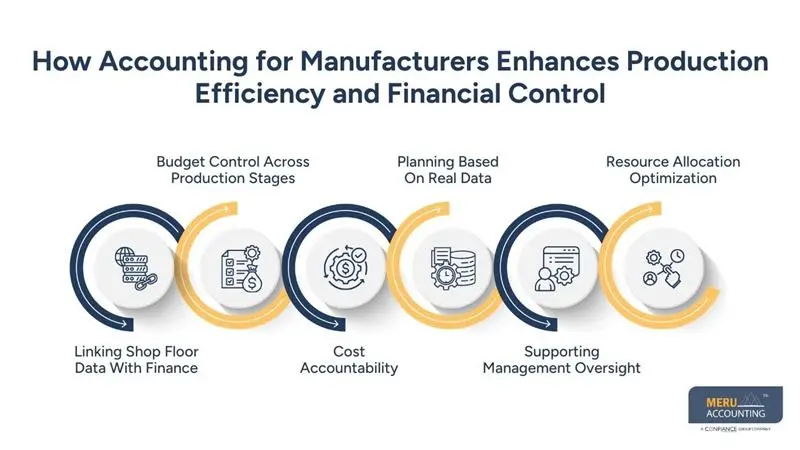
Planning Based On Real Data
Accurate accounting data supports realistic production planning decisions. Managers rely on accounting for manufacturers to reduce assumptions.
Supporting Management Oversight
Accounting reports support oversight without disrupting production workflows. Management reviews performance using structured financial data.
Resource Allocation Optimization
Accounting for manufacturers helps allocate materials and labor efficiently. Proper tracking ensures resources are used effectively to reduce waste and control costs.
How Financial And Managerial Accounting Supports Informed Production Decisions
Product Cost Analysis
Financial and managerial accounting calculates accurate product cost information. This supports better pricing and margin planning decisions.
Break-Even Evaluation
Break-even analysis helps determine required production volumes. Accurate cost inputs ensure reliable results and better decision-making.
Budget Preparation
Production budgets rely on precise financial and cost data. This ensures realistic planning and prevents budget overruns.
Performance Measurement
Managers compare planned results with actual production outcomes. Consistent evaluation allows for timely corrective actions and efficiency improvements.
Long-Term Production Planning
Long-term planning requires forecasting costs and production returns. Detailed insights guide effective future capacity planning and resource allocation.
Capacity Utilization Analysis
Capacity utilization measures production efficiency versus available resources. Accounting for manufacturers identifies bottlenecks and optimizes operations.
Cost Variance Analysis
Cost variance analysis compares planned and actual production costs. This helps management address overspending and improve financial outcomes.
How Accounting For Manufacturers Improves Resource Allocation And Capacity Planning
Material Usage Tracking
Accounting tracks raw material usage across production processes. This helps reduce excess purchasing and material shortages.
Labor Allocation Review
Labor costs are reviewed against actual production requirements. Manufacturing accounting highlights workforce efficiency concerns.
Equipment Utilization
Equipment costs reflect usage, maintenance, and depreciation levels. Accounting data supports informed capacity utilization decisions.
Production Scheduling Support
Accounting data supports realistic and cost-aware production schedules. This reduces idle capacity and overproduction risks.
Cost-Based Expansion Decisions
Expansion decisions rely on cost and return analysis. Accounting for manufacturers provides accurate financial insights.
How Technology And ERP Systems Improve Manufacturing Accounting Accuracy
Centralized Data Recording
ERP systems centralize production and financial data recording. This reduces errors within accounting for manufacturers processes.
Real-Time Cost Updates
Real-time updates reflect costs as production activities occur. This improves accuracy in financial and managerial accounting reports.
Inventory Accuracy
Technology improves inventory accuracy across multiple storage locations. Accounting systems reflect actual stock movement and valuation.
Standardized Reporting
Standard reports improve consistency across production and finance teams. Financial and managerial accounting benefits from uniform reporting formats.
Improved Audit Readiness
Accurate records simplify audits and compliance requirements. Technology supports traceable and organized accounting records.
Aligning Production KPIs With Financial Reporting For Better Decision-Making
Cost Per Unit Metrics
Cost per unit links efficiency with financial performance. Accounting for manufacturers ensures reliable unit cost calculations.
Production Yield Ratios
Yield ratios measure material efficiency and production quality. Accounting data connects yield results with financial impact.
Labor Cost Ratios
Labor ratios measure workforce cost efficiency over time. Accounting reports support labor performance comparison.
Inventory Turnover Measures
Inventory turnover reflects stock movement and cash usage. Accounting for manufacturers ensures accurate turnover calculations.
Profit Margin Tracking
Profit margins reflect the success of production decisions. Accounting aligns margin data with actual production results.
Machine Utilization Rates
Machine utilization shows equipment efficiency and downtime costs. Accounting for manufacturers tracks machine use versus financial impact.
Common Accounting Challenges Manufacturers Face In Performance Alignment
Incomplete Cost Allocation
Incomplete cost allocation causes unclear product cost reporting. Accounting for manufacturers requires accurate cost distribution.
Delayed Financial Reporting
Delayed reporting limits the usefulness of financial information. Timely accounting supports responsive production decisions.
Inventory Valuation Issues
Incorrect inventory valuation distorts profit and cost reporting. Accounting systems must apply consistent valuation methods.
Data Silos Between Teams
Disconnected systems prevent accurate production and finance alignment. Manufacturing accounting works best with shared data access.
Limited Internal Expertise
Limited expertise affects accounting accuracy and compliance. External accounting support helps address knowledge gaps.
How Meru Accounting Supports Manufacturers
Manufacturers face unique challenges in aligning production performance with financial results. Accurate accounting and timely insights are essential for cost control, efficient resource allocation, and profitability.
Meru Accounting offers tailored solutions that bridge the gap between operations and finance, helping manufacturers make informed decisions at every stage of production.
Industry-Focused Accounting Support
Meru Accounting understands manufacturing cost structures and workflows. Our services support accurate production and financial alignment.
Accurate Cost And Inventory Tracking
We maintain accurate cost and inventory accounting records. This improves clarity across production and finance teams.
Support For Financial And Managerial Accounting
We manage both financial and managerial accounting requirements. This supports informed production and budgeting decisions.
ERP And System Integration Assistance
Meru Accounting supports ERP-based manufacturing accounting systems. This improves reporting accuracy and process consistency.
Ongoing Advisory And Reporting
We provide regular reports aligned with production performance. Manufacturers gain clarity on financial outcomes.
Key Takeaways
- Production performance directly impacts financial reporting accuracy, and proper accounting makes this relationship visible.
- Reliable data improves planning and operational control, ensuring decisions are based on factual information.
- Tracking costs helps protect margins, reduce waste, and maintain disciplined financial management.
- ERP systems and technology enhance accounting accuracy, streamline reporting, and support informed decision-making.
- Professional accounting support adds value by improving alignment, compliance, and overall operational efficiency.
FAQs
Accounting for manufacturers tracks production costs and financial outcomes. Helps align daily operations directly with company profits accurately.
Accounting identifies cost overruns and highlights resource usage patterns. Supports better operational decision-making and production planning consistently.
Financial and managerial accounting calculate costs and guide production decisions. Ensures budgets and production targets are realistic and achievable.
Accounting monitors materials, labor, and overhead spending carefully. Highlights inefficiencies and reduces unnecessary production expenses significantly.
Accounting tracks trends and cost patterns over extended periods. Supports strategic planning for sustainable production and profit improvement.


