




In today’s fast-paced business environment, financial accuracy and efficiency are essential for sustainable growth. One of the most important roles in maintaining a company’s financial health is that of an accounts payable analyst. This professional is responsible for managing outgoing payments, ensuring accuracy in financial records, and maintaining strong relationships with vendors.
As businesses grow and financial transactions increase, the role of an accounts payable analyst becomes even more critical. Alongside this role, the contribution of an accounts payable specialist is also vital in handling day-to-day payment processes and supporting financial operations. With the support of experts like Meru Accounting, businesses can streamline their accounts payable functions and improve overall financial efficiency
What is an Accounts Payable Analyst?
An accounts payable analyst is a finance professional responsible for overseeing and analyzing a company’s accounts payable processes. Their primary duties include verifying invoices, ensuring timely payments, maintaining accurate records, and analyzing financial data related to vendor transactions.
Unlike an accounts payable specialist, who typically focuses on routine tasks such as data entry and invoice processing, an analyst takes on a more strategic role. They evaluate payment trends, identify discrepancies, and ensure compliance with financial policies.
The role requires strong analytical skills, attention to detail, and a deep understanding of accounting principles. Businesses rely on accounts payable analysts to ensure financial accuracy and maintain efficient payment processes.
Key Responsibilities of an Accounts Payable Analyst
The responsibilities of an accounts payable analyst go beyond simple invoice processing. They play a key role in ensuring that financial operations run smoothly.
Invoice Verification and Processing
An accounts payable analyst reviews invoices to ensure accuracy, verifies payment details, and ensures compliance with company policies.
Payment Management
They manage payment schedules, ensuring vendors are paid on time while maintaining optimal cash flow.
Financial Analysis
Analysts evaluate accounts payable data to identify trends, discrepancies, and opportunities for cost savings.
Vendor Relationship Management
Maintaining positive relationships with vendors is essential. Analysts ensure timely communication and resolve payment-related issues.
Compliance and Record Keeping
An accounts payable analyst ensures that all transactions comply with financial regulations and are recorded accurately for auditing purposes.
Skills Required for an Accounts Payable Analyst
To succeed in this role, an accounts payable analyst must possess a combination of technical and soft skills.
Analytical Skills
The ability to analyze financial data and identify inconsistencies is essential.
Attention to Detail
Accuracy is critical in managing invoices and payments.
Communication Skills
Effective communication helps in resolving vendor issues and coordinating with internal teams.
Technical Proficiency
Knowledge of accounting software and automation tools is important for managing financial data efficiently.
Problem-Solving Ability
An accounts payable analyst must be able to identify issues and implement effective solutions quickly.
Accounts Payable Analyst vs Accounts Payable Specialist
While both roles are essential, there are key differences between an accounts payable analyst and an accounts payable specialist.
An accounts payable specialist typically handles daily operational tasks such as entering invoices, processing payments, and maintaining records. In contrast, an accounts payable analyst focuses on analyzing data, improving processes, and ensuring financial accuracy.
Both roles work together to ensure smooth accounts payable operations. The specialist manages routine tasks, while the analyst provides insights and strategic direction.
How Accounts Payable Impacts Cash Flow Management
Cash flow management is one of the most important aspects of running a successful business. The accounts payable function plays a direct role in controlling how and when money leaves the organization.
An accounts payable analyst helps improve cash flow by ensuring that payments are scheduled efficiently and aligned with the company’s financial strategy.
Timely Payments
Paying vendors on time helps avoid penalties and maintain good relationships.
Optimized Payment Scheduling
Analysts ensure that payments are made at the right time to maintain healthy cash reserves.
Expense Tracking
Accurate tracking of expenses allows businesses to monitor spending and control costs.
Improved Financial Planning
By analyzing payment data, an accounts payable analyst helps businesses forecast expenses and plan budgets effectively.
Leveraging Discounts
Early payment discounts can reduce costs, and analysts identify opportunities to take advantage of them.
The Importance of Technology in Accounts Payable
Technology has transformed the way businesses manage their accounts payable processes. Automation tools and digital platforms have made it easier to process invoices, track payments, and maintain accurate records.
An accounts payable analyst often works with automation software to streamline processes and reduce manual errors. These tools help capture invoice data, automate approvals, and generate real-time financial reports.
By using advanced technology, businesses can improve efficiency, reduce costs, and gain better visibility into their financial operations.
Challenges Faced by Accounts Payable Analysts
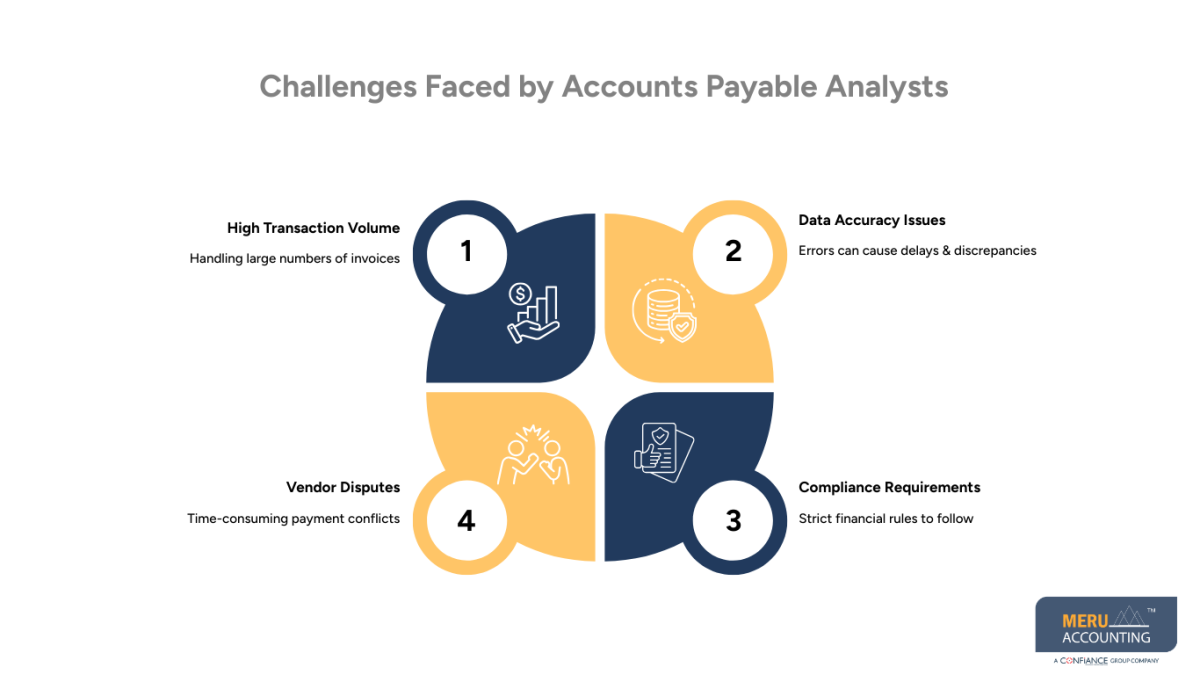 Despite the benefits of automation and technology, accounts payable analysts face several challenges in their roles.
High Volume of Transactions
Managing a large number of invoices can be overwhelming without proper systems in place.
Data Accuracy Issues
Errors in invoice data can lead to payment delays and financial discrepancies.
Compliance Requirements
Ensuring compliance with financial regulations requires careful attention to detail.
Vendor Disputes
Resolving payment disputes with vendors can be time-consuming and complex.
To overcome these challenges, businesses often rely on professional accounting services.
How Meru Accounting Supports Accounts Payable Functions
Managing accounts payable efficiently requires expertise, technology, and a structured approach.
Meru Accounting provides comprehensive accounting solutions that help businesses optimize their accounts payable processes. Their team includes experienced professionals, including skilled accounts payable analysts and accounts payable specialists, who ensure accurate and efficient financial management.
By leveraging modern tools and industry expertise, Meru Accounting helps businesses automate invoice processing, manage vendor payments, and maintain accurate financial records. Their services are designed to reduce errors, improve efficiency, and support better financial decision-making.
Outsourcing accounts payable functions to experts allows businesses to focus on their core operations while ensuring that financial processes are handled professionally.
Benefits of Hiring an Accounts Payable Analyst
Hiring an accounts payable analyst offers several advantages for businesses looking to improve their financial operations.
Improved Accuracy
Analysts ensure that financial records are accurate and free from errors.
Better Cash Flow Management
They help businesses manage payment schedules and maintain healthy cash flow.
Cost Savings
By identifying inefficiencies and leveraging discounts, analysts help reduce costs.
Enhanced Financial Visibility
Businesses gain better insights into their financial data.
Stronger Vendor Relationships
Timely payments and clear communication improve relationships with suppliers.
Conclusion
The role of an accounts payable analyst is essential in modern businesses, as it ensures accurate financial management and efficient payment processes. By analyzing financial data, managing vendor payments, and improving workflows, analysts contribute significantly to a company’s success.
Working alongside an accounts payable specialist, they help maintain smooth day-to-day operations while providing strategic insights that support better decision-making.
With the support of trusted professionals like Meru Accounting, businesses can optimize their accounts payable processes, improve cash flow management, and achieve long-term financial stability.
FAQs
An accounts payable analyst manages invoices, payments, and analyzes financial data.
An analyst focuses on analysis and strategy, while an accounts payable specialist handles daily tasks like invoice processing.
They ensure accurate payments, improve efficiency, and support financial decision-making.
It helps manage payment timing, control expenses, and maintain healthy cash flow.
Analytical skills, attention to detail, and knowledge of accounting software.


