




Introduction to Assets, Liabilities, and Equity
Understanding the fundamental accounting equation is essential for anyone looking to grasp the basics of accounting or enhance their financial literacy. The equation, Assets = Liabilities + Equity, forms the foundation of double-entry bookkeeping and business financial management. This beginner-friendly accounting guide will explore the types of assets, liabilities, and equity in detail, helping readers build a solid foundation in accounting principles.
Whether you are a small business owner, a student of finance, or simply interested in understanding how financial statements work, this comprehensive article provides a step-by-step overview of all crucial concepts related to assets, liabilities, and equity.
What Are Assets?
Assets represent everything a business owns or controls that has economic value and can provide future benefits. Assets are essential for a business’s operations because they enable it to generate revenue and grow. In accounting, assets are classified into various categories based on their nature and liquidity.
Types of Assets
- Current Assets: These are assets expected to be converted into cash or used up within one year. Common examples include cash, accounts receivable, inventory, and prepaid expenses.
- Non-current Assets (Long-term Assets): These are assets held for more than one year and used to support the business operations. Examples include property, plant, equipment, intangible assets, and long-term investments.
- Tangible Assets: Physical assets such as machinery, buildings, land, and inventory.
- Intangible Assets: Non-physical assets such as patents, trademarks, copyrights, and goodwill.
Examples of Common Assets
- Cash and cash equivalents
- Accounts receivable
- Inventory
- Prepaid expenses
- Property, plant, and equipment (PP&E)
- Intangible assets
- Investments
What Are Liabilities?
Liabilities refer to the financial obligations a company owes to external parties that must be settled over time through the transfer of assets, services, or other forms of economic benefits. Understanding liabilities is critical for effective debt management and ensuring a company’s financial health.
Types of Liabilities
- Current Liabilities: Debts and obligations due within one year, such as accounts payable, short-term loans, accrued expenses, and taxes payable.
- Non-current Liabilities (Long-term Liabilities): Debts payable over more than one year, including long-term loans, bonds payable, lease obligations, and deferred tax liabilities.
Examples of Common Liabilities
- Accounts payable
- Short-term debt
- Accrued liabilities
- Long-term debt
- Bonds payable
- Deferred tax liabilities
- Lease obligations
Understanding Equity
Equity represents the residual interest in the assets of the company after deducting liabilities. It reflects the ownership value in the business. For corporations, equity is often referred to as shareholders’ equity or owners’ equity.
Components of Equity
- Common Stock: The value of funds raised by issuing shares to investors.
- Retained Earnings: The accumulated profits or losses retained in the business rather than distributed as dividends.
- Additional Paid-in Capital: Amount investors pay above the par value of stock.
- Treasury Stock: Shares that the company has repurchased and holds in its treasury (a contra-account reducing equity).
- Owner’s Capital: In sole proprietorships or partnerships, the owner’s equity investment in the business.
Equity Calculation Example
Equity can be calculated using the basic formula:
| Assets | Liabilities | Equity |
|---|---|---|
| $500,000 | $200,000 | $300,000 |
In this case, Equity = Assets – Liabilities = $500,000 – $200,000 = $300,000.
How Assets, Liabilities, and Equity Interact
The relationship between assets, liabilities, and equity is foundational to understanding financial statements, especially the balance sheet. The balance sheet provides a snapshot of a company’s financial position by summarizing its assets, liabilities, and equity at a specific point in time.
The accounting equation Assets = Liabilities + Equity ensures that a company’s resources (assets) are always funded by borrowing (liabilities) or owner investment (equity). Each financial transaction affects these accounts, keeping the equation balanced. For example, borrowing money increases both assets (cash) and liabilities (loan payable).
Impact of Transactions on Accounting Equation
- Purchasing Equipment with Cash: Decreases one asset (cash) and increases another asset (equipment), so total assets remain unchanged.
- Obtaining a Loan: Increases assets (cash) and liabilities (loan payable).
- Owner Invests Capital: Increases assets (cash) and equity (owner’s capital).
- Paying Expenses: Decreases assets (cash) and equity (retained earnings).
Why Understanding These Concepts Is Important
Mastering the types of assets, liabilities, and equity is vital for several reasons:
- Financial decision-making: Clear insight helps management make informed decisions regarding investments, financing, and operations.
- Financial analysis: Investors and creditors use these accounts to assess solvency, liquidity, and profitability.
- Regulatory compliance: Accurate bookkeeping and reporting ensure compliance with accounting standards and taxation laws.
- Business valuation: Equity valuation is essential for mergers, acquisitions, or raising capital.
- Budgeting and forecasting: Understanding how financial elements interact aids in setting realistic budgets and forecasts.
Role in Financial Ratios and Performance Metrics
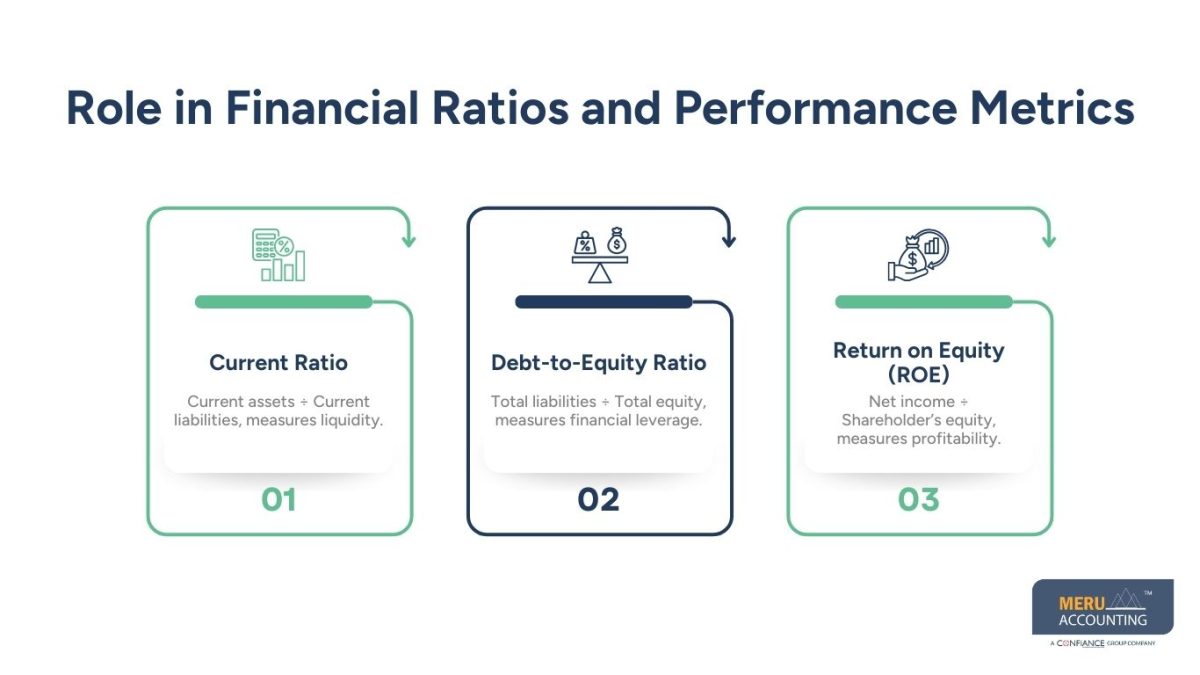
Assets, liabilities, and equity play critical roles in calculating key financial ratios, such as:
- Current Ratio: Current assets ÷ Current liabilities, measures liquidity.
- Debt-to-Equity Ratio: Total liabilities ÷ Total equity, measures financial leverage.
- Return on Equity (ROE): Net income ÷ Shareholder’s equity, measures profitability.
Meru Accounting: Your Trusted Partner
Meru Accounting is a leading accounting firm committed to delivering comprehensive financial services for individuals and businesses. With expertise in bookkeeping, tax preparation, financial advisory, and consulting, Meru Accounting helps clients navigate complex financial landscapes with ease. The firm’s dedication to accuracy, transparency, and tailored solutions equips businesses to thrive in competitive markets. Whether you need assistance understanding your financial statements or optimizing your asset and liability management, Meru Accounting provides expert guidance tuned to your unique business needs.
Summary and Key Takeaways
To recap, a solid understanding of assets, liabilities, and equity forms the backbone of accounting and business finance. These three key components collectively paint a picture of a company’s financial health and ownership structure.
- Assets are resources owned or controlled by the business expected to bring future economic benefits.
- Liabilities are financial obligations payable to external parties in the future.
- Equity represents the residual interest of the owners after liabilities have been deducted from assets.
Understanding the types of assets, liabilities, and equity helps business owners, investors, and accounting professionals record, analyze, and report financial information accurately — a skill central to sound financial management and strategic planning.
As you continue your accounting journey, focus on familiarizing yourself with specific asset accounts, liability classes, and equity components relevant to your industry or area of interest. Doing so will deepen your mastery of financial reporting and empower your business decisions.
FAQs
What are the main types of assets in accounting?
The main types of assets are current assets, such as cash and inventory, and non-current assets, such as property, equipment, and long-term investments.
How are liabilities classified in accounting?
Liabilities are classified as current liabilities, which are due within one year, like accounts payable, and long-term liabilities, which are obligations due after one year, such as loans and mortgages.
What does owner’s equity represent in accounting?
Owner’s equity represents the residual interest in the assets of the business after deducting liabilities; it includes items like common stock and retained earnings.
How do assets, liabilities, and equity relate to each other?
They are related through the accounting equation: Assets = Liabilities + Equity, which must always be in balance.
Why is it important to understand different types of assets, liabilities, and equity?
Understanding these types helps accurately record, analyze, and interpret financial statements, ensuring better financial decision-making.


