




Trust Accounting is one of the most sensitive and strictly regulated responsibilities for any law firm. These accounts hold client funds, which do not belong to the firm, yet the firm is fully responsible for safeguarding and accurately recording them.
Even a small mistake can lead to compliance issues, damaged client trust, or disciplinary action. Many law firms face challenges because trust accounts follow strict rules that differ from standard accounting practices, and without proper controls, errors can happen easily.
This blog explains law firm client fund management in simple, easy-to-understand terms. You’ll learn why it matters, how audits are conducted, and the essential controls every firm should have to manage client funds responsibly.
It also highlights how the right law firm client fund management software can help reduce risks, maintain accurate records, and ensure compliance, making audits smoother and protecting both the firm and its clients.
What You Will Learn From This Blog
- Trust Accounting is explained, including how it differs from regular accounting.
- Client funds, trust ledgers, and compliance rules are described in simple, easy-to-understand terms.
- Common mistakes made by law firms during Trust Accounting audits are highlighted to help avoid penalties and corrections.
- The role of law firm Trust Accounting software is covered, showing how it supports daily accuracy and reduces human error.
- Key controls that protect client funds and maintain the firm’s reputation are discussed, while also making audits easier.
- Practical steps for law firms are provided, focusing on clarity, accuracy, and accountability.
What Is Trust Accounting And Why It Matters For Manufacturing Businesses
Trust Accounting is the practice of tracking money held on behalf of others. These funds must always remain separate from the firm’s own business funds to ensure accuracy and compliance. Proper management of these accounts is essential for maintaining financial integrity.
Law firms and businesses alike have a legal and ethical responsibility to protect entrusted funds. Mishandling or errors can lead to serious legal consequences, making accurate recordkeeping a critical part of daily operations. Clear records also build trust with clients and partners, supporting long-term professional relationships.
Beyond law firms, the principles of client fund management apply to other industries as well. Manufacturers handling escrow, advance payments, or third-party funds face similar rules.
Maintaining proper accounts not only simplifies audits but also reduces stress and ensures compliance across all financial activities.
Using law firm Trust Accounting software can make these processes more efficient. Automation ensures transactions are accurately recorded, balances are monitored in real time, and audit trails are easy to generate. This reduces errors and strengthens overall accountability for client funds.
The Growing Importance Of Trust Accounting In Modern Manufacturing
Cross-Industry Financial Standards
Manufacturing firms must keep client or third-party funds strictly separate. Trust Accounting ensures all money is tracked accurately and securely.
Shared Compliance Expectations
Regulators require clear and precise financial records across every industry sector. Law firms experience similar scrutiny during regular audits and reviews.
Increased Financial Oversight
Audits today are more thorough, detailed, and frequent than ever before. Strong client fund management practices help firms meet compliance expectations consistently.
Focus On Transparency
Maintaining clear records builds trust with clients, partners, and regulators. This principle applies to both law firms and manufacturing companies.
Technology Influence
Modern tools simplify the compliance, tracking, and reporting of client funds efficiently. Law firm Trust Accounting software automates processes and reduces human errors.
Key Financial Challenges Faced By Modern Manufacturing Companies
Fund Segregation Issues
Mixing client and business funds often causes serious reporting errors. This is a common risk in proper client fund management practices.
Manual Recordkeeping
Using spreadsheets for tracking increases the chance of human mistakes. Automation in accounting systems helps reduce errors significantly and efficiently.
Complex Payment Structures
Handling multiple deposits and payments makes tracking transactions very complicated.
Clear, well-maintained ledgers are necessary for accurate financial management.
Audit Pressure
Auditors require complete and accurate documentation for every transaction processed. Weak records often lead to delays and compliance issues during audits.
Limited Accounting Visibility
Without proper systems, monitoring client funds becomes very difficult and risky. This is where law firm Trust Accounting software can provide assistance.
How Manufacturing Accounting Software Supports Client Fund Management Compliance
Automated Ledger Tracking
Accounting software records every transaction clearly and accurately for audits. This mirrors the strict requirements of proper Trust Accounting practices consistently.
Real-Time Balance Monitoring
Balances can be checked anytime to prevent mistakes or overdrafts. This ensures funds are always available and properly monitored.
Error Reduction
Automation significantly lowers manual entry errors and improves record accuracy. This helps firms stay prepared and ready for any audits.
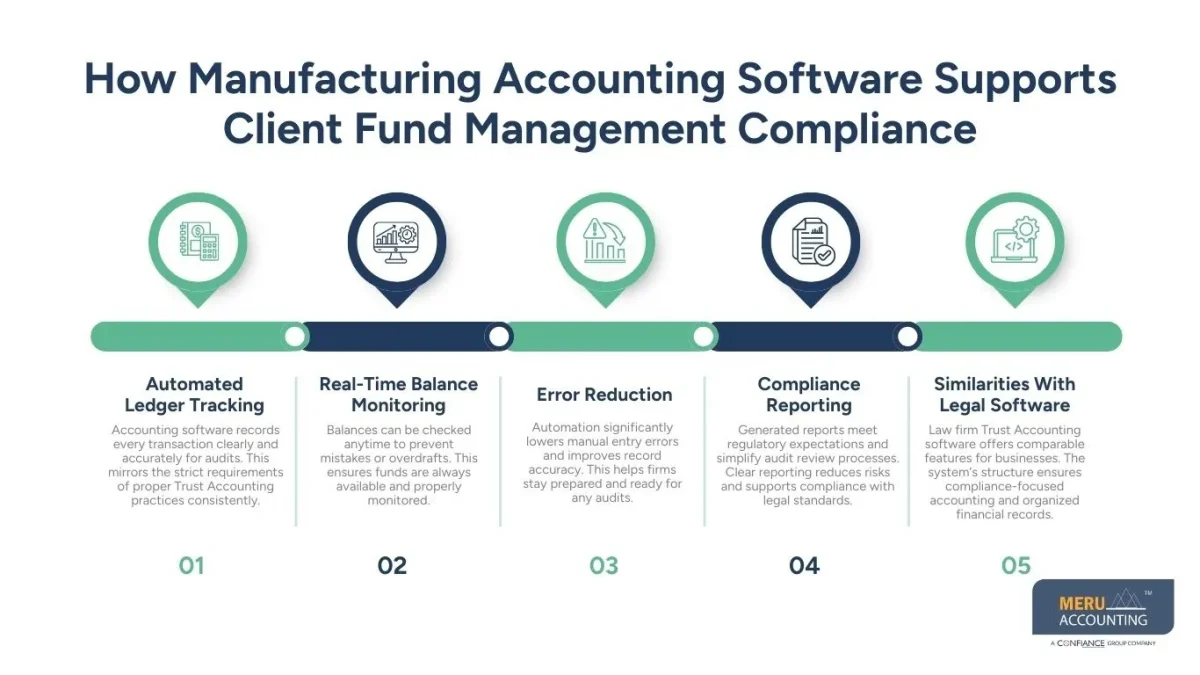
Compliance Reporting
Generated reports meet regulatory expectations and simplify audit review processes. Clear reporting reduces risks and supports compliance with legal standards.
Similarities With Legal Software
Law firm Trust Accounting software offers comparable features for businesses. The system’s structure ensures compliance-focused accounting and organized financial records.
Differences Between General Accounting Systems And Trust Accounting Solutions
Aspect | General Accounting Systems | Trust Accounting Solutions |
Fund Ownership Tracking | Tracks only business-owned funds. | Tracks client-owned funds accurately and separately. |
Separate Ledger Requirements | Ledgers are not always client-specific. | Each client requires a dedicated ledger for accurate tracking. |
Compliance Rules | Follows standard accounting rules only. | Strict guidelines must be followed for client fund management. |
Audit Documentation | Limited audit trail and reporting features. | Generates detailed audit trails critical for reviews and audits. |
Software Capabilities | Standard tools often lack trust-specific features. | Law firm Trust Accounting software is built for compliance. |
Core Features To Look For In Manufacturing Trust Accounting Software
Client-Level Ledgers
Each client’s fund must be tracked separately for full accuracy. This is an essential rule in proper client fund management.
Automatic Reconciliations
Monthly reconciliations become simpler when automated by accounting software systems. Errors are easier to detect and correct before they escalate.
User Access Controls
Role-based access ensures security and limits who can view transactions. It protects sensitive client and firm financial data effectively.
Clear Audit Trails
Every transaction is recorded with a detailed audit trail automatically. Auditors can trace changes quickly and verify the accuracy of accounts.
Reporting Tools
Reports generated support internal and regulatory compliance reviews efficiently. This mirrors key features found in law firm Trust Accounting software.
Why Accurate Trust Accounting Is Essential For Financial Transparency
Clear Client Fund Visibility
Clients expect accurate balances for every transaction in their accounts. Client fund management ensures complete clarity and transparency at all times.
Reduced Dispute Risk
Clear and accurate records prevent disagreements between clients and firms. This protects the firm’s reputation and strengthens professional relationships.
Strong Audit Outcomes
Auditors trust well-kept and properly maintained client fund management records. Fewer corrections are needed during reviews and compliance checks.
Ethical Compliance
Accuracy in records reflects a firm’s professional responsibility consistently. It supports long-term client trust and ethical financial practices.
Regulatory Confidence
Regulators value transparent, accurate, and well-organized accounting systems. This principle applies to law firms and all regulated industries.
How Trust Accounting Improves Cash Flow Management And Accountability
Accurate Fund Availability
Usable balances are always clear, preventing errors or potential misuse. This ensures funds are available when required and properly managed.
Better Financial Planning
Clear and organized data supports smarter financial and business decisions. Proper planning improves cash flow management and operational efficiency.
Reduced Error Corrections
Fewer mistakes result in less rework and minimal correction time. This saves significant time, resources, and administrative effort for firms.
Improved Accountability
Each transaction has a designated owner responsible for its accuracy. Clear accountability strengthens oversight and protects client funds effectively.
Software Support
Law firm Trust Accounting software helps ensure accuracy and compliance. Automation strengthens financial control and improves accountability for all transactions.
How Meru Accounting Supports Law Firms With Trust Accounting
Specialized Trust Accounting Services
Meru Accounting provides expert services focused on strict client fund management compliance. We fully understand the complex regulations governing law firm accounts.
Audit-Ready Recordkeeping
Our systems maintain clean, organized, and review-ready financial data consistently. This approach reduces stress and simplifies all trust account audits.
Software Integration Support
We assist firms in using law firm Trust Accounting software efficiently. Setup, configuration, and daily usage are made simple and reliable.
Ongoing Compliance Monitoring
Meru Accounting tracks updates and changes in accounting rules regularly. This ensures your firm always stays compliant with current regulations.
Dedicated Expert Support
Our team manages all complex accounting processes on your behalf. This allows your firm to focus entirely on serving clients.
Key Takeaways
- Client fund management requires precision. Accuracy is essential and small errors can lead to serious issues.
- Audits are easier with controls. Strong internal controls simplify reviews and protect client funds effectively.
- Software reduces risk. Law firm Trust Accounting software minimizes manual errors and improves consistency.
- Transparency builds trust. Clear and accurate records strengthen client confidence and long-term relationships.
- Expert help matters. Professional support improves outcomes, and Meru Accounting ensures firms stay compliant.
FAQs
Client fund management ensures client funds are kept separate from firm funds. Accurate management protects clients and keeps the firm legally compliant.
Law firms prepare by maintaining detailed ledgers, reconciling accounts regularly, and keeping supporting documents. Using law firm Trust Accounting software helps simplify audits and reduce errors.
Mixing client and firm funds, late reconciliations, and missing documentation are frequent errors. Specialized software prevents mistakes and ensures compliance.
Software tracks client funds accurately, generates audit-ready reports, and reduces manual errors. It also provides alerts for unusual transactions and ensures proper reconciliations.
Monthly reconciliation is standard, though some firms may do it more frequently. Regular checks catch errors early and maintain compliance with regulations.


