




Introduction to Owner’s Equity in Sole Proprietorship
In the world of accounting, understanding the financial health of a business is crucial for owners, investors, and stakeholders alike. One of the fundamental components that reflect a sole proprietorship’s financial position is the owner’s equity. Owner’s equity represents the residual interest in the assets of the business after deducting liabilities. Essentially, it is what the owner “owns” outright.
For sole proprietorships, calculating owner’s equity accurately is vital for effective financial management, tax reporting, and business planning. This article provides an in-depth guide on how to calculate balance sheet owner’s equity in a sole proprietorship, discussing the key components, methodologies, and practical examples to enhance understanding.
Understanding the Components of Balance Sheet Owners Equity
The owner’s equity in a sole proprietorship is composed of several key components. These components collectively represent the owner’s claim on the business assets after all liabilities have been accounted for. Here are the main elements that make up owner’s equity:
- Owner’s Capital Contributions: This is the amount of money or assets the owner invests into the business initially and over time.
- Retained Earnings: Profits that the business has earned and retained rather than distributed to the owner.
- Owner’s Drawings or Withdrawals: Funds that the owner removes from the business for personal use, which reduce owner’s equity.
- Additional Investments: Any extra investments made by the owner after the initial capital infusion.
- Net Income or Net Loss: The earnings or losses incurred by the business during a specific period which affects retained earnings.
Each of these components plays a vital role in calculating the owner’s equity on the balance sheet owners equity. By tracking changes in these elements, sole proprietors can gauge their business’s financial standing more accurately.
How to Read a Balance Sheet for Sole Proprietorship
The balance sheet owners equity is a financial statement that shows the business’s financial position at a specific point in time. It follows the fundamental accounting equation:
Assets = Liabilities + Owner’s Equity
For sole proprietorships, the balance sheet owners equity consists of three core sections:
- Assets: Resources owned by the business such as cash, inventory, equipment, and accounts receivable.
- Liabilities: Amounts owed by the business, including loans, accounts payable, and other debts.
- Owner’s Equity: The owner’s stake in the business after subtracting liabilities from assets.
Understanding the balance sheet owners equity layout helps in accurately calculating the owner’s equity and interpreting the business’s financial health.
Step-by-Step Guide to Calculate Owner’s Equity
Calculating owner’s equity in a sole proprietorship involves gathering financial information and following a systematic approach. Below is a stepwise methodology:
Step 1: Collect Financial Statements
Obtain the latest balance sheet owners equity, income statement, and any notes on owner’s transactions such as additional investments or withdrawals.
Step 2: Identify Total Assets
Summarize all business assets, including current assets like cash and inventory and fixed assets like property and equipment.
Step 3: Calculate Total Liabilities
Add all short-term and long-term liabilities, such as loans, accounts payable, and accrued expenses.
Step 4: Use the Accounting Equation
Apply the formula: Owner’s Equity = Assets – Liabilities. Subtract the total liabilities from total assets to find the owner’s equity.
Step 5: Adjust for Owner’s Contributions and Withdrawals
Add any additional capital contributions and subtract owner withdrawals made during the period.
Step 6: Incorporate Net Income or Loss
Include the net profit or loss from the income statement. A net income increases owner’s equity, while a net loss decreases it.
Step 7: Finalize Owner’s Equity Figure
Summarize all adjustments to determine the total owner’s equity on the balance sheet.
Examples of Balance Sheet Owners Equity Calculation
To illustrate, consider the following example of a sole proprietorship’s financial data:
| Category | Amount (USD) |
|---|---|
| Total Assets | 150,000 |
| Total Liabilities | 50,000 |
| Owner’s Capital Contributions (start of period) | 75,000 |
| Additional Owner Investments | 10,000 |
| Owner’s Withdrawals | 5,000 |
| Net Income for the period | 20,000 |
Using the accounting equation:
- Owner’s Equity = Assets – Liabilities = 150,000 – 50,000 = 100,000
- Adjust for capital and withdrawals: Starting Capital + Additional Investments – Withdrawals = 75,000 + 10,000 – 5,000 = 80,000
- Incorporate net income: Owner’s Equity = 80,000 + 20,000 = 100,000
This example shows how net income and owner transactions affect the final owner’s equity figure.
Common Mistakes When Calculating Owner’s Equity
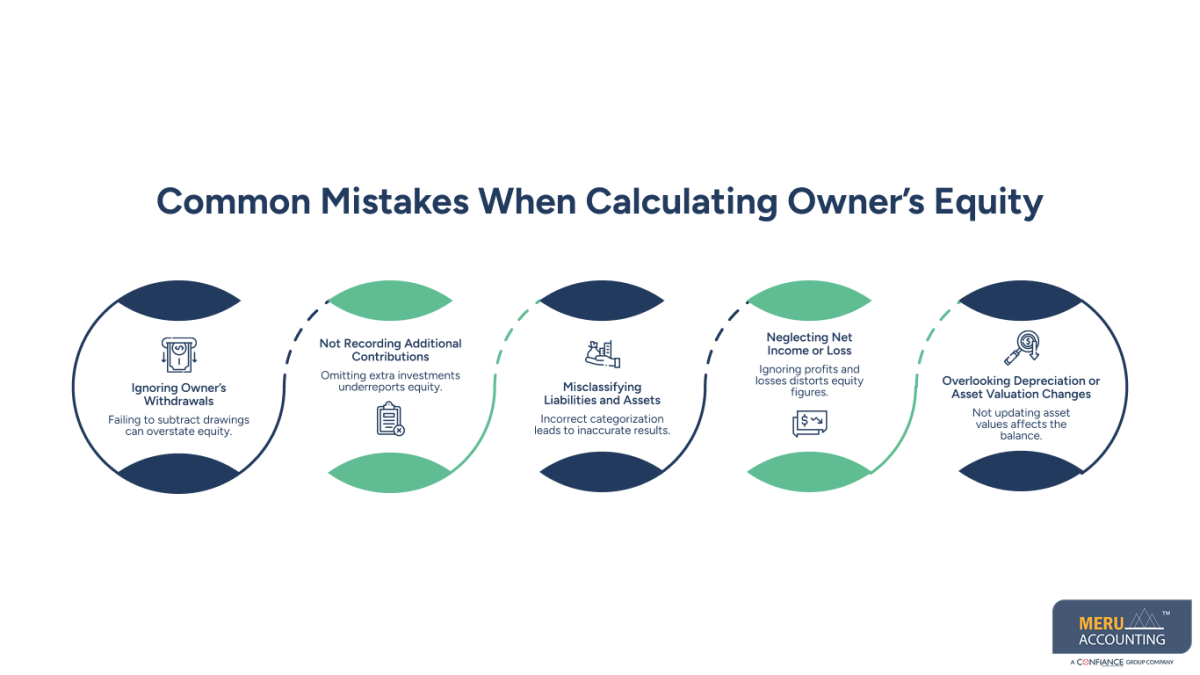
Despite its straightforward formula, mistakes in calculating balance sheet owners equity can severely affect financial decisions. Here are common errors to avoid:
- Ignoring Owner’s Withdrawals: Failing to subtract drawings can overstate equity.
- Not Recording Additional Contributions: Omitting extra investments underreports equity.
- Misclassifying Liabilities and Assets: Incorrect categorization leads to inaccurate results.
- Neglecting Net Income or Loss: Ignoring profits and losses distorts equity figures.
- Overlooking Depreciation or Asset Valuation Changes: Not updating asset values affects the balance.
Importance of Accurate Owner’s Equity Calculation
Calculating the owner’s equity correctly offers several benefits for sole proprietors:
- Financial Planning: Provides a clear picture of the owner’s stake to facilitate informed decisions.
- Loan Applications: Lenders often require equity metrics to assess creditworthiness.
- Tax Preparation: Accurate equity figures ensure compliance with tax regulations.
- Business Valuation: Crucial for valuation during sale or partnership negotiations.
- Performance Assessment: Helps owners track the growth and profitability of their business.
Role of Accounting Software in Calculating Owner’s Equity
Modern accounting software has transformed the way sole proprietors manage their finances. These tools automate the calculations of owner’s equity and related components by integrating data from various transactions. Benefits include:
- Real-time calculation of equity as transactions are recorded.
- Generation of accurate financial statements for reviews.
- Tracking of capital contributions, withdrawals, and net income without manual errors.
- Easy retrieval of financial reports to monitor changes in owner’s equity.
Popular accounting software such as QuickBooks, Xero, and FreshBooks simplify the process and help maintain precision in financial records.
Understanding Owner’s Equity Changes Over Time
Owner’s equity is dynamic and fluctuates according to business activities and owner actions. Monitoring these changes provides insights into financial trends:
Key factors influencing equity over time include:
- Profits or losses earned by the business.
- Additional investments or capital injections by the owner.
- Withdrawals or drawings taken for personal use.
- Asset revaluations or depreciation impact.
Regular review of equity movement helps in forecasting financial health and preparing for future business needs.
How Meru Accounting Supports Sole Proprietorships
Meru Accounting specializes in offering comprehensive accounting services tailored for sole proprietorships. With deep expertise in financial reporting and tax compliance, Meru Accounting helps business owners accurately calculate and manage their balance sheet owners equity. They provide personalized consultations, assist in bookkeeping, and ensure that every component of owner’s equity is tracked correctly, enabling proprietors to maintain transparent and compliant financial records. Their client-focused approach empowers small business owners to focus on growth while confidently managing their finances.
Final Thoughts
Calculating balance sheet owners equity in a sole proprietorship is an essential accounting task that reflects the owner’s financial interest in the business. By understanding the components of owner’s equity, following the step-by-step calculation process, and utilizing modern tools or expert help, proprietors can maintain accurate financial records. Regular monitoring and addressing common pitfalls lead to better financial decisions and business success. Whether you are managing your books or preparing for tax season, a clear grasp of owner’s equity equips you with the knowledge to track and grow your business’s value effectively.
FAQs
What is owner’s equity in a sole proprietorship?
Owner’s equity in a sole proprietorship represents the owner’s residual interest in the business assets after deducting liabilities.
What are the main components of owner’s equity in a sole proprietorship?
The main components include owner’s capital, withdrawals or drawings, and net income or loss.
How do you calculate owner’s equity using the balance sheet?
Owner’s equity is calculated by subtracting total liabilities from total assets on the balance sheet.
How do owner’s drawings affect the owner’s equity?
Owner’s drawings reduce the owner’s equity since money or assets are withdrawn from the business for personal use.
Why is net income important for calculating owner’s equity?
Net income increases owner’s equity as it represents the business earnings retained in the company, while a net loss decreases it.


