




Introduction to Cash Flow Statements
The cash flow statement is a critical financial document that provides insight into a company’s liquidity by detailing the inflow and outflow of cash over a specific period. Unlike the income statement, which shows profitability, or the balance sheet, which details assets and liabilities, the cash flow statement centers around cash movements, offering a clear picture of real-time cash availability.
Understanding a cash flow statement is essential for stakeholders such as investors, creditors, and management because it helps assess the firm’s ability to meet short-term obligations, pay dividends, and invest in growth opportunities.
Structure of a Cash Flow Statement
A typical cash flow statement is divided into three main sections:
- Operating Activities: Cash generated or used by core business operations.
- Investing Activities: Cash flows related to buying or selling long-term assets like equipment or investments.
- Financing Activities: Cash inflows and outflows related to borrowing, repaying debt, issuing stocks, or paying dividends.
Each section shows how cash is sourced or deployed, enabling thorough analysis of cash management over the accounting period.
Importance of a Cash Flow Statement
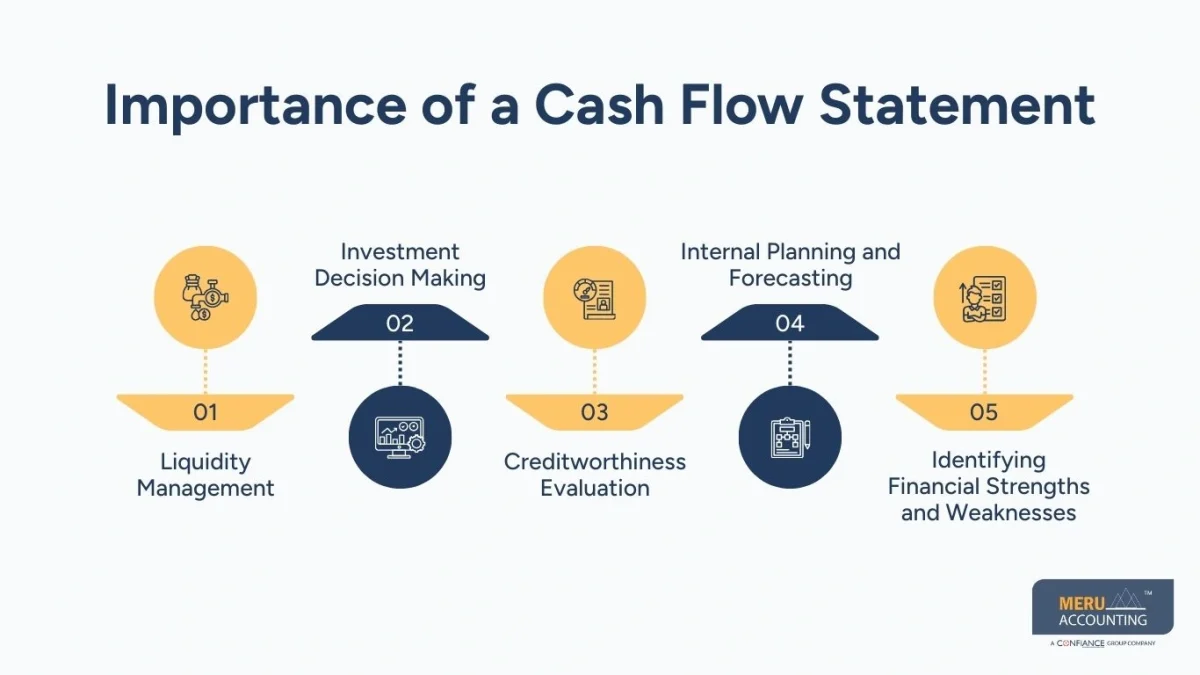
Effective cash flow management is important to keep a business solvent. The cash flow statement is fundamental as it provides the following benefits:
- Liquidity Assessment: Demonstrates if the company has enough cash to cover immediate expenses.
- Performance Indicator: Helps distinguish cash earnings from total accounting profits, highlighting the actual cash generated.
- Creditworthiness: Lenders often evaluate cash flows before approving loans to determine repayment capacity.
- Investment Decisions: Investors scrutinize cash flows to judge company health and sustainable growth potential.
Sample of Cash Flow Statement Entries
To understand how cash flow statements work in practice, here is a realistic sample of cash flow entries drawn from a hypothetical company’s financial transactions for one fiscal quarter. These entries are organized into the three cash flow sections and illustrate typical inflows and outflows.
Operating Activities
- Cash received from customers: $350,000
- Cash paid to suppliers and employees: ($210,000)
- Interest paid: ($8,000)
- Income taxes paid: ($20,000)
- Other operating expenses: ($12,000)
- Depreciation (non-cash item, added back): $15,000
Investing Activities
- Purchase of equipment: ($50,000)
- Sale of old machinery: $12,000
- Investment in marketable securities: ($25,000)
- Interest received: $3,000
Financing Activities
- Proceeds from bank loan: $100,000
- Repayment of long-term debt: ($30,000)
- Dividends paid: ($15,000)
- Issuance of common stock: $20,000
Realistic Sample of a Cash Flow Statement
| Cash Flow Section | Description | Amount (USD) |
|---|---|---|
| Operating Activities | Cash from customers | $350,000 |
| Cash paid to suppliers and employees | ($210,000) | |
| Interest paid | ($8,000) | |
| Income taxes paid | ($20,000) | |
| Other operating expenses | ($12,000) | |
| Depreciation added back | $15,000 | |
| Net Cash Provided by Operating Activities | $115,000 | |
| Investing Activities | Purchase of equipment | ($50,000) |
| Sale of machinery | $12,000 | |
| Investment in securities | ($25,000) | |
| Interest received | $3,000 | |
| Net Cash Used in Investing Activities | ($60,000) | |
| Financing Activities | Proceeds from bank loan | $100,000 |
| Repayment of debt | ($30,000) | |
| Dividends paid | ($15,000) | |
| Issuance of common stock | $20,000 | |
| Net Cash Provided by Financing Activities | $75,000 | |
| Net Increase in Cash | $130,000 |
Step-by-Step Explanation of the Sample Entries
Operating Activities Analysis
The operating section starts with cash received from customers, $350,000, representing the cash inflows from goods and services. Cash paid to suppliers and employees totaling $210,000 are the primary outflows, representing operational expenses. Interest and income taxes paid further reduce cash, by $8,000 and $20,000 respectively. Other operating expenses such as utilities and rent reduce cash by $12,000. Depreciation, a non-cash expense, is added back to adjust for accounting earnings that don’t affect cash, contributing $15,000 to the net operating cash flow. Overall, these entries result in $115,000 net cash provided by operations, indicating healthy cash generation from core business functions.
Investing Activities Analysis
Investing inflows and outflows include a large purchase of equipment costing $50,000, which is a cash outflow because it is an investment in fixed assets. The sale of older machinery resulted in a $12,000 inflow, and $25,000 was spent on acquiring marketable securities. Interest income from investments added $3,000. Net investing cash used is $60,000, reflecting the company’s effort to invest in growth and capital expenditures during the period.
Financing Activities Analysis
Financing activities included raising $100,000 from a bank loan, which increases cash resources. The business repaid $30,000 of long-term debt and paid $15,000 in dividends to shareholders, both cash outflows. Issuance of common stock brought in an additional $20,000. Net cash provided from financing activities ended at $75,000, highlighting active capital management to fund operations and shareholder returns.
Common Cash Flow Statement Formats and Presentation Tips
There are two primary methods used to prepare the operating activities section in cash flow statements:
- Direct Method: Lists actual cash receipts and cash payments during the period, for example, cash received from customers and cash paid to suppliers.
- Indirect Method: Starts with net income and adjusts for non-cash expenses, changes in working capital, and other reconciling items.
While both methods are acceptable under GAAP and IFRS, the indirect method is more commonly used for its simplicity and linkage to the income statement and balance sheet.
For maximum clarity, companies should:
- Disclose significant non-cash investing and financing activities separately.
- Use clear headings and subheadings for each activity category.
- Provide reconciliations for operating cash flows when using the indirect method.
- Present comparative statements for multiple periods to identify cash trends.
Analyzing Cash Flow Statements for Decision Making
Financial analysts, investors, and management use cash flow statements to support various critical decisions, such as:
- Assessing Operational Efficiency: Consistent positive cash flow in operating activities suggests sustainable business operations.
- Investment Planning: Investing activities provide insight into management’s strategy regarding asset acquisition and disposition.
- Financing Strategy: Monitoring financing inflows and outflows helps evaluate dependency on external funding and shareholder capital transactions.
- Liquidity Management: Understanding the timing and magnitude of cash flows helps in scheduling payments and managing working capital.
Ratios derived from cash flow statements, such as the free cash flow ratio and operating cash flow ratio, are frequently employed to measure company health beyond just profitability.
Summary and Final Thoughts on Sample of Cash Flow Statements
Understanding a cash flow statement is vital to getting a transparent view of a company’s financial health. This detailed sample of cash flow entries shows the types of transactions businesses typically experience and how they are summarized under operating, investing, and financing activities. Whether you are a small business owner, an investor, an accountant, or a student, mastering cash flow statement analysis equips you with the knowledge to make better financial decisions.
Regular monitoring and review of cash flows help avoid liquidity crises and support sustainable growth by ensuring that inflows adequately cover outflows.
About Meru Accounting
Meru Accounting is a premier accounting and financial consulting firm known for delivering expert services tailored to the unique needs of businesses. With a focus on accuracy and compliance, Meru Accounting offers bookkeeping, tax advisory, and comprehensive financial statement preparation including detailed cash flow statements. Their seasoned professionals ensure clients gain clear, actionable insights to drive strategic decisions and maintain robust financial health.
FAQs
What is a cash flow statement sample?
A cash flow statement sample is a template or example that illustrates how cash inflows and outflows are recorded and categorized in a cash flow statement.
Why is it important to use a realistic sample of cash flow entries?
Using a realistic sample of cash flow entries helps in understanding how actual business transactions affect cash flows and improves accuracy in financial reporting.
What are the three main sections in a cash flow statement sample?
The three main sections are operating activities, investing activities, and financing activities, each showing different types of cash movements.
Can a cash flow statement sample be used for financial analysis?
Yes, a cash flow statement sample can help in analyzing the liquidity and financial health of a company by demonstrating how cash is generated and used.
Where can I find a reliable sample of cash flow statements?
Reliable samples can be found in accounting textbooks, financial websites, accounting software tutorials, and business finance courses.


