




Introduction to Cashflow Statements
Understanding the cash flow of a business is essential for evaluating its financial health and operational efficiency. A cash flow statement is a critical financial document that records the inflows and outflows of cash within a business over a specified period. Unlike profit and loss accounts or balance sheets, which provide static snapshots or accrued accounting figures, the cash flow statement offers a dynamic view of how money moves in and out of a company.
This article explores detailed cashflow statement examples that illuminate real business cash flow structures. By studying these examples, business owners, investors, and financial analysts can better comprehend the practical application and interpretation of cash flow information in real-world settings.
What is a Cashflow Statement and Why is It Important?
A cash flow statement is a financial report that records the actual cash generated and used during a particular period, typically a quarter or fiscal year. It complements the balance sheet and income statement by providing insight into liquidity, solvency, and cash management. The main purpose of this statement is to illustrate a company’s ability to generate cash to fund operations, pay debts, invest in assets, and return value to shareholders.
The significance of a cashflow statement includes:
- Identifying sources of cash inflows and outflows
- Assessing the company’s ability to meet financial obligations
- Providing insights into operational efficiency and sustainability
- Supporting decision-making for investments and financing activities
Structure of a Cashflow Statement
A typical cashflow statement is divided into three primary sections:
- Operating Activities: Cash flows related to core business operations.
- Investing Activities: Cash flows resulting from purchase and sale of long-term assets.
- Financing Activities: Cash flows from transactions involving equity, debt, and dividend payments.
Each section impacts the overall cash position of the company, helping stakeholders understand where cash is coming from and how it is being utilized.
Cashflow Statement Examples with Real Business Contexts
Example 1: Retail Business Cashflow Statement
This example represents a mid-sized retail company illustrating the cash inflows and outflows during the fiscal year 2023.
| Cash Flow from Operating Activities | Amount (USD) |
|---|---|
| Net Income | 500,000 |
| Depreciation & Amortization | 50,000 |
| Changes in Working Capital | (40,000) |
| Net Cash from Operating Activities | 510,000 |
| Cash Flow from Investing Activities | Amount (USD) |
| Purchase of Equipment | (120,000) |
| Sale of Investments | 30,000 |
| Net Cash Used in Investing Activities | (90,000) |
| Cash Flow from Financing Activities | Amount (USD) |
| Proceeds from Bank Loan | 100,000 |
| Dividend Paid | (60,000) |
| Net Cash from Financing Activities | 40,000 |
| Net Increase in Cash | 460,000 |
This example helps to identify the cash-generating operations and investment expenditures typical in a retail environment. Notably, positive operating cash flow despite investment outflows confirms the company’s ability to sustain growth.
Example 2: Technology Startup Cashflow Statement
A technology startup typically experiences distinct cash flow patterns, often characterized by substantial investment activities and financing inflows for research and scaling needs. Below is an illustrative cash flow structure for the year 2023:
- Operating Activities: Net loss of ($200,000) due to growth stage investments combined with depreciation of $10,000 and working capital changes ($15,000).
- Investing Activities: Purchase of hardware and software assets totaling ($150,000).
- Financing Activities: Equity capital raised at $500,000.
The operating activities show temporary cash shortages, common in startups focusing on product development. Financing inflows help bridge this gap, allowing for essential investments to support future revenue growth.
Analyzing Cashflow Statements: Key Ratios and Metrics
Analyzing a cashflow statement involves reviewing several ratios and financial indicators that provide deeper insight into the company’s liquidity, efficiency, and risk profile. Some key metrics include:
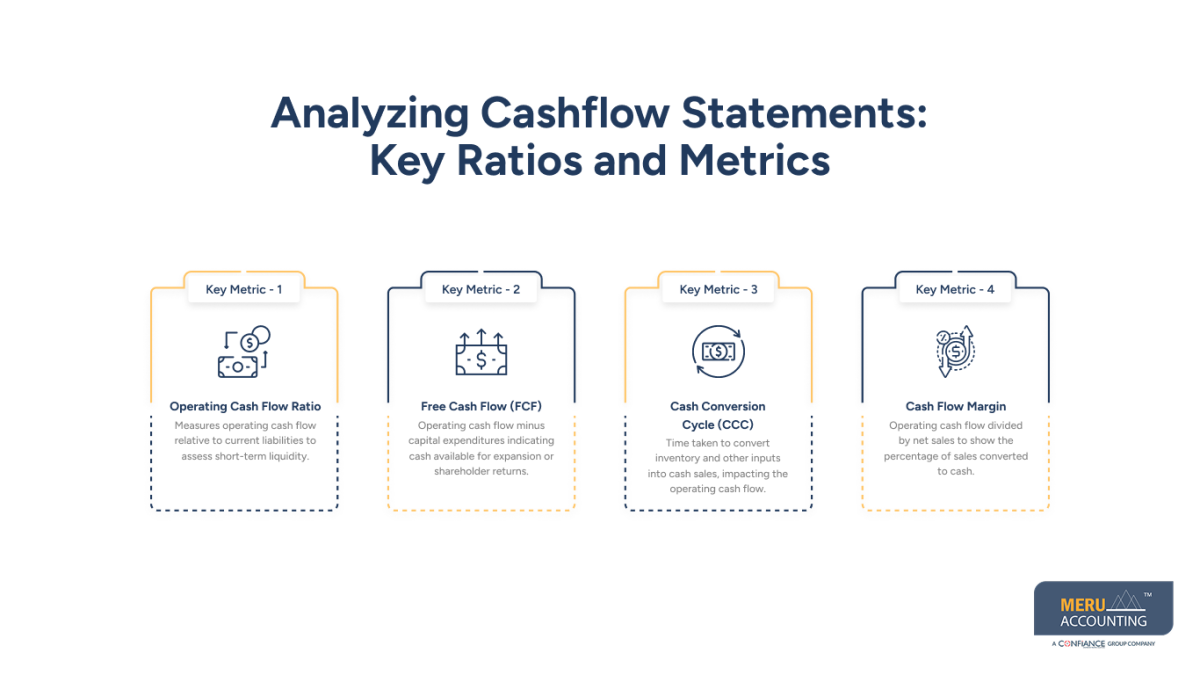
- Operating Cash Flow Ratio: Measures operating cash flow relative to current liabilities to assess short-term liquidity.
- Free Cash Flow (FCF): Operating cash flow minus capital expenditures indicating cash available for expansion or shareholder returns.
- Cash Conversion Cycle (CCC): Time taken to convert inventory and other inputs into cash sales, impacting the operating cash flow.
- Cash Flow Margin: Operating cash flow divided by net sales to show the percentage of sales converted to cash.
Monitoring these ratios over time helps identify trends and cash flow sustainability.
Common Cash Flow Statement Formats
The cash flow statement can be prepared using two methods, each with different presentation styles:
Direct Method
This method lists the specific cash receipts and payments, such as cash received from customers and cash paid to suppliers. It provides a more detailed view but requires more comprehensive data tracking.
Indirect Method
The indirect method starts with net income and adjusts for non-cash transactions and changes in working capital. It is more commonly used because it links the income statement with the cash flow statement and is simpler to prepare.
| Comparison | Direct Method | Indirect Method |
|---|---|---|
| Starting Point | Cash receipts and payments | Net income |
| Level of Detail | Detailed cash transactions | Adjustments to income |
| Ease of Preparation | Requires detailed records | Generally simpler |
| Usage Frequency | Less common | More common |
Practical Implications of Cashflow Statement Examples
Studying real-world cashflow statement examples reveals several crucial business insights:
- Cash Management: Companies with positive operating cash flows can self-finance operations, reducing dependency on external funding.
- Investment Strategies: High investing cash outflows may indicate growth initiatives but require balancing to avoid liquidity issues.
- Financing Decisions: Financing inflows such as loans or equity raises can sustain business expansions but may impact long-term financial structure and cost.
- Risk Identification: Negative cash flows over extended periods highlight risks and warrant strategic corrective actions.
Meru Accounting: Expert Services in Cash Flow Analysis
Meru Accounting specializes in providing comprehensive financial management and accounting solutions tailored for businesses of all sizes. With expertise in crafting detailed cash flow statements and conducting thorough cash flow analyses, Meru Accounting helps organizations gain clarity over their liquidity and capital management. Their approach emphasizes timely, accurate reporting and strategic insights to support sustainable business growth and informed decision-making.
How to Prepare a Cashflow Statement Using Examples
Preparing a cashflow statement can be accomplished by following a systematic approach:
- Begin with the net income or loss from the income statement for the period.
- Adjust for non-cash expenses such as depreciation and amortization.
- Analyze changes in working capital components, including accounts receivable, accounts payable, and inventory.
- Record cash flows resulting from investing activities, such as purchases or sales of property, plant, and equipment.
- Document financing activities including issuance or repayment of debt, equity transactions, and dividend payments.
- Reconcile the net change in cash with the opening and ending cash balances on the balance sheet.
Using cashflow statement examples as templates reduces errors and aligns financial reporting with industry best practices.
Conclusion: The Value of Cashflow Statement Examples for Real Business Cash Flow Structure
Cashflow statements serve as vital tools for understanding the true financial vitality of a business beyond profits on paper. Through detailed cashflow statement examples, stakeholders can better appreciate the nuances of cash inflows and outflows, the interplay of operating, investing, and financing activities, and the implications these have on company liquidity and risk management.
Analyzing these examples equips decision-makers with insights required to efficiently manage cash, plan for growth, and ensure long-term business sustainability. Businesses and financial professionals must utilize cash flow statements regularly in conjunction with other financial reports to maintain a comprehensive view of organizational financial performance.
FAQs
What is a cashflow statement?
A cashflow statement is a financial document that shows the inflows and outflows of cash within a business over a specific period.
Why are cashflow statement examples important?
Cashflow statement examples help illustrate how real businesses manage their cash inflows and outflows, aiding in better understanding of financial health and decision-making.
What are the main components of a cashflow statement?
The main components include operating activities, investing activities, and financing activities, each showing different sources and uses of cash.
How do cashflow statement examples explain business cash flow structure?
They demonstrate how different types of transactions affect cash positions, providing a practical view of the business’s liquidity and operational efficiency.
Can cashflow statement examples help in forecasting cash needs?
Yes, studying examples allows businesses to anticipate future cash inflows and outflows, improving financial planning and cash management.


