



Construction accounting is a critical part of running a successful construction business. Proper Accounting for construction companies ensures accurate financial records, clear client billing, and smooth project management.
When implemented correctly, it can significantly reduce payment disputes with clients and improve trust. By maintaining organized records of expenses, revenues, and project progress, construction businesses can demonstrate transparency and professionalism to their clients.
Additionally, accurate accounting allows contractors to identify potential issues early, ensuring disputes are resolved before they escalate.
In this blog, we will explore how accounting for construction companies and construction accounting methods help in preventing payment conflicts and ensuring timely payments.
What You Will Learn From This Blog
- How construction accounting prevents payment disputes
- The role of construction accounting methods in accurate billing
- Why cost tracking is essential for avoiding conflicts
- How transparent invoicing improves client relationships
- Key steps to reconcile accounts regularly and prevent disputes
By the end of this blog, you will understand why accounting for construction companies is essential for your business and how adopting the right methods can keep both your finances and client relations smooth.
What Is Construction Accounting And Its Importance
Construction accounting is a specialized form of accounting that focuses on managing the financial aspects of construction projects. It tracks all project-related costs, revenues, and payments, helping businesses maintain accurate records and monitor overall financial performance.
Accurate construction accounting ensures that project costs are calculated correctly and clients receive precise invoices for completed work. This clarity minimizes confusion over payments, reduces disputes, and builds trust between contractors and clients.
Beyond billing, accounting for construction companies supports better decision-making by organizing financial data for project planning, pricing, and resource allocation. It also ensures compliance with financial regulations, helping businesses avoid legal issues and maintain smooth operations with clients and contractors.
In the long term, accounting for construction companies provides a clear financial history for each project, which helps businesses forecast budgets, manage cash flow, and plan future projects efficiently.
This historical insight also strengthens client relationships, as clients can see transparent records of past work and payments, reinforcing confidence in the contractor’s professionalism.
How Construction Accounting Helps Prevent Payment Disputes
Clear Project Cost Tracking
Construction accounting allows businesses to monitor expenses for materials, labor, and overhead. This transparency reduces arguments over costs. By keeping all costs documented, it becomes easy to justify charges to clients at any stage of the project.
Accurate Billing For Clients
With proper accounting, invoices are precise and reflect the work completed. Clients are less likely to question charges. Accurate billing also ensures that payments are received on time, improving cash flow for the business.
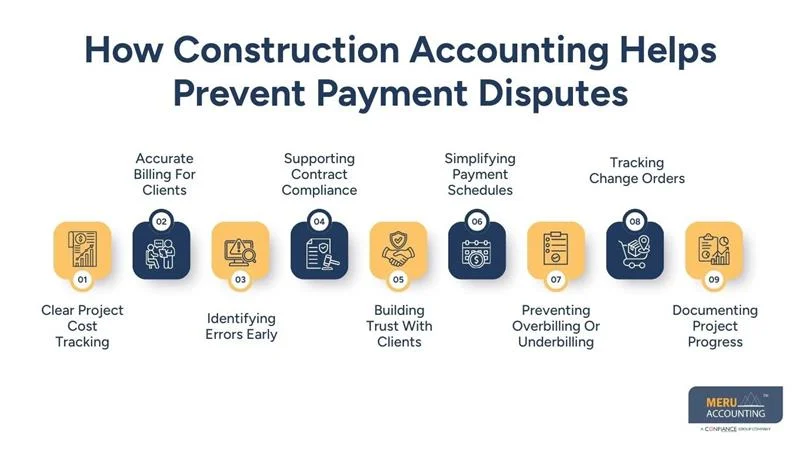
Identifying Errors Early
Accounting for construction companies helps detect discrepancies early, allowing corrections before sending bills to clients. Catching errors early prevents conflicts and maintains professionalism with clients.
Supporting Contract Compliance
Account records show that all work billed aligns with the agreed-upon contract, reducing potential disputes. This also helps in providing documented proof if a client questions any charges or deliverables.
Building Trust With Clients
Clients are more confident when invoices are detailed, showing every cost item clearly. This trust leads to smoother payments. Transparent records demonstrate accountability and professionalism, strengthening long-term client relationships.
Simplifying Payment Schedules
Proper construction accounting helps set clear payment milestones, so clients know when payments are due and why. This clarity prevents delays caused by confusion over project billing timelines.
Preventing Overbilling Or Underbilling
Detailed records ensure that clients are billed fairly, avoiding disputes over missing or extra charges. It also safeguards the business from losing revenue due to accidental underbilling.
Tracking Change Orders
Accounting for change orders ensures that additional work is recorded and billed correctly, preventing misunderstandings. Clients can easily see why extra charges were applied, reducing disagreements and complaints.
Documenting Project Progress
Regular updates on project expenses and completion status help clients see how their funds are used, reducing conflicts. It also allows businesses to plan resources efficiently and address potential cost overruns early.
Understanding Construction Accounting Methods For Accurate Billing
Percentage Of Completion Method
This method, one of the widely used construction accounting methods, bills clients based on project progress. It ensures that payments match the work completed, reducing misunderstandings.
It also helps contractors manage cash flow by receiving partial payments throughout the project instead of waiting until completion.
Completed Contract Method
This method records revenue only when the project is finished. It prevents disputes over partial work and avoids premature billing. It is particularly useful for long-term projects where billing before completion might create confusion with clients.
Job Costing Method
Costs are tracked per job, making it easy to generate detailed invoices that clients can verify. This method provides a clear breakdown of labor, materials, and overhead for each project, improving transparency.
Time And Material Method
Billing is based on actual labor hours and materials used, ensuring fair charges and avoiding disagreements. Clients can see exactly how their funds are being used, which builds trust and reduces payment conflicts.
Unit Cost Method
This method calculates charges per unit of work, making invoicing simple and transparent for clients. It ensures clients are only charged for work completed, making it easy to resolve any questions about billing.
Why Choosing The Right Construction Accounting Method Reduces Errors
Matches Project Needs
Selecting the right construction accounting methods ensures that billing aligns with project type and client expectations. It also allows contractors to tailor their accounting approach to each project, reducing misunderstandings and disputes.
Reduces Manual Mistakes
Automated or well-structured construction accounting methods minimize errors caused by manual calculations. Fewer mistakes lead to accurate invoices and prevent conflicts with clients over charges.
Ensures Consistency
Using the correct method ensures that all projects are billed consistently, making it easier to compare and manage multiple projects. Consistency also helps clients understand billing patterns, building trust over time.
Simplifies Client Communication
Clients understand the charges better when consistent methods are used, reducing confusion and complaints. Clear communication about billing methods makes it easier to explain costs and answer client questions promptly.
Helps With Tax Reporting
Proper methods also make it easier to prepare accurate tax returns and avoid issues with authorities. It ensures that income and expenses are recorded correctly, reducing the risk of penalties or audits.
What Role Cost Tracking Plays In Minimizing Payment Conflicts
Detailed Expense Monitoring
Tracking costs for labor, materials, and overhead ensures that bills are accurate and justified. It also allows businesses to verify that every expense aligns with project budgets, preventing disputes.
Avoids Overbilling
Accounting for construction companies prevents charging clients for work that hasn’t been completed. This ensures fairness and maintains client trust, reducing potential conflicts.
Identifies Budget Overruns
By tracking costs, you can spot and address budget issues before they escalate into disputes. Early identification of overruns helps contractors take corrective measures to stay within budget.
Helps Allocate Resources Properly
Monitoring expenses ensures resources are used efficiently and clients are billed fairly. It also ensures that labor and materials are assigned appropriately to avoid unnecessary costs.
Supports Transparent Reporting
Detailed cost tracking allows clients to see how their money is spent, creating trust and reducing conflicts. Transparent reports make it easier to answer client questions and provide proof for all charges.
How Transparent Invoicing Through Construction Accounting Improves Client Relations
Clear Itemized Bills
Invoices generated through construction accounting show every cost clearly, making it easy for clients to understand charges. Itemized bills help clients see exactly what they are paying for, preventing misunderstandings.
Timely Invoicing
Accurate accounting ensures invoices are sent promptly, preventing delays in payments. Prompt invoicing also improves cash flow and keeps projects running smoothly.
Easy To Verify Costs
Clients can compare invoices with project progress, reducing disagreements. Verification gives clients confidence that they are only paying for completed work.
Supports Communication
Transparency allows contractors to explain costs and justify charges clearly. Open communication strengthens client relationships and reduces the likelihood of disputes.
Strengthens Long-Term Relationships
Clients are more likely to continue working with contractors who provide honest and transparent billing. Reliable billing practices foster trust and encourage repeat business over time.
Why Regular Reconciliation Of Accounts Prevents Disputes
Matching Payments With Work
Regular reconciliation ensures payments received match work completed, avoiding confusion. It confirms that no payments are missing or applied incorrectly, preventing conflicts.
Detecting Errors Early
Reconciliation identifies missing or duplicate entries before they become issues. Early detection saves time and prevents disputes from escalating.
Keeps Financial Records Up-To-Date
Updated records help in preparing accurate invoices and reports for clients. Current records also support better project management and financial planning.
Improves Cash Flow Management
Knowing exactly what has been paid and what is pending helps manage funds efficiently. It ensures that businesses can meet their financial obligations on time without delay.
Builds Client Confidence
Clients feel secure knowing their payments are tracked and applied correctly. Confidence in financial management encourages long-term collaboration and reduces disputes.
How Meru Accounting Supports Construction Businesses With Accurate Accounting
Expert Accounting Services
Specialized construction accounting services ensure accurate billing and record-keeping.
This helps contractors maintain financial clarity and reduce the risk of client disputes.
Customized Solutions
Choosing the right construction accounting methods tailored to each project ensures accuracy.
Custom solutions allow businesses to handle unique project requirements effectively.
Cost Tracking And Reporting
Monitoring costs closely helps contractors prevent disputes and manage budgets efficiently.
Detailed reports give clear insights into project expenses and financial performance.
Transparent Invoicing Assistance
Providing detailed, clear invoices improves client understanding and trust.
Transparent billing allows clients to see exactly what they are paying for, minimizing conflicts.
Regular Account Reconciliation
Reconciling accounts regularly prevents errors and payment conflicts.
It ensures that all payments are recorded correctly and that discrepancies are addressed promptly.
Ongoing Support
Continuous support helps construction businesses maintain smooth financial operations. Regular guidance ensures accounting practices are consistently followed across all projects.
Meru Accounting provides construction businesses with accurate accounting services to reduce payment disputes. Contact us for transparent billing and smooth project management.
Key Takeaways
- Construction accounting is essential for accurate billing and financial management.
- Using the right construction accounting methods prevents errors and payment disputes.
- Cost tracking, transparent invoicing, and account reconciliation strengthen client trust.
- Meru Accounting helps businesses implement these practices effectively.
- Proper accounting reduces misunderstandings and ensures timely payments.
FAQs
Construction accounting keeps detailed financial records and accurate invoices, making it clear what clients owe and why, which reduces disagreements over payments.
Methods like percentage of completion, completed contract, and job costing make sure invoices match project progress, minimizing chances of disputes.
Cost tracking ensures every expense is recorded correctly, so clients are billed only for completed work, avoiding arguments over overcharges.
When clients see itemized bills with all costs clearly listed, they feel confident in the charges, which reduces conflicts and late payments.
Regular reconciliation, such as monthly or after each project milestone, ensures that payments received match the work done and prevents misunderstandings with clients.


