



Cost accounting is one of the most important financial tools for manufacturing businesses that want to control expenses and improve profit margins. Manufacturing operations involve many moving parts, including raw materials, labor, machinery, and factory overhead. If these costs are not tracked properly, even profitable businesses can face margin pressure.
Through proper cost analysis, manufacturers gain a clear view of where money is being spent and where savings are possible. When supported by proper accounting for manufacturing, cost accounting helps businesses reduce waste, improve pricing decisions, and maintain stable margins even when costs fluctuate.
What You Will Learn From This Blog
- An explanation of how cost accounting works for manufacturing businesses and how it differs from basic bookkeeping.
- An overview of how manufacturers use cost tracking to control expenses at each stage of production.
- Insight into how accurate cost data helps protect profit margins and supports better pricing decisions.
- A clear understanding of how accounting for manufacturing connects financial records with manufacturing operations.
- Practical benefits of structured cost systems include improved cost visibility and stronger expense control.
- An understanding of how cost information supports better budgeting and production planning.
Introduction To Cost Accounting For Manufacturing Businesses
Cost accounting focuses on identifying, recording, and analyzing all costs related to manufacturing products. It helps manufacturers understand how much they spend on raw materials, labor, and factory overheads during the production process.
Unlike general bookkeeping, cost accounting looks closely at production-level expenses and provides detailed cost information for internal use.
In manufacturing businesses, cost management plays an important role in daily operations and planning. It helps production teams plan workloads, manage resources better, and avoid unnecessary spending.
By tracking costs at each stage of production, manufacturers can spot inefficiencies early and take corrective action before costs rise further.
Cost accounting also supports long-term business growth. Accurate cost information allows manufacturers to scale operations with confidence, knowing that margins are protected.
While financial accounting shows overall business performance, cost management strengthens internal cost control and supports better decision-making across manufacturing operations.
Why Cost Accounting Is Critical For Cost Control And Margin Improvement
Controls Rising Production Costs
Cost accounting highlights increases in material, labor, and overhead costs early. This allows manufacturers to take action before costs affect overall profitability.
Improves Cost Awareness
Managers gain a clear understanding of cost behavior across departments. This visibility helps teams make informed decisions at every production stage.
Reduces Waste And Losses
Tracking costs helps identify waste in materials and inefficient labor use. Reducing waste directly improves production efficiency and cost control.
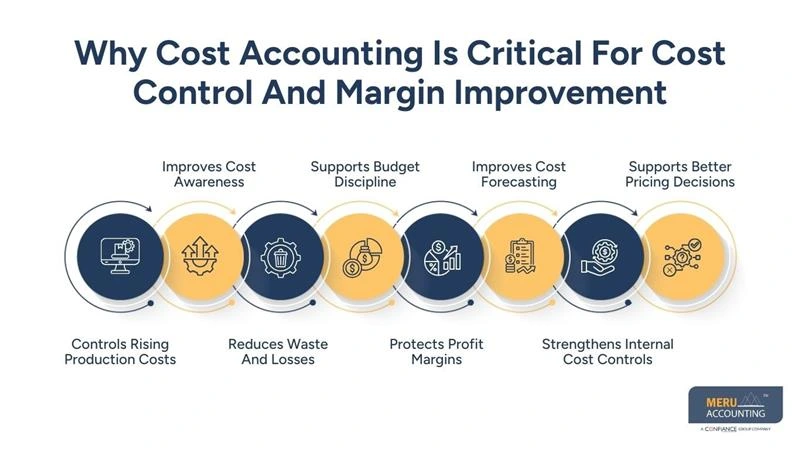
Supports Budget Discipline
Manufacturers create realistic budgets based on actual cost patterns. This prevents overspending and keeps operations aligned with financial plans.
Protects Profit Margins
Strong cost control ensures margins remain stable even during cost changes. Manufacturers can maintain pricing confidence despite cost fluctuations.
Improves Cost Forecasting
Cost management accounting uses past cost data to predict future expenses more accurately. This helps manufacturers prepare for price changes and plan production without financial surprises.
Strengthens Internal Cost Controls
Clear cost records improve accountability across teams. Departments become more careful with spending when costs are tracked and reviewed regularly.
Supports Better Pricing Decisions
Accurate cost information helps manufacturers set prices that cover expenses and protect margins. This reduces the risk of underpricing products due to incomplete cost data.
Understanding Manufacturing Cost Structures And Profit Margins
Direct Material Costs
Raw materials form a major part of total manufacturing cost and affect margins directly. Even small changes in material prices can significantly impact profitability.
Direct Labor Costs
Labor hours and productivity levels impact total production costs. Efficient labor planning helps reduce unnecessary payroll expenses.
Manufacturing Overheads
Utilities, maintenance, and factory rent must be allocated correctly. Proper allocation ensures product costs reflect true production expenses.
Fixed And Variable Costs
Understanding cost behavior helps manufacturers plan better. This knowledge supports accurate forecasting and cost control decisions.
Profit Margin Calculation
Margins improve when all cost components are tracked accurately. Clear margin data supports better pricing and financial planning.
Key Cost Accounting Methods Used To Improve Manufacturing Margins
Job Costing Method
This method tracks costs for specific production jobs or batches. It is useful for manufacturers handling custom or small-batch orders.
Process Costing Method
Used when products are produced in continuous production cycles. It helps calculate average costs across large production volumes.
Standard Costing Method
Expected costs are compared with actual costs to identify differences. These comparisons help managers correct inefficiencies quickly.
Activity-Based Costing
Overheads are allocated based on actual activities performed. This improves accuracy in product cost calculation.
Cost Variance Analysis
Differences between planned and actual costs are reviewed regularly. This helps identify problem areas affecting margins.
How Cost Accounting Helps Manufacturers Control Direct And Indirect Costs
Monitoring Material Costs
Cost accounting tracks material usage, price changes, and waste levels. This helps manufacturers avoid excess purchasing and unnecessary storage losses.
Managing Labor Costs
Labor hours are monitored to control overtime and operational inefficiencies. Better labor tracking improves workforce planning and overall employee productivity.
Allocating Overheads
Indirect costs are distributed accurately across all manufactured products. This ensures no product remains undercosted or incorrectly overcosted.
Comparing Actual And Budgeted Costs
Cost reports highlight gaps between expected spending and actual costs. Managers adjust production operations based on these cost insights.
Regular Cost Reviews
Frequent cost reviews help maintain strong financial discipline. Ongoing monitoring keeps manufacturing expenses under effective control.
Using Cost Accounting Data To Improve Pricing And Profit Margins
Accurate Product Cost Calculation
Correct cost data helps manufacturers price products properly. This ensures prices cover costs and support desired margins.
Avoiding Underpricing Issues
Businesses avoid selling products below actual production cost. This protects long-term profitability and business financial stability.
Supporting Target Margins
Pricing strategies are aligned with planned margin goals. Manufacturers can plan profits more confidently and accurately.
Adjusting To Cost Changes
Manufacturers respond quickly to material or labor cost changes. Timely adjustments prevent margin erosion across production operations.
Improving Customer Negotiations
Clear cost breakdowns support pricing discussions with customers. Manufacturers justify prices confidently using accurate cost data.
How Accounting For Manufacturing Improves Cost Visibility And Margins
Organized Financial Records
Accounting for manufacturing keeps production costs well structured. This reduces confusion and improves reporting accuracy overall.
Improved Inventory Cost Tracking
Accurate inventory valuation reduces holding and storage costs. It also prevents losses caused by excess or obsolete stock.
Clear Manufacturing Cost Reports
Managers receive timely cost summaries for better decision making. These reports support quick operational adjustments when required.
Better Expense Monitoring
Clear reports help reduce unnecessary operational and production expenses. This leads to stronger cost control across departments.
Long-Term Margin Stability
Improved visibility supports consistent margin control over time. Manufacturers plan future growth with greater financial confidence.
Role Of Cost Accounting In Inventory And Production Planning
Raw Material Planning
Cost accounting helps estimate material requirements accurately. This prevents shortages and excess inventory during production.
Work-In-Progress Tracking
Costs related to unfinished goods are monitored carefully. This improves cost accuracy throughout different production stages.
Finished Goods Costing
Accurate costing ensures the correct valuation of finished products. This supports proper pricing and inventory reporting decisions.
Reducing Overstocking
Better planning prevents excess inventory buildup in warehouses. Lower inventory levels reduce carrying and storage costs.
Supporting Production Scheduling
Cost data helps balance production volumes with market demand. This avoids unnecessary production expenses and idle capacity.
Cost Accounting And Its Impact On Operational Efficiency
Identifying Inefficient Processes
Cost reports highlight high-cost areas within production processes. These insights support informed process improvement decisions.
Improving Resource Allocation
Resources are directed to areas delivering better financial returns. This increases overall production efficiency and output quality.
Supporting Maintenance Planning
Cost data helps plan equipment maintenance budgets effectively. Proper planning reduces unexpected repair and downtime costs.
Reducing Production Delays
Efficient cost tracking reduces unexpected operational expenses. This supports smoother and more predictable production schedules.
Strengthening Internal Controls
Clear cost records improve accountability across production teams. This reduces errors and misuse of manufacturing resources.
Challenges Manufacturers Face Without Cost Accounting
Lack Of Cost Visibility
Manufacturers struggle to understand exactly where money is spent. This leads to poor financial control and decision-making.
Poor Pricing Decisions
Incomplete cost data leads to incorrect product pricing. Margins often suffer due to inaccurate cost assumptions.
Rising Operational Costs
Untracked expenses gradually reduce overall profit margins. Costs increase without clear explanations or accountability.
Weak Budget Planning
Budgets become unreliable without accurate and updated cost data. Financial planning becomes difficult and less effective.
Reduced Profit Stability
Margins fluctuate due to weak cost control systems. Long-term business growth becomes uncertain and risky.
How Meru Accounting Supports Manufacturers With Cost Accounting
Managing manufacturing costs requires industry understanding and accurate financial systems.
Meru Accounting supports manufacturers by providing structured cost accounting and reliable cost control support.
Manufacturing-Focused Knowledge
Meru Accounting understands real-world manufacturing cost challenges. Our experience helps address industry-specific cost issues.
Structured Cost Accounting Systems
We build cost accounting frameworks suited to production operations. These systems improve accuracy and control.
Reliable Accounting For Manufacturing
Our team ensures accurate and consistent manufacturing cost records. This supports better reporting and decision-making.
Cost Control And Margin Review
We help identify cost gaps that impact profitability. Manufacturers gain clear insights into margin improvement.
Ongoing Reporting And Support
Regular reports help manufacturers stay informed and in control. Continuous support ensures long-term cost stability.
Key Takeaways
- Cost accounting helps manufacturers gain clear insight into production expenses and maintain better cost control.
- Accurate cost data supports stronger profit margins by enabling better pricing decisions.
- Manufacturing costs require a proper structure, as unorganized cost tracking can weaken profitability.
- Accounting for manufacturing improves clarity by aligning financial records with production activities.
- Expert professional support strengthens cost systems and helps manufacturers improve margins over time.
FAQs
Cost accounting in manufacturing industry tracks all production costs like materials, labor, and overhead. This process helps manufacturers calculate product costs and improve pricing decisions.
Cost accounting identifies cost inefficiencies and helps control expenses effectively. Accurate cost tracking improves profitability and supports precise product pricing.
Manufacturers classify costs as direct materials, direct labor, and overhead expenses. Costs can also be fixed, variable, or semi-variable for better financial analysis.
Manufacturing costing software automates cost tracking, allocation, and reporting tasks. Automation reduces errors and ensures reliable cost data for informed decisions.
Implementation includes defining objectives, classifying costs, and setting up cost centers. Tracking materials, labor, overhead, and reviewing variances completes the process.


