




Cost accounting in manufacturing industry plays a vital role in helping manufacturers understand where money is spent, how resources are used, and how products are priced. In the first stage of growth, many manufacturers rely on estimates, but as operations expand, structured cost tracking becomes necessary. A clear cost system helps reduce waste, improve margins, and support better planning.
This blog explains cost accounting in manufacturing industry in a clear and practical way, using simple steps and real operational logic rather than theory.
What You Will Learn From This Blog
- A clear understanding of the complete process of cost accounting in manufacturing industry and how it supports informed financial decisions.
- Better visibility into material, labor, and overhead costs, helping manufacturers understand true product expenses.
- Insight into structured cost processes that track expenses through each stage of production and reduce confusion during financial reviews.
- Practical, step-by-step methods for applying cost systems that suit small and mid-sized manufacturing businesses.
- An explanation of how proper cost tracking supports stronger cost control and helps prevent budget overruns.
- An overview of the role of manufacturing costing software in automating cost tracking and improving overall cost accuracy.
Understanding Cost Accounting In Manufacturing Industry
Cost accounting in manufacturing industry measures production costs for pricing.
Purpose Of Cost Accounting
The process measures the cost of producing each unit. This approach supports pricing decisions and improves product margin analysis.
Difference From Financial Accounting
Cost accounting tracks internal production expenses within manufacturing operations. Financial accounting focuses mainly on reporting information to external users.
Link To Operations
Production data and accounting data work together during daily operations. This coordination improves planning accuracy across manufacturing departments.
Role In Decision-Making
Managers rely on cost data for pricing, budgeting, and cost control. Accurate cost information supports better decisions and reduces financial uncertainty.
Importance For Growth
Growing manufacturers require detailed cost insights to manage expansion. This structure ensures stable growth and controlled use of financial resources.
Understanding Different Types Of Costs In Manufacturing
Identifying cost categories is essential for accurate cost accounting in manufacturing industry. This ensures proper tracking in the manufacturing industry operations
Direct Material Costs
Raw materials used in production must be tracked carefully each day. These costs vary depending on production levels and material usage.
Direct Labor Costs
Wages paid to production workers are included in direct labor. Labor costs, managed through cost accounting in manufacturing industry, directly relate to employee work on production lines.
Manufacturing Overheads
Overheads include utilities, maintenance, and factory rent expenses. These costs support production indirectly but are not directly traceable.
Fixed Costs
Fixed costs remain stable regardless of production output levels. Examples include factory lease payments and full-time employee salaries.
Variable Costs
Variable costs increase or decrease with changing production volume. Materials, packaging, and shipping often fall under variable costs.
Practical Steps For Implementing An Effective Cost System
A structured approach ensures accurate cost accounting in manufacturing industry. Clear processes, aligned production data, and standardized cost categories improve reporting consistency. Training staff on cost recording and using manufacturing costing software automates tasks and reduces errors.
Step 1: Define Cost Objectives And Operational Scope
Clear objectives guide accurate cost accounting in manufacturing industry.
Identify Business Goals
Decide whether the focus should be pricing or operational control. Goals clearly guide the design of the manufacturing cost structure.
Select Product Scope
Choose which products or lines require detailed cost tracking. Focusing prevents overloading the system with unnecessary information.
Determine Cost Periods
Define weekly, monthly, or quarterly cycles for cost tracking. Consistent cost periods improve operational consistency and reporting accuracy.
Set Reporting Needs
Decide which financial and production reports management actually needs. This ensures cost tracking effectively supports operational planning decisions.
Align With Strategy
Cost objectives should support long-term business growth and plans. Proper alignment ensures relevance across all manufacturing operations.
Step 2: Classify Production Costs Accurately
Accurate classification strengthens overall cost accounting in manufacturing industry systems.
Separate Direct And Indirect Costs
Separate direct and indirect costs to improve clarity in reporting. Correct classification strengthens cost accounting in manufacturing industry and also supports accurate allocation of overhead costs.
Identify Variable And Fixed Costs
Understanding cost behavior improves budgeting and production planning decisions. This also supports proper break-even and profitability analysis accurately.
Track Semi-Variable Costs
Some costs partially change with production output during operations. These costs require careful attention and accurate handling in accounting.
Assign Costs Correctly
Proper assignment avoids misclassification errors that distort financial reporting. Correct allocation improves overall cost accuracy for all products.
Review Regularly
Cost classifications must be reviewed periodically to reflect operations. Regular updates ensure systems remain relevant and accurate consistently.
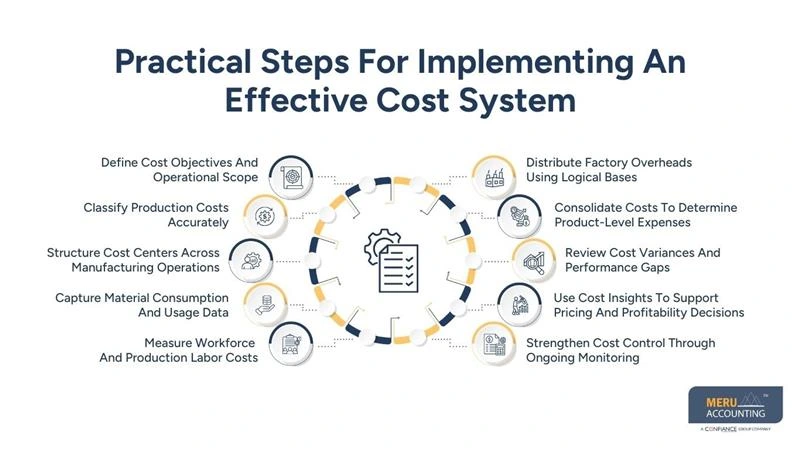
Step 3: Structure Cost Centers Across Manufacturing Operations
Cost centers organize cost tracking effectively in the manufacturing industry.
Production Departments
Each production unit should be defined as a separate cost center. This improves visibility and tracking for individual operational areas.
Support Departments
Maintenance and quality teams require distinct cost center classification. Separate tracking helps allocate overheads more accurately and fairly.
Administrative Units
Indirect and administrative departments should also be tracked separately. Clear tracking improves financial clarity across the organization consistently.
Responsibility Assignment
Assign an accountable owner for each defined cost center. Responsibility ensures accurate reporting and operational accountability in operations.
Performance Review
Cost center data should be reviewed regularly for efficiency improvements. Analysis of centers helps identify opportunities to improve operations.
Step 4: Capture Material Consumption And Usage Data
Material tracking is critical for cost accounting in manufacturing industry for accuracy.
Record Material Issues
Track all materials issued to production each day accurately. Proper tracking prevents unnecessary wastage and controls material costs effectively.
Monitor Scrap And Waste
Collect data on scrap and waste from production processes. Waste monitoring highlights efficiency gaps and identifies improvement opportunities.
Link Inventory And Accounting
Inventory records must match cost accounting data precisely every time. This ensures overall accuracy and reliable financial reporting across departments.
Use Standard Rates
Apply standard material rates to help with cost comparisons. Using standards simplifies variance analysis and improves decision-making accuracy.
Use Manufacturing Costing Software
Manufacturing costing software supports accurate and efficient material tracking. It reduces manual errors and saves significant time in operations.
Step 5: Measure Workforce And Production Labor Costs
Labor tracking directly affects cost accounting in manufacturing industry outcomes.
Track Time Accurately
Time sheets should record production staff working hours correctly. Accurate tracking improves labor cost allocation and reporting precision.
Separate Direct And Indirect Labor
Direct and indirect labor must be classified separately for accuracy. Proper allocation improves product costing reliability for management decisions.
Monitor Overtime
Overtime increases production costs and should be tracked carefully. Monitoring helps control unexpected labor cost escalations during operations.
Use Standard Labor Rates
Use standard labor rates for cost comparisons across periods. This supports planning and helps with profitability analysis effectively.
Automation Support
Manufacturing costing software assists in tracking labor costs automatically. Automation saves time and reduces the chance of calculation errors.
Step 6: Distribute Factory Overheads Using Logical Bases
Overhead allocation is vital in cost accounting in manufacturing industry.
Identify Overhead Pools
Group similar overhead expenses into logical and manageable pools. This simplifies allocation and ensures accurate costing across operations.
Select Allocation Bases
Use machine hours, labor hours, or other logical allocation bases. Correct selection ensures fairness and accuracy in cost assignment.
Apply Rates Consistently
Consistent overhead application prevents distortion in product cost calculations. It improves accuracy and comparability across reporting periods.
Review Allocation Methods
Allocation methods should be periodically reviewed and updated as necessary. This ensures methods reflect actual operational and production processes correctly.
System Support
Manufacturing costing software can automate overhead allocation efficiently. Automation reduces manual calculation errors and saves significant administrative time.
Step 7: Consolidate Costs To Determine Product-Level Expenses
Product costing completes cost accounting in manufacturing industry accurately.
Combine All Cost Elements
Materials, labor, and overhead should be combined for total cost. This provides a complete view of product-level financial requirements.
Calculate Unit Costs
Divide total product cost by units produced to calculate costs. This supports pricing decisions and cost analysis effectively for management.
Compare Across Products
Product-level costs should be compared to identify cost variances. This analysis helps management make better operational and pricing decisions.
Validate Results
Check for unusual cost movements before finalizing product costing data. Validation avoids errors and ensures reliable financial reporting across operations.
Software Integration
Production cost management software simplifies consolidation and cost reporting automatically. Integration improves efficiency and reduces manual errors in accounting processes.
Step 8: Review Cost Variances And Performance Gaps
Variance analysis strengthens cost accounting in manufacturing industry effectiveness.
Identify Cost Variances
Compare actual costs with standard or budgeted costs accurately. This highlights any issues or unexpected deviations in operations clearly.
Analyze Root Causes
Determine underlying reasons for cost variances in production processes. Root cause analysis supports corrective actions and process improvements efficiently.
Focus On Major Deviations
Significant variances should be prioritized for immediate attention and correction. Focusing on critical deviations ensures effective cost control across operations.
Share Insights With Teams
Share variance insights with operational teams to improve performance. Team awareness supports better decision-making and accountability in processes.
Track Trends
Regularly reviewing historical cost trends identifies patterns for management. Trend tracking supports strategic planning and operational improvements efficiently.
Step 9: Use Cost Insights To Support Pricing And Profitability Decisions
Pricing decisions depend on cost accounting in manufacturing industry accuracy.
Understand True Product Cost
Accurate cost data ensures correct product pricing and profitability. This prevents losses and supports financial stability in manufacturing operations.
Set Profit Margins
Margins should reflect actual production costs and overhead allocations. Proper margin setting strengthens overall business financial health consistently.
Evaluate Product Mix
Cost analysis guides decisions on which products to focus on. This ensures profitability is maximized across the product portfolio.
Support Customer Pricing
Cost insights guide customer pricing and negotiation decisions effectively. Accurate pricing improves competitiveness while protecting profit margins reliably.
Software Reports
Manufacturing costing software provides real-time product cost and pricing reports. Reports simplify decision-making and support operational and strategic planning.
Step 10: Strengthen Cost Control Through Ongoing Monitoring
Continuous monitoring improves cost accounting in manufacturing industry reliability.
Set Cost Benchmarks
Benchmarks guide performance reviews and operational cost control efforts. Benchmarks help management track progress and maintain discipline consistently.
Review Reports Regularly
Regular review of cost reports prevents unexpected financial issues. Monitoring ensures all departments adhere to planned cost standards effectively.
Update Standards
Update standard costs regularly to reflect current production conditions. This ensures cost accounting remains accurate and relevant over time.
Train Teams
Staff must understand the impact of cost control measures. Training improves adherence and improves overall financial performance significantly.
Use Automation
Manufacturing costing software supports ongoing cost monitoring automatically. Automation improves efficiency, accuracy, and reduces manual effort across departments.
Benefits Of Using Manufacturing Costing Software
Manufacturing costing software improves cost accounting in manufacturing industry accuracy.
Faster Data Processing
Automation reduces manual work and speeds up data collection. Faster processing allows timely reporting for operational decisions consistently.
Improved Accuracy
System-based calculations reduce errors compared to manual accounting methods. Accurate data improves financial reporting and decision-making reliability consistently.
Better Reporting
Reports are generated in real-time for immediate management review. This supports fast, informed decisions on pricing, costs, and operations.
Cost Transparency
Costs are visible across departments and production stages clearly. Transparency improves control and highlights areas requiring operational improvements.
Scalability
Production cost management software supports business growth and complexity easily. Scalable systems adapt to expanding production and operational requirements efficiently.
Role Of Manufacturing Costing Software In Cost Accuracy
Manufacturing costing software strengthens cost accounting in manufacturing industry processes.
Automated Data Capture
Production and financial data flow directly into accounting systems automatically. This reduces errors and ensures accurate real-time cost tracking consistently.
Standard Cost Management
Standards are stored, maintained, and updated efficiently within software. This supports proper cost comparisons and variance analysis accurately over time.
Variance Tracking
Variances are calculated automatically to identify cost discrepancies quickly. This saves time and improves operational efficiency for management teams.
Integration With ERP
Software integrates with inventory, payroll, and other operational systems. Integration ensures consistency and accuracy of cost data across departments.
Audit Support
Clear records and automated reporting support internal and external audits. This builds confidence in cost data and financial reporting accuracy.
How Structured Costing Improves Long-Term Profitability
Structured cost accounting in manufacturing industry ensures steady profit margins.
Better Cost Awareness
Managers clearly understand production cost drivers for better control measures.
Improved Pricing Decisions
Product pricing accurately reflects actual costs and protects profit margins.
Reduced Waste
Cost visibility identifies inefficiencies, reducing unnecessary material and labor usage.
Informed Investment Decisions
Cost data helps plan equipment purchases and future production expansions.
Sustainable Growth
Strong cost systems support long-term operational stability and financial security.
How Meru Accounting Supports Manufacturing Cost Accounting
Meru Accounting delivers professional services for accurate cost accounting systems. We help manufacturers implement full cost tracking across their operations. Our team ensures every aspect of cost accounting is fully managed.
Cost System Setup
We design structured cost frameworks aligned with client operational needs.
Software Implementation
We assist in implementing manufacturing costing software for accurate operations.
Cost Review And Analysis
Our team reviews reports and variances for actionable cost insights.
Ongoing Support
We provide continuous accounting support to maintain system accuracy consistently.
Industry Experience
Our experts understand manufacturing cost challenges and provide practical solutions.
Key Takeaways
- Cost accounting in manufacturing industry helps track true production costs.
- Structured steps improve cost clarity and control.
- Manufacturing costing software supports accuracy and efficiency.
- Regular reviews strengthen pricing and profitability decisions.
- Expert support ensures systems remain effective.
FAQs
Cost accounting in manufacturing industry tracks all production costs like materials, labor, and overhead. This process helps manufacturers calculate product costs and improve pricing decisions.
Cost accounting identifies cost inefficiencies and helps control expenses effectively. Accurate cost tracking improves profitability and supports precise product pricing.
Manufacturers classify costs as direct materials, direct labor, and overhead expenses. Costs can also be fixed, variable, or semi-variable for better financial analysis.
Manufacturing costing software automates cost tracking, allocation, and reporting tasks. Automation reduces errors and ensures reliable cost data for informed decisions.
Implementation includes defining objectives, classifying costs, and setting up cost centers. Tracking materials, labor, overhead, and reviewing variances completes the process.


