



Understanding the difference between cpa and tax preparer is important for individuals and businesses looking to manage taxes correctly. Many people assume both professionals perform the same tasks, but their roles, qualifications, and responsibilities differ significantly. Knowing these differences helps you make better financial decisions and avoid costly mistakes.
In this blog, we will break down the difference between cpa and tax preparer in a simple and structured way. We will also compare cpa vs tax preparer across various factors such as expertise, accuracy, and risk management so you can choose the right professional for your needs.
What You Will Learn From This Blog
- Clear understanding of the difference between cpa and tax preparer
- Roles and responsibilities of each professional
- Key factors in cpa vs tax preparer comparison
- Common myths and misunderstandings
- Tips to choose the right tax expert
- How each professional impacts accuracy and risk
Definition And Role Of A Certified Public Accountant
A Certified Public Accountant (CPA) is a licensed professional who has passed strict exams and meets state requirements. They are required to complete ongoing education to maintain their license, ensuring they stay updated with current financial regulations and standards.
This strong educational and licensing background is one of the key factors in the difference between cpa and tax preparer, as it reflects a higher level of expertise and accountability.
CPAs handle a wide range of financial responsibilities, including accounting, auditing, tax planning, and financial consulting. Their role goes far beyond just filing tax returns, as they provide complete financial management support. They also offer tax planning services, helping clients reduce tax liability through legal strategies, and this planning is carried out throughout the year rather than only during tax season.
Another important aspect of a CPA’s role is their ability to represent clients before tax authorities, which is a major point in the difference between cpa and tax preparer. In addition, CPAs act as financial advisors by guiding businesses in budgeting, forecasting, and compliance.
Their insights help support long-term financial growth and stability, making them valuable partners for both individuals and businesses.
Definition And Role Of A Tax Preparer
A tax preparer primarily focuses on preparing and filing tax returns, providing assistance to individuals and businesses during tax season.
Unlike a CPA, their role is limited and usually does not extend to broader financial management or advisory services. This narrower scope is a key point in the difference between cpa and tax preparer, as tax preparers mainly handle the compliance and filing aspects of taxation.
The qualifications of tax preparers can vary widely. Some hold certifications, while others may not have formal credentials, depending on the region and the type of services they offer.
Most tax preparers operate heavily during the tax season and may not provide ongoing financial guidance throughout the year, making their support seasonal and task-focused rather than continuous.
Tax preparers’ services are largely centered on data entry and preparing accurate tax returns, which makes them suitable for individuals or businesses with straightforward tax needs.
One of the advantages of hiring a tax preparer is the cost, as they generally charge lower fees compared to CPAs. This cost-effectiveness makes them an attractive option for simple tax filing, while more complex financial situations may require the expertise of a CPA.
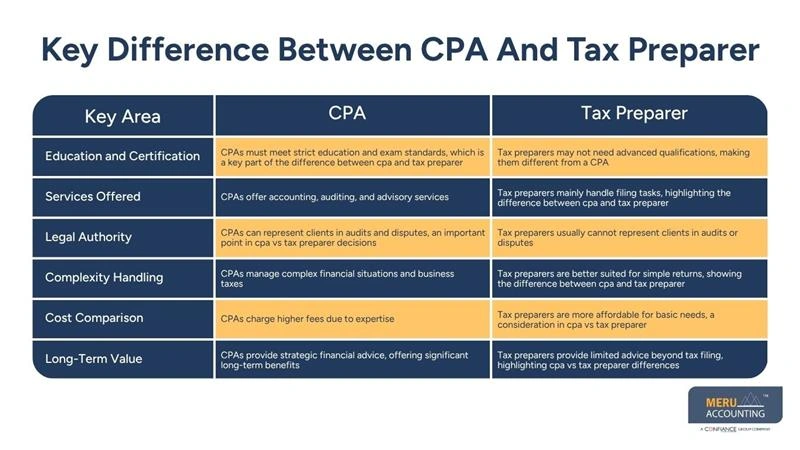
Key Difference Between CPA And Tax Preparer
Key Area | CPA | Tax Preparer |
Education and Certification | CPAs must meet strict education and exam standards, which is a key part of the difference between cpa and tax preparer | Tax preparers may not need advanced qualifications, making them different from a CPA |
Services Offered | CPAs offer accounting, auditing, and advisory services | Tax preparers mainly handle filing tasks, highlighting the difference between cpa and tax preparer |
Legal Authority | CPAs can represent clients in audits and disputes, an important point in cpa vs tax preparer decisions | Tax preparers usually cannot represent clients in audits or disputes |
Complexity Handling | CPAs manage complex financial situations and business taxes | Tax preparers are better suited for simple returns, showing the difference between cpa and tax preparer |
Cost Comparison | CPAs charge higher fees due to expertise | Tax preparers are more affordable for basic needs, a consideration in cpa vs tax preparer |
Long-Term Value | CPAs provide strategic financial advice, offering significant long-term benefits | Tax preparers provide limited advice beyond tax filing, highlighting cpa vs tax preparer differences |
Common Misconceptions About CPA Vs Tax Preparer
Both Provide Same Services
Many people mistakenly believe that CPAs and tax preparers perform identical roles and offer the same range of services.
In reality, the difference between cpa and tax preparer is significant, as CPAs provide a broader set of financial and advisory services beyond simple tax filing.
Tax Preparers Are Always Cheaper And Better
It is a common misconception that hiring a tax preparer is always the cheaper and better option for everyone.
While tax preparers may charge lower fees, more complex financial situations often require the expertise of a CPA, highlighting a key factor in cpa vs tax preparer decisions.
CPAs Are Only For Big Businesses
Many assume CPA services are only for large companies, but individuals and small business owners can also benefit. Their tax planning, strategic advice, and long-term guidance highlight the difference between cpa and tax preparer.
Tax Preparers Cannot Be Skilled
Some believe tax preparers lack skill, but many are highly experienced in preparing returns. Their work is still limited compared to a CPA, especially in advisory and audit support, highlighting cpa vs tax preparer differences.
You Only Need Help During Tax Season
Many think professional help is only needed during tax season, but financial planning should happen year-round. This ongoing support is a key part of the difference between cpa and tax preparer, as CPAs provide continuous guidance while tax preparers focus mainly on filing.
How To Choose The Right Tax Professional
- Simple returns may only require a tax preparer, while complex finances often need a CPA.
- Small businesses might start with a tax preparer, but growing businesses benefit from CPA support.
- Multiple income sources or investments require expertise, showing the difference between cpa and tax preparer.
- Always verify the qualifications and experience of your tax professional for reliable service.
- Look beyond fees and focus on long-term benefits, important in cpa vs tax preparer decisions.
- Choose a professional who can assist year-round, highlighting the difference between cpa and tax preparer.
Difference Between CPA And Tax Preparer In Accuracy And Risk Management
Accuracy In Filing
CPAs ensure accurate filings due to extensive training and experience. Errors are far less likely compared to basic tax preparers.
Risk Reduction
They help reduce audit risks using proper documentation methods. This is an important part of the difference between cpa and tax preparer.
Handling Audits
CPAs can fully represent clients during audits and disputes. Tax preparers usually cannot provide audit representation services.
Compliance Knowledge
CPAs stay updated with all changes in tax laws. This knowledge significantly reduces compliance risks for clients.
Error Correction
Mistakes can be quickly corrected by an experienced CPA. This adds reliability in cpa vs tax preparer comparisons.
Financial Security
Working with a CPA provides peace of mind and safety. They ensure long-term financial security and proper planning.
Why Choose Meru Accounting For Your Tax Needs
- Meru Accounting offers skilled experts in tax and accounting who understand both simple and complex financial needs.
- From tax filing to financial planning, all services are covered, reducing the need to hire multiple professionals.
- Services are designed to fit different budgets, ensuring clients receive value without overspending.
- Meru Accounting serves clients across various industries and can handle international tax requirements as well.
- Advanced tools and technology are used to ensure accuracy, timely delivery, and improved efficiency.
- Each client receives customized solutions, ensuring better outcomes compared to generic services.
Key Takeaways
- The difference between CPA and tax preparer lies in qualifications, scope, and authority.
- CPAs provide broader financial and tax services compared to tax preparers.
- Tax preparers focus mainly on filing returns and basic tax tasks.
- Choosing the right professional depends on the complexity of your finances and your specific needs.
- CPA vs tax preparer comparison shows that CPAs offer more long-term value.
- Accuracy and risk management are generally stronger when working with CPAs.
FAQs
A CPA has a license, advanced training, and can handle audits and tax planning. A tax preparer mainly files returns and may not have formal qualifications.
Hire a CPA for complex taxes, business finances, or audit representation. A tax preparer is enough for simple personal tax returns.
Yes, CPAs can represent clients during IRS audits and tax disputes. Tax preparers usually cannot provide audit representation.
Yes, for basic tax filing, a tax preparer is safe and cost-effective. For more complex situations, a CPA reduces risk and errors.
Consider the complexity of your taxes, business needs, and budget. CPAs are ideal for long-term planning, tax strategy, and audit support.


