



When it comes to managing your taxes, knowing the difference between tax preparer and CPA can save you time, money, and stress. Many people are unsure who to hire—whether a tax preparer or a certified public accountant (CPA). This decision is especially important for individuals with complex tax situations or businesses seeking accurate financial management.
Choosing the right professional can help you maximize deductions, stay compliant with tax laws, and avoid costly mistakes. Understanding their specific roles, qualifications, and services ensures you get the right expertise for your financial needs.
What You Will Learn From This Blog
- How a tax preparer can assist with personal and business taxes
- The responsibilities and expertise of a CPA
- Key differences between a tax preparer and a CPA
- Education and licensing requirements that set them apart
- How to decide which professional is right for your financial situation
Who Is A Tax Preparer And What Services Do They Offer For Individuals And Businesses
A tax preparer is a professional trained to assist individuals and businesses in completing and filing their tax returns, which is a key part of understanding the difference between tax preparer and CPA.
They are skilled in handling standard tax forms, identifying eligible deductions, and ensuring that clients comply with federal and local tax regulations.
Tax preparers are particularly valuable for those who have straightforward tax situations and need accurate filing without the complexity of advanced financial planning, highlighting one aspect of the difference between tax preparer and CPA.
For individuals, tax preparers help with preparing and filing personal tax returns, maximizing deductions, and offering guidance on year-end tax planning. Their expertise ensures that taxpayers meet all compliance requirements while taking advantage of available tax benefits.
Businesses also benefit from tax preparers, especially small enterprises with routine tax needs. They manage payroll taxes, sales tax filings, and other standard tax obligations, helping businesses stay organized and avoid penalties.
Hiring a tax preparer is generally more cost-effective than employing a CPA, highlighting an important factor in the tax preparer vs CPA comparison for simple tax situations. However, tax preparers have limitations—they typically do not provide advanced tax strategies, financial consulting, or auditing services that a CPA would offer.
Understanding The Role Of A CPA: Certified Public Accountant Responsibilities And Expertise
A Certified Public Accountant (CPA) is a licensed professional who provides accounting, auditing, and tax services. CPAs are trained to handle complex financial matters and can offer advanced tax advice, strategic planning, and guidance for both individuals and businesses.
Their expertise goes beyond basic tax filing, a major element in understanding the difference between tax preparer and CPA.
CPAs manage tax preparation and filing for individuals and businesses, including complicated situations involving investments, partnerships, or international taxes, which is one of the main points in the difference between tax preparer and CPA.
They also provide financial advisory services, such as retirement planning, investment strategies, and budgeting advice, helping clients plan for both short-term and long-term financial goals.
In addition, CPAs are qualified to perform audits, review financial statements, and ensure compliance with federal, state, and local regulations.
They can also represent clients before the IRS during audits, disputes, or investigations, offering added security and peace of mind that tax preparers cannot provide. This makes CPAs particularly valuable for businesses with stakeholders or complex financial requirements.
Understanding The Difference Between Tax Preparer And CPA And Why It Matters
Aspect | Tax Preparer | CPA (Certified Public Accountant) |
Certification and Licensing | May only have a PTIN (Preparer Tax Identification Number); not formally licensed. | Licensed and regulated by state boards with strict requirements, which is a key factor in the difference between tax preparer and CPA. |
Scope of Services | Focuses on filing tax returns and basic tax planning, showing a core distinction in the tax preparer vs CPA roles. | Offers a broader range of services, including auditing, financial planning, and advanced tax strategy. This highlights the main tax preparer vs CPA distinction. |
Education and Expertise | May or may not have formal accounting education; training varies. | Must have a degree in accounting or related field and pass the CPA exam, which highlights one major difference between tax preparer and CPA. |
Accountability and Ethics | Fewer regulatory requirements; less professional oversight. | Held to strict professional and ethical standards to protect clients. |
Cost Differences | Usually charges less, suitable for simple tax situations. | Typically higher fees but provides comprehensive services that can save money in the long term, making it a crucial consideration in the difference between tax preparer and CPA. |
Education, Licensing, And Professional Requirements That Separate A Tax Preparer From A CPA
Educational Background
CPAs need at least a bachelor’s degree in accounting or finance. Tax preparers may only require basic training or experience in tax filing.
Licensing Requirements
CPAs are licensed by state boards and must meet strict standards. Tax preparers only need a PTIN from the IRS to file returns.
Continuing Education
CPAs are required to complete ongoing professional education. Tax preparers have no mandatory continuing education, though optional courses are available.
Professional Accountability
CPAs adhere to a code of ethics and are subject to disciplinary action, emphasizing a key point in the difference between tax preparer and CPA. Tax preparers are less regulated, with fewer professional obligations.
Advanced Tax Knowledge
CPAs can handle complex tax strategies, audits, and business advisory services, which highlights a major point in the difference between tax preparer and CPA, while tax preparers typically handle standard tax filing tasks.
How To Choose Between A Tax Preparer And A CPA
Assess The Complexity Of Your Taxes
For simple returns, a tax preparer is sufficient, but understanding the difference between tax preparer and CPA helps you decide when a CPA is a safer choice for complex returns, business ownership, or investments.
Consider Long-Term Financial Needs
If you need financial planning, audits, or representation, a CPA provides long-term value beyond tax filing.
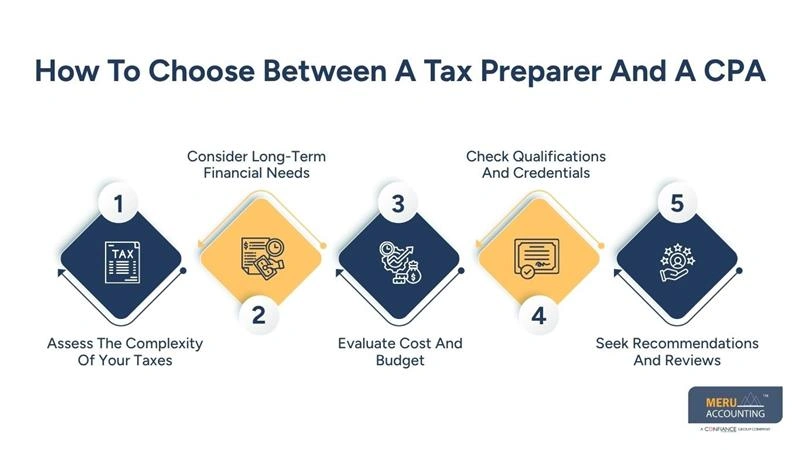
Evaluate Cost And Budget
Tax preparers are more affordable for simple services. CPAs cost more but offer broader expertise and peace of mind.
Check Qualifications And Credentials
Ensure the professional is licensed or certified. Verify a CPA’s credentials through state boards or professional associations.
Seek Recommendations And Reviews
Evaluate how accessible the professional is, especially during tax season, which is an important aspect to consider in the difference between tax preparer and CPA, as CPAs often provide year-round support, whereas tax preparers may only be available during peak filing periods.
Why Choose Meru Accounting For Tax Services
- Meru Accounting has certified CPAs and skilled tax preparers with extensive experience in handling individual and business taxes.
- Our team assesses your financial situation and provides solutions tailored to your needs, helping clients clearly see the tax preparer vs CPA differences for their situation.
- CPAs at Meru Accounting can represent you in case of audits or disputes, which is one of the main differences between tax preparer and CPA.
- Whether you need a tax preparer or a CPA, we offer competitive rates without compromising service quality.
- We handle clients across the world, offering comprehensive services while explaining the difference between tax preparer and CPA for global tax needs.
Key Takeaways
- Tax preparers assist with basic tax filing and standard deductions.
- CPAs provide advanced financial advice, audits, and IRS representation.
- Understanding the difference between tax preparer and CPA helps you choose the right professional.
- Cost, complexity of taxes, and long-term needs should guide your decision.
- Meru Accounting offers both tax preparers and CPAs to suit your financial requirements.
FAQs
A tax preparer focuses on filing tax returns and basic tax planning. A CPA can also provide audits, financial advice, and IRS representation, making them suitable for complex tax situations.
If you have a business, investments, or complex tax issues, a CPA is recommended. For simple personal tax returns, a tax preparer is usually enough.
No. Only CPAs, enrolled agents, or tax attorneys can represent clients during IRS audits or disputes. Tax preparers can only file returns.
Tax preparers generally charge less for straightforward tax filing. CPAs charge more due to their broader expertise and ability to handle complex financial matters.
Consider your tax complexity, long-term financial needs, and budget. Simple returns can use a tax preparer, while business or complex financial situations need a CPA.


