




Introduction to Equity and Liabilities in Accounting
In accounting, understanding the composition of equity and liabilities is fundamental to interpreting a company’s financial position. The balance sheet, one of the key financial statements, presents a snapshot of what a business owns and owes at a specific point in time. This statement is divided into three main categories: assets, liabilities, and equity. While assets represent resources controlled by the company, equity and liabilities represent claims against those assets. In this comprehensive guide, we delve into equity and liabilities, exploring their significance, types, and how to analyze them effectively to improve financial understanding.
Understanding Equity in Accounting
Equity represents the residual interest in the assets of a business after deducting liabilities. It is essentially the ownership value held by shareholders or owners in the enterprise. Equity gives a clear picture of how much the business is worth from the owners’ perspective.
Components of Equity
- Share Capital: Funds raised by issuing shares to investors.
- Retained Earnings: Accumulated profits not distributed as dividends but reinvested in the business.
- Additional Paid-in Capital: Amount paid by investors above the nominal value of shares.
- Other Comprehensive Income: Gains and losses not realized through the income statement but recorded directly in equity, such as foreign currency translation adjustments.
The Importance of Equity Analysis
Evaluating equity provides insights into the company’s financial health and stability. It reflects the amount invested by owners and earnings retained for growth. A strong equity base often indicates resilience against financial distress and the ability to finance operations and expansions.
Exploring Liabilities: What They Mean for a Business
Liabilities represent obligations or debts the company must settle in the future. These obligations arise from past transactions or events and require the company to transfer assets or provide services to other entities.
Types of Liabilities in Accounting
Liabilities are broadly classified into two categories: current liabilities and non-current liabilities. Understanding these classifications helps in assessing the company’s short-term and long-term financial commitments.
Types of Current Liabilities in Accounting
- Accounts Payable: Amounts owed to suppliers for goods and services purchased on credit.
- Short-Term Loans: Borrowings that need to be repaid within one year.
- Accrued Expenses: Expenses incurred but not yet paid, such as wages and utilities.
- Dividends Payable: Dividends declared but not yet disbursed to shareholders.
- Unearned Revenue: Money received before delivering goods or services.
- Current Portion of Long-Term Debt: The portion of long-term debt due within a year.
Non-Current Liabilities
- Long-Term Loans: Debts payable over periods longer than one year.
- Bonds Payable: Debt securities issued to raise capital, repayable at a future date.
- Deferred Tax Liabilities: Taxes assessed but deferred for payment to future periods.
- Lease Obligations: Long-term lease commitments.
How to Read and Analyze the Balance Sheet
The balance sheet displays assets, liabilities, and equity in a structured manner. To analyze equity and liabilities, one must understand the relationships between different elements and the implications for financial stability and liquidity.
Balance Sheet Equation
The fundamental accounting equation serves as the backbone to analyze the balance sheet:
| Assets | = | Liabilities + Equity |
|---|
This equation ensures that the total resources of the company are funded either by creditors (liabilities) or owners (equity).
Step-by-Step Guide to Analyze Equity and Liabilities
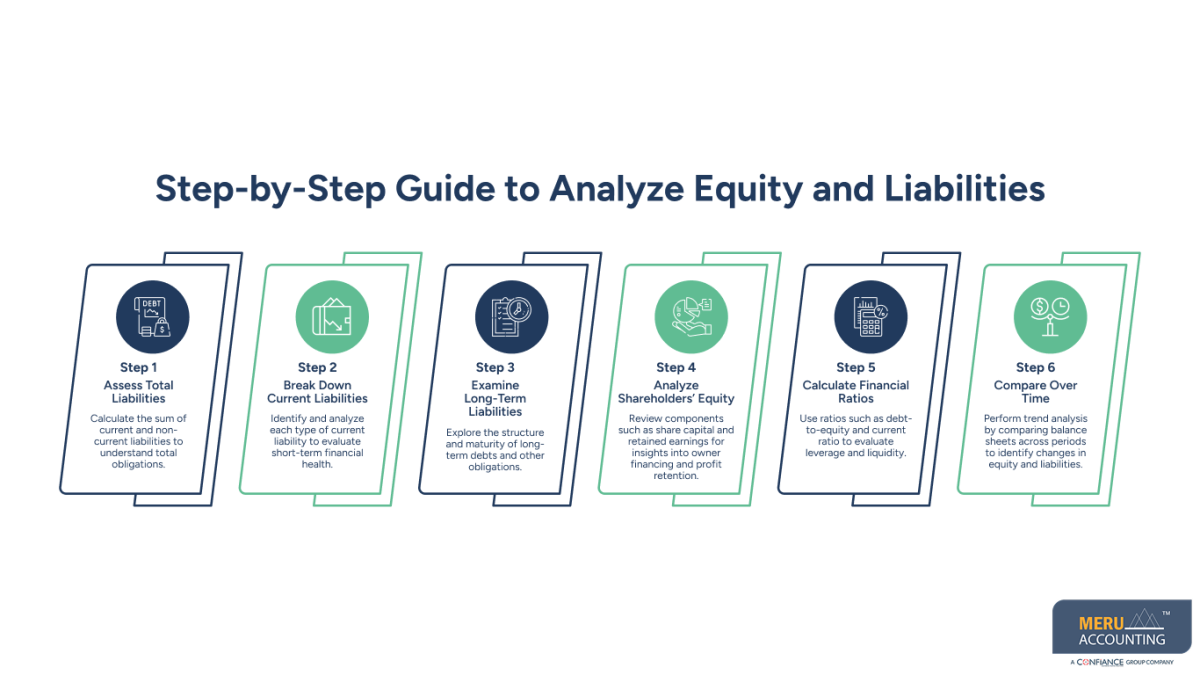
- Step 1: Assess Total Liabilities – Calculate the sum of current and non-current liabilities to understand total obligations.
- Step 2: Break Down Current Liabilities – Identify and analyze each type of current liability to evaluate short-term financial health.
- Step 3: Examine Long-Term Liabilities – Explore the structure and maturity of long-term debts and other obligations.
- Step 4: Analyze Shareholders’ Equity – Review components such as share capital and retained earnings for insights into owner financing and profit retention.
- Step 5: Calculate Financial Ratios – Use ratios such as debt-to-equity and current ratio to evaluate leverage and liquidity.
- Step 6: Compare Over Time – Perform trend analysis by comparing balance sheets across periods to identify changes in equity and liabilities.
Key Financial Ratios Involving Equity and Liabilities
Financial ratios derived from equity and liabilities figures help stakeholders make informed decisions regarding creditworthiness, investment potential, and operational efficiency. Some critical ratios include:
Debt-to-Equity Ratio
This ratio indicates the relative proportion of debt and equity financing, providing insights into the company’s leverage.
| Debt-to-Equity Ratio Formula | = Total Liabilities / Total Shareholders’ Equity |
|---|
A higher ratio signals greater leverage and potentially higher risk, while a lower ratio suggests more conservative financing.
Current Ratio
Measures the company’s ability to meet short-term liabilities with current assets.
| Current Ratio Formula | = Current Assets / Current Liabilities |
|---|
A ratio above 1 generally indicates good short-term liquidity.
Equity Ratio
Shows the proportion of total assets financed by owners’ equity.
| Equity Ratio Formula | = Total Equity / Total Assets |
|---|
This ratio highlights financial strength and reliance on owner funding as opposed to debt.
Common Mistakes When Analyzing Equity and Liabilities
While analyzing equity and liabilities, it’s important to be cautious of common errors that can misrepresent the financial situation.
- Ignoring Off-Balance Sheet Liabilities: Some obligations, like operating leases or contingent liabilities, may not appear on the balance sheet but still impact financial risk.
- Failing to Distinguish Between Current and Long-Term Liabilities: Mixing these can distort liquidity analysis and mislead about short-term obligations.
- Overlooking Equity Adjustments: Events like stock buybacks, dividend declarations, or revaluation of assets affect equity and should be thoroughly evaluated.
- Misinterpreting Negative Equity: Negative equity does not always mean insolvency; it requires deeper investigation of reasons and implications.
Practical Tips for Better Financial Understanding
Enhancing financial acumen requires both knowledge and regular practice in analyzing company financials. Below are actionable tips to improve your interpretation of equity and liabilities:
- Study Financial Statements in Conjunction: Analyze income statement, cash flow statement, and balance sheet collectively for a holistic view.
- Focus on Trends: Compare data over multiple periods to detect patterns or irregularities in liabilities and equity.
- Utilize Financial Ratios: Employ selected ratios consistently to benchmark against industry standards.
- Keep Updated on Accounting Standards: Regulations and standards evolve, affecting how equity and liabilities are reported.
- Leverage Technology: Use accounting software and financial analysis tools to streamline data interpretation.
The Role of Expert Accounting Services in Analyzing Equity and Liabilities
Accurate interpretation of equity and liabilities can be complex and requires expertise in accounting principles and financial analysis. Partnering with professional accounting firms like Meru Accounting can provide invaluable support. Meru Accounting specializes in delivering comprehensive accounting, bookkeeping, and financial advisory services tailored to the specific needs of businesses. Their expertise helps organizations maintain accurate financial records, comply with regulatory requirements, and generate insightful reports that facilitate sound decision-making. Utilizing expert services ensures that equity and liabilities are analyzed accurately for better financial understanding and strategic planning.
Conclusion: Mastering Equity and Liabilities for Corporate Financial Health
Equity and liabilities form the foundation of a company’s financial structure. A detailed understanding of these components, along with the ability to analyze them effectively in the context of the balance sheet, empowers stakeholders to make informed decisions. By dissecting the types of current liabilities in accounting, scrutinizing equity components, and utilizing key financial ratios, one can gauge financial stability, solvency, and growth prospects.
Continuous learning and adherence to best practices in financial analysis coupled with professional accounting support can significantly enhance overall financial management. Whether you are a business owner, investor, or financial analyst, mastering the intricacies of equity and liabilities unlocks deeper insights essential for sustaining and growing a successful enterprise.
FAQs
What are Equity and Liabilities in accounting?
Equity represents the owners’ interest in the company, while liabilities are obligations the company owes to others. Both appear on the balance sheet to give a snapshot of financial health.
How do I analyze the balance sheet for better financial understanding?
Start by reviewing assets, then examine current and non-current liabilities, and finally assess shareholders’ equity to understand the company’s financial stability and funding sources.
What are the main types of current liabilities in accounting?
Current liabilities typically include accounts payable, short-term loans, accrued expenses, wages payable, and taxes payable that need to be settled within one year.
Why is it important to differentiate between current and long-term liabilities?
Differentiating helps assess liquidity and solvency: current liabilities impact short-term cash flow, while long-term liabilities affect long-term financial planning.
How does understanding equity help in analyzing a balance sheet?
Understanding equity reveals the net worth of the company, the retained earnings, and shareholders’ contributions, which are crucial for evaluating financial robustness and funding sources.


