




Introduction to Liabilities in Accounting
Liabilities are a fundamental component of a company’s financial structure. Understanding liabilities in accounting is essential for accurately assessing an organization’s financial health. This article delves into the key concepts surrounding liabilities accounting examples, provides a comprehensive list of liabilities in accounting, and illustrates practical examples to facilitate better accounting practices.
Liabilities represent the financial obligations that a company owes to external parties, such as creditors, suppliers, or employees. These obligations must be settled over time through the transfer of assets, provision of services, or other financial settlements. Proper classification and management of liabilities are crucial for compliance, reporting accuracy, and strategic financial planning.
What Are Liabilities in Accounting?
In accounting, liabilities refer to debts or obligations arising from past transactions or events that require an outflow of resources embodying economic benefits. They are categorized as either current liabilities or long-term liabilities, depending on the timeframe in which the company expects to settle them.
Definition and Characteristics of Liabilities
Liabilities have the following defining characteristics:
- Present Obligation: The company has a current obligation due to a past event.
- Settlement Expected through Outflow: The settlement involves an outflow of economic resources such as cash, goods, or services.
- Probable Outflow: It is more likely than not that the outflow will occur.
- Reliable Measurement: The amount of the obligation can be reasonably estimated.
Classification of Liabilities
Liabilities are generally classified into two main types:
- Current Liabilities: Obligations due within one operating cycle or one year, whichever is longer.
- Non-Current Liabilities: Obligations due beyond one year or operating cycle, sometimes referred to as long-term liabilities.
Common Types of Liabilities in Accounting
An exhaustive understanding of the list of liabilities in accounting ensures completeness in financial reporting. The following types are most commonly encountered in business accounting:
Current Liabilities
- Accounts Payable: Amounts owed to suppliers for goods and services acquired on credit.
- Accrued Expenses: Expenses that have been incurred but not yet paid, such as wages, utilities, and interest.
- Short-Term Loans and Notes Payable: Debt obligations to be settled within the short term.
- Unearned Revenue: Payments received in advance from customers for goods or services yet to be delivered.
- Current Portion of Long-Term Debt: The amount of long-term debt that is due within the next year.
Non-Current Liabilities
- Long-Term Loans and Bonds Payable: Debt instruments with maturities exceeding one year.
- Deferred Tax Liabilities: Taxes owed but not payable within the current period, typically arising from temporary differences in accounting methods.
- Lease Liabilities: Obligations under lease agreements classified as long-term debt.
- Mortgage Payable: Loans secured by real property with extended repayment terms.
- Pension and Post-Employment Obligations: Liabilities arising from employee benefits payable in the future.
Liabilities Accounting Examples in Business Accounting
Below are practical examples illustrating various liabilities on a company’s balance sheet and how they affect accounting entries.
Example 1: Accounts Payable
A manufacturing company purchases raw materials worth $50,000 on credit from a supplier. The entry records a credit to accounts payable and a debit to inventory, increasing liabilities until payment is made.
Example 2: Accrued Expenses
Consider a firm accrues $10,000 in salaries at month-end, payable next month. The accounting entry records accrued expenses (a liability) and salary expense, recognizing the obligation even though cash has not yet been paid.
Example 3: Unearned Revenue
A software company receives $30,000 in advance for annual subscription services. It records unearned revenue (liability) until the service is delivered, then gradually recognizes revenue over the subscription period.
Example 4: Long-Term Debt
A corporation issues bonds worth $1,000,000 payable over 10 years. The initial recording includes the long-term liability and corresponding cash inflow. Interest expenses are recognized periodically, with principal repayments reducing the liability accordingly.
How to Account for Liabilities: Key Accounting Concepts
The accurate accounting of liabilities involves several key considerations, from recognition to measurement and disclosure.
Recognition of Liabilities
Recognition occurs when it is probable that an outflow of economic benefits will result from a present obligation and the amount can be reliably measured. This ensures the balance sheet reflects valid obligations.
Measurement and Valuation
Liabilities are typically measured at their settlement amount or the present value of future cash outflows when payment is deferred. Different types of liabilities accounting examples may require specific measurement treatments, such as:
- Amortized cost for long-term debt.
- Fair value for financial instruments where applicable.
Disclosure Requirements
Details about liabilities, including maturity dates, interest rates, and terms, must be disclosed in the financial statements notes to provide transparency and assist stakeholders in evaluation.
Impacts of Liabilities on Financial Statements
Liabilities directly affect a company’s balance sheet, income statement, and cash flow statement. A thorough comprehension of these effects is crucial for financial analysis and decision-making.
Balance Sheet Presentation
Liabilities accounting examples are reported alongside assets and equity to represent the company’s financial position. They are segregated into current and non-current categories, providing clarity on liquidity and solvency.
Income Statement Effects
Expenses related to liabilities, such as interest expense and accrued costs, reduce net income. Properly matching these expenses to the reporting period is fundamental to accurate profitability analysis.
Cash Flow Implications
Repayment of liabilities results in cash outflows, while borrowing or incurring new liabilities creates cash inflows. Managing these flows is vital for operational continuity and financial stability.
List of Liabilities in Accounting: Comprehensive Table
| Liability Type | Description | Typical Accounting Treatment |
|---|---|---|
| Accounts Payable | Amounts owed to suppliers for purchases made on credit. | Recorded as current liabilities on the balance sheet, credited when goods/services are received. |
| Accrued Expenses | Expenses incurred but unpaid during the accounting period. | Recognized as accrued liabilities; expenses recorded with corresponding liability. |
| Unearned Revenue | Payments received in advance from customers. | Recorded as a liability until revenue is earned, then recognized on income statement. |
| Short-Term Notes Payable | Loans and promissory notes payable within one year. | Classified as current liabilities; interest and principal payments recorded as expenses and reductions of liability. |
| Long-Term Debt | Borrowings payable after one year, including bonds and mortgages. | Recorded at amortized cost; interest expense recognized periodically. |
| Deferred Tax Liabilities | Taxes payable in future periods due to timing differences. | Recognized in accordance with tax regulations; disclosed separately for clarity. |
| Lease Liabilities | Obligations arising from lease agreements (long-term). | Measured at present value of lease payments; recognized as liabilities and corresponding right-of-use assets. |
Best Practices for Managing Liabilities in Accounting
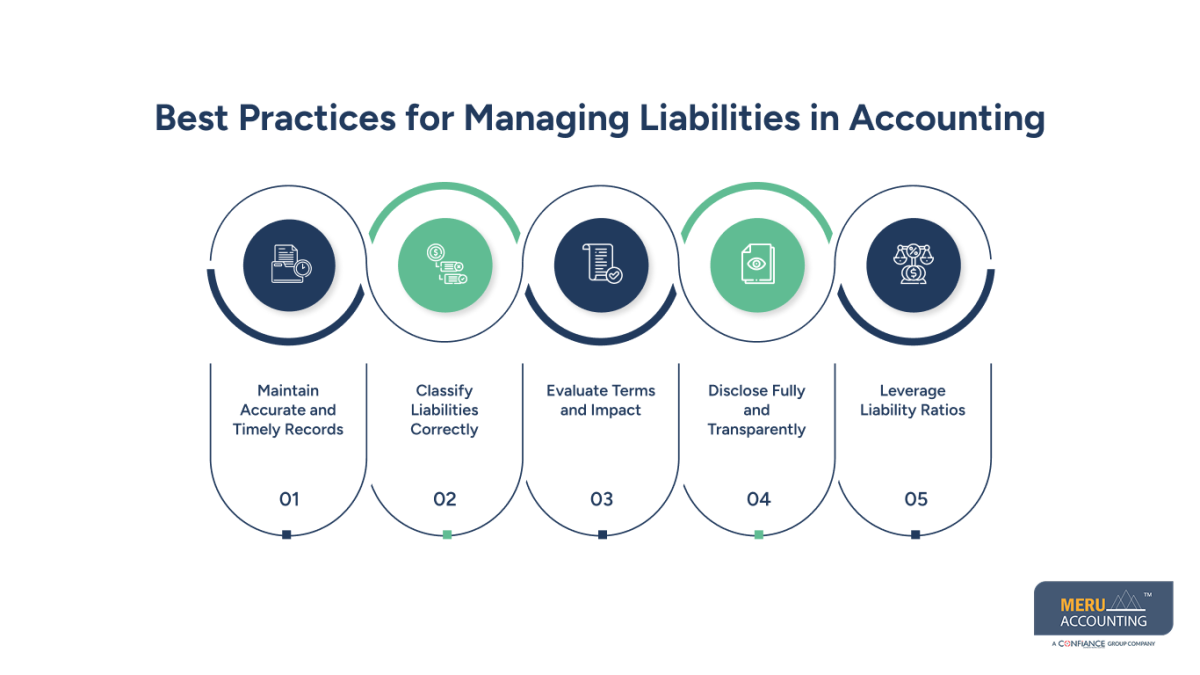
Effective liability management enhances financial health and compliance. Accountants and financial managers should adopt the following best practices:
Maintain Accurate and Timely Records
Accurate documentation of all liabilities helps prevent errors and omissions. Regular reconciliations ensure that liabilities accounting examples are reflected correctly in financial statements.
Classify Liabilities Correctly
Properly distinguish between current and long-term liabilities for better liquidity analysis and reporting integrity.
Evaluate Terms and Impact
Analyze the cost and implications of liabilities, such as interest rates and repayment schedules, to optimize debt management and cash flow planning.
Disclose Fully and Transparently
Ensure all relevant information about liabilities is disclosed in the notes to the financial statements for stakeholders’ informed decision-making.
Leverage Liability Ratios
- Debt-to-Equity Ratio: Measures leverage and financial risk.
- Current Ratio: Evaluates short-term liquidity and ability to meet current liabilities.
- Interest Coverage Ratio: Assesses capacity to pay interest on outstanding debt.
Meru Accounting: Expert Support in Liabilities Accounting
Meru Accounting specializes in delivering professional accounting services tailored to modern business needs, including thorough management of liabilities. Their expert team ensures accurate classification, recognition, and reporting of liabilities in compliance with the latest accounting standards. Meru Accounting also offers customized financial advisory to help organizations optimize their debt structure, improve cash flow, and maintain transparency for stakeholders.
Conclusion
Understanding liabilities in accounting, along with a comprehensive list of liabilities in accounting and practical examples, builds a strong foundation for precise financial reporting and decision-making. Correct recognition, measurement, and disclosure of liabilities are vital for reflecting the true financial position of a company and for effective financial management. By implementing best practices and leveraging professional expertise like that offered by Meru Accounting, businesses can enhance their accounting processes and sustain financial health over the long term.
FAQs
What is the definition of liabilities in accounting?
Liabilities are financial obligations or debts that a company owes to outside parties, which must be settled in the future through payment of money, transfer of goods, or services.
What are some common examples of liabilities in accounting?
Common examples include accounts payable, loans payable, mortgages, accrued expenses, and unearned revenue.
How are liabilities classified in accounting?
Liabilities are classified as current liabilities, which are due within one year, and long-term liabilities, which are due after more than one year.
Why is it important to maintain an accurate list of liabilities in accounting?
Maintaining an accurate list helps ensure proper financial reporting, effective debt management, and compliance with accounting standards.
How do liabilities impact the financial position of a company?
Liabilities represent claims on a company’s assets, reducing the equity and cash flow available, and they influence the company’s leverage and overall financial health.


