



Small and medium-sized manufacturers often see constant movement in their business. Machines function round the clock, raw materials come in at certain intervals, and finished goods go out based on customer demand. Effective manufacturing accounting is the backbone of any production operation. It ensures that every resource and cost is tracked, providing a clear picture of profitability and efficiency. But, to keep all these processes organized, you need manufacturing accounting. Without it, you cannot link the cost of each resource to activities inside your unit.
For SMEs, the challenge often lies in balancing limited staff, limited funds, and tight deadlines. Without the right accounting approach, it becomes hard to see where money is being used and whether production is truly profitable. Manufacturing accounting gives that clarity. It shows the cost pattern across materials, labour, overhead, and stock value. With improved visibility, the business gains more control over profit, workflow, and daily operations.
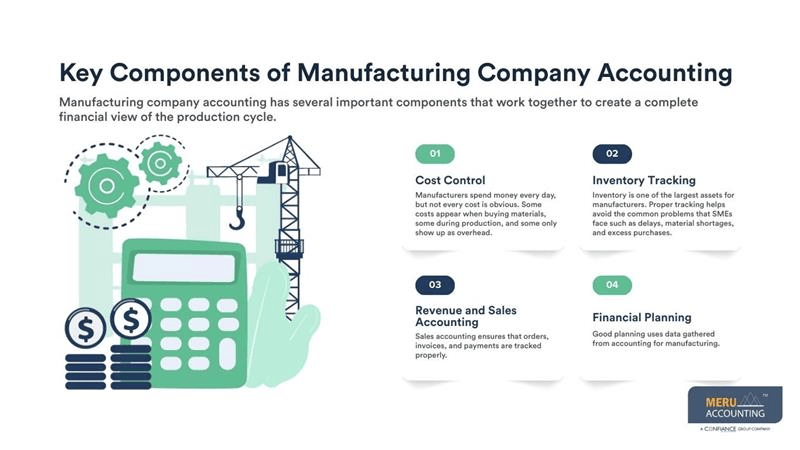
Key Components of Manufacturing Company Accounting
Manufacturing company accounting has several important components that work together to create a complete financial view of the production cycle.
A. Cost Control
Manufacturers spend money every day, but not every cost is obvious. Some costs appear when buying materials, some during production, and some only show up as overhead. Good cost control records:
- Each type of material used
- The exact labour hours spent on each job
- Ongoing expenses like tools, repairs, utilities, and machine upkeep
By watching these costs closely, SMEs can prevent overspending and set prices that actually reflect the full cost of making the product. When cost behaviour becomes easier to understand, profit planning becomes stronger as well.
B. Inventory Tracking
Inventory is one of the largest assets for manufacturers. Proper tracking helps avoid the common problems that SMEs face such as delays, material shortages, and excess purchases. Tracking systems show:
- How much stock is left
- Whether there is enough material for upcoming batches
- Which items are stuck in WIP longer than expected
- How quickly finished goods are selling
Better inventory accuracy reduces waste, improves cash flow, and keeps production moving smoothly.
Why Small and Medium Manufacturers Need Specialized Manufacturing Accounting
Here are some key reasons why small and medium manufacturers need specialized manufacturing accounting:
Unique Challenges in SME Operations
SMEs face challenges that larger manufacturers can handle easily because of bigger teams and budgets. Smaller units deal with sudden material price changes, supply delays, and the need to use every resource efficiently. A single error in cost estimation can impact profit for an entire month.
This is why precise manufacturing accounting is essential. It delivers timely information that supports quick decisions. It helps identify where delays are forming, where costs are rising, and where margins are shrinking. When SMEs can spot these issues early, they maintain stronger control over daily operations.
Inventory-Heavy Environments and Cost Tracking Needs
Manufacturers naturally hold more inventory than most other types of businesses. But this also increases the risk of losses. Materials can get damaged, misplaced, or wasted if not tracked properly. WIP can stay stuck for days, affecting delivery schedules. Finished goods can pile up if sales slow down.
With the right manufacturing company accounting system, every one of these risks becomes easier to manage. Regular valuation, tracking, and reconciliation keep inventory clean, measurable, and ready for decision-making.
Essential Costing Methods in Accounting for Manufacturing
Here are all the essential costing methods in accounting for manufacturing business:
Job Costing
Job costing gives a detailed picture for each order or project. Manufacturing accounting uses job costing to provide a detailed cost breakdown for each order or project, particularly when customers request items with different features or sizes. By recording cost per job, SMEs can compare expected costs with actual costs, understand variances, and improve accuracy in future quotes. It reduces the risk of underpricing work.
Process Costing
Process costing makes work easier for manufacturers with identical items. Instead of tracking each unit separately, the cost is shared equally across all units. This lowers the workload on staff and helps managers see whether the overall process is becoming more expensive or more efficient over time.
Activity-Based Costing (ABC)
ABC breaks down overheads into different activities. This is powerful for SMEs because many units often struggle to understand why overheads keep rising. When each activity has a clear cost attached, it becomes easier to change or improve those activities.In manufacturing company accounting process, Activity-Based Costing (ABC) breaks down overheads by activity, providing deeper insight into costs and helping make better decisions about automation, labor use, and batch planning.
When SMEs Should Use Each Method
Choosing the right costing method in accounting for manufacturing business is critical as:
- Job costing helps with custom work and small unique batches.
- Process costing suits large runs with identical output.
- ABC helps when overheads are difficult to manage or when the owner wants deeper visibility into hidden costs.
Each method strengthens accounting for manufacturing business by giving clarity in different situations.
Internal Controls and Risk Management in Manufacturing Accounting
A strong part of manufacturing accounting for small and medium units is the use of simple but effective internal controls that reduce risk in day-to-day operations. Manufacturers often face risks linked to stock loss, production glitches, slow approvals, and gaps in cost tracking. With clear controls in place, even a small team can build a steady system that protects cash, reduces errors, and keeps production data clean. This includes regular stock counts, approval steps for purchases, and proper recording of material issues and returns.
Many SMEs use internal controls to make sure that raw materials and work in progress move through each stage with proper visibility. When every movement is logged, the firm gains a clear view of actual usage versus planned usage. This helps identify waste early and improves the precision of accounting for manufacturing. It also strengthens cost allocation because overheads, labour, and material usage become easier to verify with real activity.
Internal controls also help the manufacturing company accounting process support growth. As order volume increases, controls keep the system stable so the team does not lose track of stock or cash. When records flow in the right way, management can rely on the reports to guide decisions on pricing, capacity, and production flow. For SMEs, this level of control does not require complex tools. It requires a consistent process, regular checks, and clear roles — all of which support long term stability and help the business stay ready for change.
Managing Inventory Through Manufacturing Accounting
Manufacturing accounting helps you gain complete control over your inventory.
Raw Materials, WIP, and Finished Goods
All stock inside a manufacturing unit falls into these three groups. Manufacturers need to watch each stage daily because delays or errors at one stage affect all others. Understanding these stages helps managers:
- Plan purchases
- Reduce storage costs
- Avoid stalled production
- Improve delivery timelines
When these categories are recorded correctly, the business runs smoother and wastes less material.
How Manufacturing Company Accounting Improves Cash Flow and Profitability
Manufacturing company accounting can significantly improve cash flow and profitability by:
Identifying Waste
Waste does not always appear as damaged material. Sometimes waste appears in the form of slow processes, long idle hours, or unbalanced workloads. A strong accounting system shows these hidden losses clearly. Once identified, managers can adjust operations and reduce these losses over time.
Cost Allocation for Decision-Making
Accurate allocation helps SMEs choose which products to continue and which ones to reduce. It shows which resources are used more than expected and whether current prices are fair. With this insight, owners can adjust pricing, negotiate with suppliers, and choose the most profitable production plan.
Production Planning Insights
With updated cost and inventory data, manufacturers can plan the next steps with more confidence. They know how much material to order, how many workers to schedule, and how long each batch might take. This leads to better planning of timelines, better customer service, and smoother operations across all departments.
Meru Accounting’s Remote Accounting and Bookkeeping Services for Manufacturers
Meru Accounting supports manufacturers by creating systems that fit their actual workflows. We help streamline cost tracking, organise inventory records, prepare clear management reports, and maintain full bookkeeping accuracy. Our remote service model gives manufacturers constant access to expert support without needing a full in-house team. With our manufacturing accounting services, we bring structure, clarity, and consistency to financial processes, helping units focus more on production, expansion, and long-term stability.
Need a remote accountant for your manufacturing company accounting? Contact us now and get professional manufacturing accounting services at cost-effective rates.
FAQs
Manufacturing accounting is the approach used to track production costs, inventory value, overheads, and financial results for manufacturing businesses.
It must record every stage of production, track multiple types of costs, and manage inventory across many phases.
Job costing suits custom work, process costing fits mass production, and ABC works best when overheads need deeper analysis.
It reveals real costs, highlights waste, and supports smarter pricing and operational choices.
It reduces stock loss, avoids shortages, improves planning, and frees up cash locked in excess stock.


