



When it comes to filing taxes, many people wonder who is better suited to handle their financial documents – a tax preparer vs CPA. Understanding the differences between these two professionals can help you save time, reduce stress, and maximize your tax benefits. This guide will help you make the right choice based on your unique financial situation.
Whether you are an individual, small business owner, or self-employed professional, choosing the right expert can make a significant difference in accuracy, compliance, and potential tax savings. By exploring the roles, qualifications, and services of a tax preparer vs CPA, you can confidently decide which professional aligns best with your financial goals.
What You Will Learn From This Blog
- Learn the key roles of both tax preparers and CPAs and how each can assist with tax filing and planning.
- Understand the credentials, training, and licensing requirements that differentiate a tax preparer vs CPA.
- Explore which professional is best suited for simple tax returns, complex tax planning, or business accounting.
- Explore the costs associated with hiring a tax preparer vs CPA to make a budget-friendly decision.
- Understand how your choice impacts self-employed professionals, small business owners, and families.
Tax Preparer vs CPA: Understanding Which Professional Fits Your Tax Needs
When comparing tax preparer vs CPA, it is important to understand that a tax preparer is trained to prepare and file federal and state tax returns for individuals and businesses.
Their primary focus is on ensuring accurate filing according to IRS rules, making them a suitable choice for straightforward tax situations.
In contrast, a Certified Public Accountant (CPA) provides more advanced services, including tax planning, auditing, and financial consulting. CPAs have broader expertise than standard tax preparers and can offer strategic guidance for more complex financial matters.
While both professionals assist with taxes, understanding the difference between CPA and tax preparer helps clarify their roles and expertise.
CPAs are licensed and regulated, and they have the authority to represent clients in complex IRS audits, a service that many tax preparers cannot provide.
Choosing the right professional depends on your specific needs. Simple tax returns, basic deductions, or straightforward filing are often well-suited to a tax preparer. On the other hand, more complex financial situations, business accounting, or detailed tax planning may require the expertise of a CPA.
CPAs are also held to strict ethical standards and must complete ongoing education to maintain their license. Tax preparers, depending on their credentials, may face fewer regulations, which can impact the level of accountability and professional oversight.
What Does a Tax Preparer Do in the Tax Filing Process
Gathering Financial Information
When analyzing tax preparer vs CPA, tax preparers primarily collect income statements, receipts, and relevant tax documents from clients to prepare returns. This ensures nothing is missed and your filing is accurate.
Preparing Tax Returns
They enter financial data accurately into tax software and calculate deductions and credits. This step helps optimize potential refunds and minimize errors.
Filing Returns
Tax preparers electronically file your tax returns or prepare paper submissions to the IRS. Understanding the difference between CPA and tax preparer shows that tax preparers primarily ensure returns are filed accurately and on time to avoid penalties.
Advising on Basic Tax Questions
They can answer simple tax questions and guide clients on standard deductions, credits, and tax refunds. This support helps you make informed decisions during filing.
Limited Representation
Some tax preparers can represent clients before the IRS, but only if they are enrolled agents or have additional authorization. This provides peace of mind in case of IRS inquiries.
What Is a CPA and How They Provide Advanced Tax and Financial Services
Tax Planning and Strategy
One major point in the difference between CPA and tax preparer is that CPAs help clients plan taxes throughout the year, not just during filing season, reducing liabilities legally.
Their guidance ensures long-term financial efficiency and maximizes potential savings.
Audit Representation
A major difference between CPA and tax preparer is that CPAs can represent clients in audits and work with the IRS on disputes. This protection provides peace of mind during complex IRS reviews.
Business and Financial Consulting
They provide advice on business structures, investments, retirement planning, and cash flow management. Their insights help clients make informed financial decisions for growth and stability.
Preparation of Complex Returns
When evaluating tax preparer vs CPA, CPAs are better equipped to handle corporate, partnership, and multi-state tax filings. They ensure accuracy and compliance even in the most intricate financial scenarios.
Continuing Education
CPAs must maintain ongoing education and licensing, ensuring up-to-date expertise on changing tax laws. This commitment guarantees professional advice that reflects the latest regulations and best practices.
What Is the Key Difference Between CPA and Tax Preparer
Key Difference | CPA | Tax Preparer |
Licensing and Credentials | Licensed professionals with state certification | May only need a PTIN from the IRS |
Scope of Services | Comprehensive tax planning, auditing, and financial consulting | Mainly focuses on preparing and filing tax returns |
Representation Rights | Can fully represent clients in audits or disputes with the IRS | Most have limited or no audit representation authority |
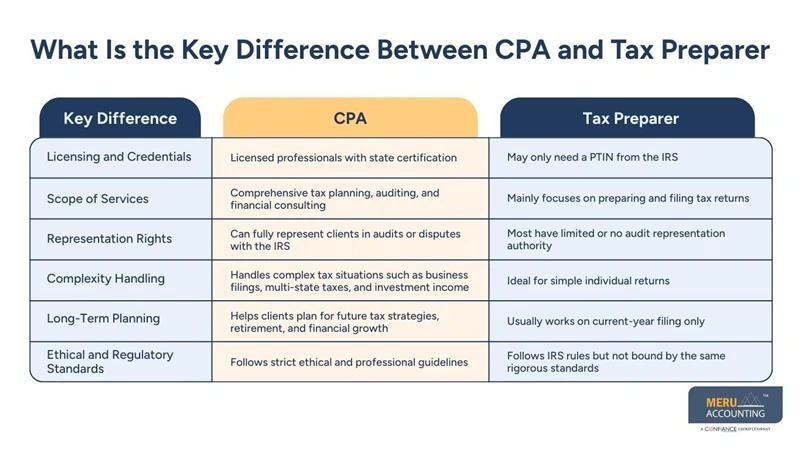
Key Difference | CPA | Tax Preparer |
Complexity Handling | Handles complex tax situations such as business filings, multi-state taxes, and investment income | Ideal for simple individual returns |
Long-Term Planning | Helps clients plan for future tax strategies, retirement, and financial growth | Usually works on current-year filing only |
Ethical and Regulatory Standards | Follows strict ethical and professional guidelines | Follows IRS rules but not bound by the same rigorous standards |
Why Understanding the Tax Preparer vs CPA Choice Can Save Time and Money
Avoid Mistakes
Understanding the tax preparer vs CPA decision helps you hire the right professional and reduce errors that could result in penalties or audits. This ensures your filing is accurate and compliant with tax laws.
Efficient Filing
Understanding tax preparer vs CPA helps you choose the skilled professional who can organize documents and maximize deductions while filing on time. Proper organization also saves valuable time during tax season.
Strategic Planning
One important difference between CPA and tax preparer is that CPAs offer long-term strategies that may lower future tax bills. Their guidance helps you make informed financial decisions year-round.
Cost-Effective Decision
Choosing a tax preparer for simple returns can save money, while hiring a CPA for complex cases prevents costly mistakes. Investing in the right expert can save more than it costs.
How Qualifications and Certifications Differ in Tax Preparer vs CPA Roles
Tax Preparer Requirements
When discussing the difference between CPA and tax preparer, tax preparers may need to complete IRS-approved training or obtain a Preparer Tax Identification Number (PTIN). This ensures they are registered and recognized to prepare federal tax returns legally.
CPA Licensing
In the tax preparer vs CPA comparison, CPAs are licensed by state boards and must meet strict education, exam, and experience requirements. This rigorous process guarantees a high level of expertise and professionalism.
Continuing Education
CPAs must complete 40–80 hours of continuing education yearly, depending on the state, to maintain their license. This ongoing education is another key difference between CPA and tax preparer, ensuring CPAs stay updated on changing tax laws.
Ethical Guidelines
CPAs adhere to strict ethical and professional standards; tax preparers follow IRS guidelines but may not have the same enforcement standards. CPAs are accountable to both the public and regulatory boards, ensuring trustworthiness.
Representation Rights
Only CPAs (and enrolled agents) have unlimited rights to represent clients before the IRS, while many tax preparers have limited authority. This ability provides additional security during audits and complex tax issues.
What Are the Cost Differences in Hiring a Tax Preparer vs CPA
Tax Preparer Fees
In the tax preparer vs CPA comparison, tax preparers typically charge less than CPAs, making them suitable for straightforward returns. This makes them a budget-friendly option for individuals with simple tax situations.
CPA Fees
CPAs charge higher rates due to advanced expertise, licensing, and the complexity of services offered. In the tax preparer vs CPA comparison, CPA fees reflect the value of handling complicated tax scenarios and providing strategic guidance.
Value for Money
Although CPAs are costlier, their strategic advice may save more money in the long term. Understanding the difference between CPA and tax preparer helps taxpayers see how proper planning and expert guidance can prevent costly mistakes.
Hourly vs Flat Rate
Many CPAs charge hourly for complex consultations, while tax preparers may offer flat-rate pricing. Choosing the right billing model can help manage expenses effectively.
Business Implications
For businesses, the added cost of a CPA often outweighs fees because of tax savings and financial insights. This clearly demonstrates the tax preparer vs CPA distinction, as a CPA’s expertise supports business growth and long-term financial planning.
When Should Individuals Choose a Tax Preparer for Filing Taxes
Simple Tax Situations
When evaluating tax preparer vs CPA, individuals with W-2 income, standard deductions, and limited credits often benefit from a tax preparer. They ensure your return is accurate without unnecessary complexity.
Budget-Friendly Option
Tax preparers are generally more affordable than CPAs, ideal for individuals looking to save on fees. This makes them a practical choice for routine tax filings.
Quick Filing Needs
In the tax preparer vs CPA comparison, tax preparers are ideal for straightforward filings and meeting deadlines efficiently. This helps avoid last-minute stress during tax season.
Minimal Planning Required
If you do not need long-term financial advice, a tax preparer is sufficient. They handle filing accurately while keeping the process simple and straightforward.
Basic IRS Representation
Some tax preparers can represent clients with minor IRS inquiries, making them adequate for simple issues. This provides support for routine questions or minor adjustments without needing a CPA.
When Is Hiring a CPA the Better Choice for Complex Tax Situations
Multiple Income Sources
If you have income from self-employment, investments, or rental properties, a CPA is preferable. They can accurately handle complex calculations and ensure all deductions are applied.
Business Ownership
This highlights the difference between CPA and tax preparer, as business owners benefit from CPA expertise in corporate taxes, deductions, and audit support. Their guidance helps optimize profitability and maintain compliance.
IRS Audits
CPAs offer full representation during IRS audits, which provides security and peace of mind. They can communicate directly with the IRS to resolve issues efficiently.
Tax Planning Needs
CPAs help plan future taxes, retirement, and financial strategies, which tax preparers may not handle. This proactive approach can reduce liabilities and improve long-term financial health.
Multi-State Filing
When comparing tax preparer vs CPA, CPAs are better suited for individuals or businesses with multi-state income. They prevent costly errors and help take advantage of all applicable credits and deductions.
Why Choose Meru Accounting?
- Meru Accounting evaluates your tax needs carefully to help determine whether a tax preparer or CPA is the right choice. Our experts review income sources and deductions to recommend the most suitable professional.
- Our team includes experienced CPAs and trained tax preparers who understand various tax rules and filing requirements. This ensures accurate tax preparation and reliable financial guidance.
- We provide customized services for individuals, entrepreneurs, and self-employed professionals. Our solutions are designed to match financial goals while ensuring proper tax compliance.
- Meru Accounting offers complete support from tax preparation to tax planning. We help clients organize documents, meet filing deadlines, and manage tax responsibilities.
- Our services are affordable while maintaining high standards of accuracy. We focus on practical solutions that help clients manage taxes efficiently and reduce unnecessary costs.
Key Takeaways
- Tax Preparer vs CPA differs in expertise, services, and cost.
- Tax preparers are ideal for simple tax filing and basic advice.
- CPAs handle complex taxes, audits, and financial planning.
- Choosing the right professional can save time, money, and stress.
- Meru Accounting offers guidance and professional services to ensure the right choice for your needs.
FAQs
A tax preparer mainly files taxes, while a CPA provides advanced tax planning, audits, and financial advice.
Only some tax preparers with specific credentials can represent you; CPAs have full rights to represent clients.
Tax preparers are usually less expensive for simple returns; CPAs charge more for complex services and planning.
Individuals with businesses, multiple income sources, or complex tax situations should hire a CPA.
Yes, small businesses with simple financial records may use a tax preparer, but growing businesses often benefit more from a CPA’s guidance.


