



Introduction to Owner’s Equity
Owner’s equity is a fundamental concept in accounting and finance, representing the residual interest in the assets of a business after deducting liabilities. It reflects the owner’s claim on the company’s resources and is a critical figure on the balance sheet. Understanding what owner’s equity tells you helps business owners, investors, and stakeholders assess the company’s financial health and make informed decisions.
This article dives deep into owner’s equity, illustrating its significance, components, calculation methods, and analysis through detailed explanations, examples, and tables. Whether you are a small business owner, accountant, or financial analyst, this comprehensive guide will enhance your grasp of owner’s equity and its implications.
What Is Owner’s Equity?
Owner’s equity, sometimes referred to as stockholders’ equity or shareholders’ equity in corporations, represents the owner’s stake in the company after all debts and liabilities have been accounted for. It can be understood as the net worth of the business from an accounting perspective.
In the simplest terms, owner’s equity can be seen through the basic accounting equation:
| Assets | Liabilities | Owner’s Equity |
|---|---|---|
| $500,000 | $300,000 | $200,000 |
From this equation, it’s clear that owner’s equity equals assets minus liabilities.
- Assets: Resources owned by the company.
- Liabilities: Obligations or debts owed by the company.
- Owner’s Equity: The owner’s residual interest in those assets.
How to Calculate the Owner’s Equity
Calculating owner’s equity is straightforward and integral to preparing and interpreting financial statements. The core calculation is based on the accounting equation:
Basic Formula
Owner’s Equity = Assets – Liabilities
This formula provides a snapshot of the value that remains for the owners once all debts are paid.
Detailed Calculation Components
Beyond the basic formula, owner’s equity calculation may consider these components:
- Common Stock: The capital invested by owners or shareholders.
- Additional Paid-in Capital: Money paid by investors above the par value of stock.
- Retained Earnings: Profit reinvested in the business rather than paid out as dividends.
- Treasury Stock: Shares bought back by the company (reduces equity).
- Owner’s Draw or Distributions: Withdrawals made by owners in sole proprietorships or partnerships.
In the context of a sole proprietorship or partnership, owner’s equity calculation would take into account the beginning capital, additional investments, net income, and withdrawals.
Example Calculation
| Components | Amount ($) |
|---|---|
| Total Assets | 800,000 |
| Total Liabilities | 500,000 |
| Owner’s Equity (Assets – Liabilities) | 300,000 |
In this example, the owner’s equity stands at $300,000, indicating the owner’s value in the company’s net assets.
The Components of Owner’s Equity
Understanding the components of owner’s equity is crucial for analyzing balance sheets comprehensively. These components vary depending on the business type—sole proprietorship, partnership, or corporation.
For Sole Proprietorships and Partnerships
- Owner’s Capital Account: The initial and additional contributions by the owner(s).
- Drawings or Withdrawals: Money or assets taken out by the owner(s) during the period.
- Net Income or Loss: The profit or loss generated during the accounting period.
For Corporations
- Common Stock: Par value of issued shares.
- Preferred Stock: Stock with specific rights in dividends and liquidation.
- Additional Paid-in Capital: Capital paid over the par value.
- Retained Earnings: Accumulated profits not distributed as dividends.
- Treasury Stock: Repurchased shares deducted from equity.
The result is the total shareholders’ equity in corporations, equivalent to owner’s equity in other business structures.
What Owner’s Equity Indicates About a Company’s Financial Health
Owner’s equity on the balance sheet conveys vital information about the company’s financial status.
Positive Owner’s Equity
A positive owner’s equity indicates the company has more assets than liabilities, a signal of financial stability and growth potential. It often translates to:
- The business can meet its obligations comfortably.
- The owner(s) have valuable equity in the company.
- The company may attract investors and obtain financing more easily.
Negative Owner’s Equity
Negative owner’s equity means liabilities exceed assets, which could be a warning sign. This scenario might indicate:
- Poor financial health or ongoing losses.
- Excessive debt or over-leverage.
- Potential insolvency if the situation persists.
Changes in Owner’s Equity Over Time
Monitoring changes in owner’s equity over multiple periods provides insight into trends, including:
- Profitability through retained earnings growth.
- Impact of owner investments or withdrawals.
- Effect of share buybacks or dividend payments in corporations.
How to Analyze Owner’s Equity on the Balance Sheet
Effective analysis of owner’s equity involves more than reading the final number. Several financial ratios and techniques enhance the interpretation of owner’s equity data.
Common Financial Ratios Involving Owner’s Equity
| Ratio | Formula | Interpretation |
|---|---|---|
| Debt-to-Equity Ratio | Total Liabilities / Owner’s Equity | Measures financial leverage and risk; higher values indicate more debt relative to equity. |
| Return on Equity (ROE) | Net Income / Average Owner’s Equity | Indicates profitability relative to owner’s investments; higher ROE shows efficient use of equity. |
Trend Analysis
Examining owner’s equity trends over time aids in spotting growth or decline in business value. Consistent growth in owner’s equity suggests profitable operations and sound management.
Comparative Analysis
Comparing owner’s equity with industry benchmarks or competitors helps assess relative financial performance and stability.
Owner’s Equity and Its Role in Business Decision-Making
Owner’s equity impacts various business decisions, ranging from funding strategies to dividend policies.
Financing Decisions
Owner’s equity is a key factor when deciding whether to raise capital through equity or debt. Companies with strong owner’s equity may have better creditworthiness and options for obtaining debt financing at favorable terms.
Investment Decisions
Investors use owner’s equity to gauge company value and growth potential before committing capital. Equity investors look for returns through dividends or value appreciation linked directly to changes in owner’s equity.
Dividend and Withdrawal Decisions
For corporations, retained earnings within owner’s equity indicate the capacity to pay dividends. In sole proprietorships or partnerships, owner withdrawals directly reduce equity. Business owners must balance drawing funds with maintaining adequate equity for operational needs.
Practical Examples: Calculating Owner’s Equity in Various Business Types
Sole Proprietorship Example
Consider a sole proprietorship with the following year-end balances:
- Assets: $150,000
- Liabilities: $50,000
- Owner’s Capital Beginning of Year: $80,000
- Additional Investments: $10,000
- Net Income: $30,000
- Owner Withdrawals: $15,000
Calculation of owner’s equity at year end:
| Step | Amount ($) |
|---|---|
| Beginning Owner’s Capital | 80,000 |
| + Additional Investments | 10,000 |
| + Net Income | 30,000 |
| – Owner Withdrawals | (15,000) |
| Ending Owner’s Equity | 105,000 |
Alternatively, calculating from assets and liabilities:
Owner’s Equity = $150,000 – $50,000 = $100,000
The small discrepancy may arise from timing differences or other accounting adjustments.
Corporation Example
A corporation’s balance sheet shows:
- Common Stock: $200,000
- Additional Paid-in Capital: $50,000
- Retained Earnings: $300,000
- Treasury Stock: $20,000
Owner’s (shareholders’) equity calculation:
| Component | Value ($) |
|---|---|
| Common Stock | 200,000 |
| Additional Paid-in Capital | 50,000 |
| Retained Earnings | 300,000 |
| Treasury Stock (deduction) | (20,000) |
| Total Owner’s Equity | 530,000 |
This figure represents the shareholders’ total claim on corporate assets.
Common Misconceptions About Owner’s Equity
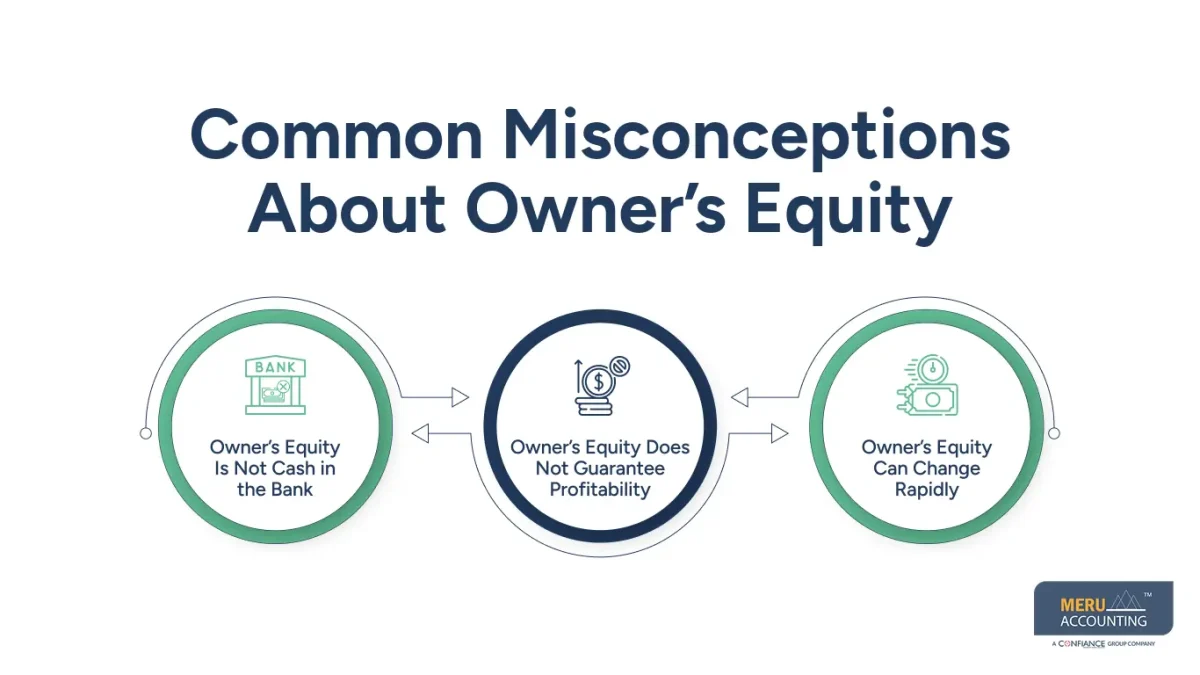
Despite its clear definition, owner’s equity is sometimes misunderstood.
Owner’s Equity Is Not Cash in the Bank
Owner’s equity reflects net assets but does not equate directly to cash. It includes tangible and intangible assets, some of which may not be liquid or easily convertible to cash.
Owner’s Equity Does Not Guarantee Profitability
A business can have significant equity due to prior investments or asset appreciation but may currently be unprofitable.
Owner’s Equity Can Change Rapidly
Business events such as losses, investments, or distributions can alter owner’s equity frequently. It’s important to review the latest financial statements regularly.
Using Owner’s Equity for Financial Planning and Growth
Companies and business owners use owner’s equity not just for reporting but as a tool for strategic planning.
Capital Budgeting
Owner’s equity provides a basis for evaluating capital needs and potential investments, ensuring the company does not overextend its financial position.
Managing Debt and Equity Mix
Maintaining a healthy balance between debt financing and owner’s equity helps optimize the cost of capital and reduce financial risk.
Attracting Investors
Strong owner’s equity and consistent growth attract investors by reflecting stability and potential to deliver returns.
Meru Accounting: Your Partner in Financial Clarity
Meru Accounting specializes in providing expert accounting services tailored to meet the needs of businesses of all sizes. With a comprehensive understanding of owner’s equity and financial reporting, Meru Accounting helps clients navigate complex balance sheet analysis and optimize their financial strategies. By leveraging advanced tools and personalized consultations, Meru Accounting supports businesses in calculating owner’s equity accurately and using it effectively to improve decision-making and achieve sustainable growth.
Conclusion
Owner’s equity on the balance sheet is a vital indicator of a company’s net worth and financial stability. It serves multiple roles including reflecting ownership’s value, assessing financial health, and guiding key business decisions. Learning how to calculate the owner’s equity and understanding its components and implications equips business owners, investors, and professionals to make informed choices.
From basic calculations to sophisticated financial analyses, owner’s equity remains a cornerstone of sound accounting and strategic business management. Regularly monitoring changes in owner’s equity and applying thoughtful analysis can reveal important trends that influence a company’s future.
In summary, owner’s equity tells you not just where a company stands financially but also points toward its growth trajectory, risks, and opportunities, providing a comprehensive picture crucial for all stakeholders involved.
FAQs
What is owner’s equity on a balance sheet?
Owner’s equity represents the owner’s claim on the assets of the business after all liabilities have been deducted.
How do you calculate owner’s equity?
Owner’s equity is calculated by subtracting total liabilities from total assets: Owner’s Equity = Total Assets – Total Liabilities.
Why is owner’s equity important for a business?
Owner’s equity provides insight into the financial health and net worth of the business, indicating how much the owner actually owns.
Can owner’s equity be negative?
Yes, owner’s equity can be negative if the company’s liabilities exceed its assets, indicating financial distress.
How does owner’s equity change over time?
Owner’s equity changes with business activities such as profits, losses, additional investments, and withdrawals by the owner.


