




What Is Owner’s Equity on a Balance Sheet?
Owner’s equity, often referred to as shareholders’ equity for corporations or simply equity for sole proprietorships and partnerships, represents the residual interest in the assets of a company after deducting liabilities. In simple terms, it shows what the owners actually own outright—their stake in the business. Owner’s equity is a fundamental concept in accounting, reflecting the net worth of the company and providing crucial insights into its financial health.
On a balance sheet, which is one of the core financial statements, owner’s equity is presented alongside assets and liabilities, adhering to the accounting equation:
Assets = Liabilities + Owner’s Equity
This equation highlights that everything a company owns (assets) is financed either by borrowing (liabilities) or by the owners’ investment (owner’s equity). Understanding owner’s equity is essential not only for company management but also for investors, creditors, and other stakeholders who evaluate business performance and stability.
Components of Owner’s Equity
Owner’s equity is composed of various elements that can differ depending on the business structure, but the core components generally include:
- Capital Contributions: The initial and additional investments made by the business owners or shareholders.
- Retained Earnings: Accumulated profits that have been reinvested in the business rather than distributed as dividends to owners.
- Withdrawals or Dividends: Cash or assets taken out of the business by owners, which reduce owner’s equity.
- Other Comprehensive Income: Changes in equity arising from sources other than net income, such as unrealized gains or losses on investments.
Each component plays a unique role in shaping owner’s equity and provides insight into how profits are managed and distributed.
Capital Contributions
Capital contributions refer to the money or assets that owners put into the business. This might include cash investments, property, or equipment contributed to the company. The total amount of capital contributions forms the initial basis of owner’s equity and is often recorded in accounts named “Paid-in Capital” or “Contributed Capital.”
Retained Earnings
Retained earnings accumulate over the life of the company based on its profitability. When a company earns profits, it can either distribute those profits as dividends or retain them for future growth. Retained earnings represent the amount that hasn’t been distributed and remain within the business, increasing owner’s equity.
Withdrawals and Dividends
When owners take money out of the business, it reduces owner’s equity. Sole proprietors and partners make withdrawals whereas corporations pay dividends to their shareholders. These distributions reflect a return of invested capital and profits, and therefore decrease the equity balance.
Other Comprehensive Income
This includes gains or losses that are not included in net income but still affect equity, such as adjustments from foreign currency translation or unrealized gains on investments classified as available-for-sale. These may increase or decrease owner’s equity without impacting the profit or loss statement.
What is Owner’s Equity on a Balance Sheet Formula and How to Calculate It
Understanding the owner’s equity formula is critical for accurately interpreting balance sheets. The core formula can be expressed in several forms, but the primary equation is:
| Formula | Description |
|---|---|
| Owner’s Equity = Assets – Liabilities | The simplest and most direct calculation, showing equity as the residual interest after liabilities are subtracted from assets. |
| Owner’s Equity (End of Period) = Owner’s Equity (Beginning of Period) + Additional Investments + Net Income – Withdrawals/Dividends | Shows how equity changes over time with investments, earnings, and distributions. |
For investors and analysts, the first formula is often used to assess the overall financial position of the business at a specific point in time, while the second formula explains changes in equity across accounting periods.
Detailed Breakdown of the Formula
Let’s consider each element:
- Assets: Resources owned by the company that provide economic benefits, including cash, accounts receivable, inventory, equipment, and investments.
- Liabilities: Company obligations such as loans, accounts payable, mortgages, and other debts.
- Owner’s Equity: Residual interest after debts have been paid—the owners’ claim on company resources.
For example, if a company has $500,000 in assets and $350,000 in liabilities, the owner’s equity is $150,000.
Why Owner’s Equity Plays a Key Role for Investors
Investors closely scrutinize owner’s equity because it reflects the company’s intrinsic value and capital structure. It is an indicator of financial health, providing valuable signals about profitability, solvency, and management effectiveness.
Assessing Financial Stability
A strong owner’s equity balance generally suggests that a company is stable and has a cushion to cover liabilities. Companies with higher equity are less reliant on debt financing, which can reduce risk and increase investor confidence.
Determining Net Worth
Owner’s equity reflects the company’s net worth from an accounting standpoint. For investors considering buying shares or investing capital, it serves as a baseline for evaluating whether the market value aligns with the reported net worth.
Evaluating Return on Equity (ROE)
Return on equity is a key performance metric that measures how effectively a company generates profit from shareholders’ equity. It is calculated as:
ROE = Net Income / Average Owner’s Equity
A high ROE generally attracts investors as it indicates efficient use of equity capital.
Understanding Capital Structure and Leverage
The balance between liabilities and owner’s equity indicates the level of financial leverage. Investors analyze how much debt a company uses relative to its equity to understand risk exposure and growth potential.
Liquidity and Solvency Analysis
Owner’s equity impacts liquidity and solvency ratios, which help investors gauge a company’s ability to meet short-term and long-term obligations. Increased equity space often means greater flexibility.
How Different Business Structures Affect Owner’s Equity
Owner’s equity varies substantially depending on the business entity type—sole proprietorship, partnership, or corporation. Each has unique equity accounts, regulations, and implications for investors.
Sole Proprietorship
In a sole proprietorship, owner’s equity is often called “owner’s capital” and reflects the individual’s investment and retained earnings. It is directly affected by withdrawals made by the owner and profits or losses from the business operations.
Partnership
Partnerships maintain capital accounts for each partner, representing their equity share. Equity is affected by each partner’s contributions, share of profits or losses, and drawings. Transparency and agreements govern how equity is handled among partners.
Corporation
In corporations, owner’s equity is reported as shareholders’ equity and includes common stock, preferred stock, additional paid-in capital, and retained earnings. Dividends paid reduce retained earnings, impacting overall equity. Corporations follow stricter regulations for equity reporting and distribution.
Owner’s Equity in Financial Analysis and Decision Making
Owner’s equity serves as a cornerstone for numerous financial analyses, influencing decisions by managers, investors, and creditors.
Investment Decisions
Investors evaluate owner’s equity to determine the intrinsic value of shares, assess risk, and predict growth prospects. Equity strength signals financial health and influences stock price valuations.
Creditworthiness and Lending Decisions
Creditors review owner’s equity to decide whether to extend credit. A high equity ratio reduces lender risk and may facilitate favorable loan terms.
Company Growth and Expansion
Companies with substantial owner’s equity often have greater capital for investments, research and development, acquisitions, and other growth initiatives.
Profit Distribution Strategy
Owners and management decide how much profit to retain versus distribute based on equity goals and business strategy. Proper management of owner’s equity balances sustaining operations and rewarding investors.
Risk Management
A robust owner’s equity provides a buffer to absorb losses during economic downturns, reducing bankruptcy risk and ensuring sustainable operations.
Common Owner’s Equity Metrics and Ratios Used by Investors
Several key metrics help investors analyze owner’s equity in depth:
- Book Value per Share: Owner’s equity divided by the number of outstanding shares, showing the per-share net asset value.
- Debt-to-Equity Ratio: Total liabilities divided by owner’s equity, measuring financial leverage.
- Return on Equity (ROE): Net income divided by average owner’s equity, indicating profitability.
- Equity Multiplier: Total assets divided by owner’s equity, reflecting financial leverage impact on return.
Challenges and Limitations of Owner’s Equity Measurement
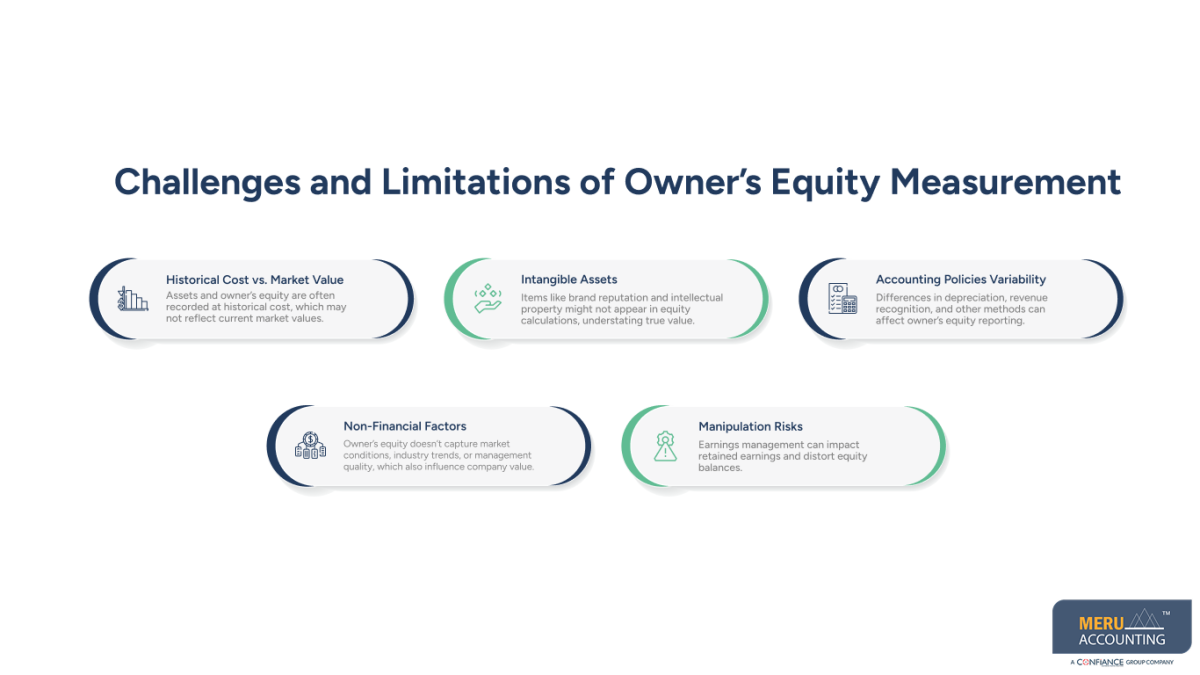
Despite its importance, owner’s equity has some limitations that investors and analysts should consider:
- Historical Cost vs. Market Value: Assets and owner’s equity are often recorded at historical cost, which may not reflect current market values.
- Intangible Assets: Items like brand reputation and intellectual property might not appear in equity calculations, understating true value.
- Accounting Policies Variability: Differences in depreciation, revenue recognition, and other methods can affect owner’s equity reporting.
- Non-Financial Factors: Owner’s equity doesn’t capture market conditions, industry trends, or management quality, which also influence company value.
- Manipulation Risks: Earnings management can impact retained earnings and distort equity balances.
Investors should use owner’s equity alongside other financial metrics and qualitative data to make comprehensive decisions.
Meru Accounting: Your Reliable Partner in Financial Clarity
Meru Accounting is a trusted provider of comprehensive accounting services and financial consultancy aimed at empowering businesses with precise and transparent financial reporting. Specializing in accurate balance sheet preparation, including detailed owner’s equity analysis, Meru Accounting helps companies maintain compliance and presents financial data in a way that supports informed decision-making. Their expert team supports businesses and investors by delivering insights that clarify financial positions, enhance transparency, and promote sustainable growth strategies tailored to each client’s unique needs.
Conclusion: The Vital Role Owner’s Equity Plays for Investors
Owner’s equity is more than just a number on a balance sheet—it encapsulates the true stake owners possess in the company after obligations are accounted for. For investors, understanding owner’s equity and its components is essential for evaluating a company’s financial stability, profitability, and future growth potential. It provides a fundamental measure of net worth, informs critical financial ratios, and influences investment and lending decisions.
By mastering the owner’s equity formula and appreciating its nuances across different business structures, investors can better analyze business health and make smarter investment choices. Despite certain limitations, owner’s equity remains a cornerstone of financial analysis and a key metric for those seeking to navigate the complexities of business finance with confidence. Whether you are an investor, entrepreneur, or financial professional, a comprehensive grasp of owner’s equity empowers you to interpret financial statements accurately and engage more effectively with financial markets and business opportunities.
FAQs
What is owner’s equity on a balance sheet?
Owner’s equity represents the owner’s residual interest in the assets of a business after deducting liabilities.
Why is owner’s equity important for investors?
Owner’s equity provides insight into the financial health and value of a company, helping investors assess its stability and profitability.
What is the owner’s equity formula?
The owner’s equity formula is: Owner’s Equity = Total Assets – Total Liabilities.
How does owner’s equity impact investment decisions?
Higher owner’s equity can indicate a stronger financial position, making the company more attractive to potential investors.
Can owner’s equity change over time?
Yes, owner’s equity changes due to business profits, losses, owner contributions, and withdrawals.


