




Accounting for manufacturers is often complex due to the variety of costs, production schedules, and inventory management challenges. That’s why accountants for manufacturers play a crucial role in ensuring smooth financial operations. They apply proven methods to simplify complex tasks, making manufacturing accounting more accurate and efficient.
With the right strategies, accountants for manufacturers not only reduce errors but also save valuable time and resources. By organizing financial data, optimizing processes, and providing clear insights, they help manufacturers focus on production and growth while maintaining precise and reliable accounting records.
What You Will Learn From This Blog
- Why accountants for manufacturers are essential for business efficiency
- Key strategies used to simplify manufacturing accounting
- Practical approaches for cost management, reporting, and compliance
- How technology can help improve financial insights
- Ways to manage risks and ensure regulatory accuracy
- Tips for handling multi-currency transactions and global operations
By the end of this blog, you will have a clear understanding of how accountants for manufacturers can make a significant difference in managing your business finances.
Importance of Accountants For Manufacturers
Accurate Cost Tracking
Accountants for manufacturers ensure that all production costs, including raw materials, labor, and overhead, are properly recorded. This allows businesses to price products correctly.
Inventory Control
Effective accountants help manage inventory levels to prevent overstocking or shortages. They track inventory value and provide insights into efficiency improvements.
Financial Reporting
Accountants for manufacturers prepare accurate financial statements that help management make informed decisions and maintain transparency with stakeholders.
Compliance with Regulations
Manufacturing businesses face many financial regulations. Accountants ensure all reporting meets legal standards, reducing the risk of fines.
Decision Support
By analyzing financial data, accountants provide recommendations that improve profitability and operational efficiency.
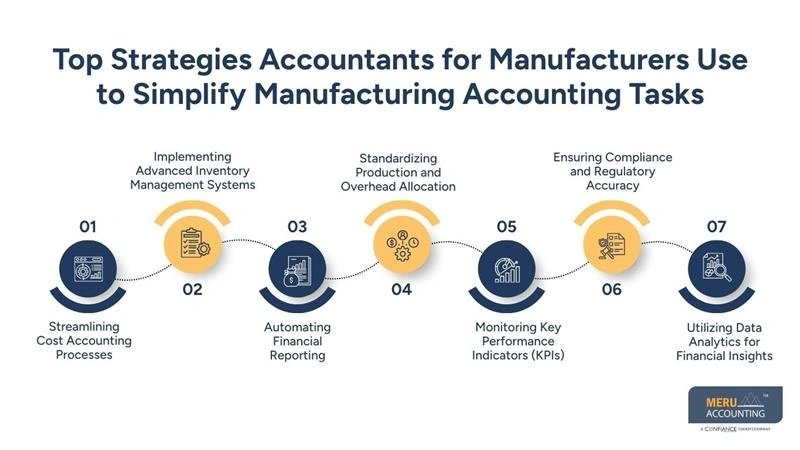
Top Strategies Accountants for Manufacturers Use to Simplify Manufacturing Accounting Tasks
Streamlining Cost Accounting Processes
Standardizing Cost Records: Ensures consistent recording of costs across departments for easier financial reviews.
Separating Direct and Indirect Costs: Clearly distinguishes production costs to improve budgeting and product profitability insights.
Tracking Production Expenses: Monitors daily expenses to identify areas for cost reduction effectively.
Simplifying Journal Entries: Automates recurring transactions to save time and reduce human errors.
Regular Cost Analysis: Reviews cost trends regularly to uncover opportunities for resource optimization.
Implementing Advanced Inventory Management Systems
Real-Time Inventory Updates: Accountants for manufacturers use systems that provide real-time stock levels, improving accuracy in financial statements.
Managing Raw Materials Efficiently: Tracking raw materials helps reduce waste and ensures production schedules are met without delays.
Setting Inventory Thresholds: Minimum and maximum stock levels are established to prevent shortages or excess storage costs.
Integrating With Accounting Software: Inventory data is linked to financial systems for seamless tracking of purchases and usage.
Inventory Valuation: Accountants apply consistent valuation methods, such as FIFO or weighted average to maintain accurate financial reporting.
Automating Financial Reporting
Scheduled Reports: Accountants for manufacturers set up automated schedules for monthly, quarterly, and yearly reports.
Error Reduction: Automation reduces manual data entry errors, ensuring reliable financial statements.
Customizable Templates: Reports can be tailored to show key cost and revenue information specific to manufacturing operations.
Data Consolidation: Automated tools combine data from multiple departments, giving a comprehensive view of finances.
Faster Decision Making: Quick access to accurate reports allows management to make timely decisions about production and costs.
Standardizing Production and Overhead Allocation
Consistent Overhead Rates: Accountants for manufacturers assign overhead costs consistently across products to maintain accurate cost calculations.
Production Department Allocations: Allocating costs to specific departments helps identify efficiency and profitability levels.
Simplifying Complex Calculations: Standard methods reduce errors when distributing shared expenses like utilities or equipment depreciation.
Monitoring Resource Usage: Tracking how resources are used ensures fair allocation and highlights areas to save costs.
Clear Documentation: Maintaining detailed allocation records helps during audits and management reviews.
Monitoring Key Performance Indicators (KPIs)
Cost per Unit: Accountants for manufacturers track the cost of producing each unit to manage pricing strategies.
Profit Margins: Analyzing profit margins by product or department helps identify underperforming areas.
Inventory Turnover: KPI monitoring shows how efficiently inventory is used, avoiding excess storage costs.
Production Efficiency: Accountants assess output versus resource input to measure operational performance.
Expense Ratios: Tracking ratios like overhead-to-sales helps control spending and improve financial health.
Ensuring Compliance and Regulatory Accuracy
Tax Compliance: Accountants for manufacturers ensure all taxes, including sales and payroll, are calculated and filed correctly.
Financial Audits: Regular internal audits help maintain accuracy and prevent issues during external reviews.
Record Retention: Keeping organized records ensures compliance with government regulations and simplifies audits.
Adhering to Accounting Standards: Following accepted accounting principles ensures reliable and consistent reporting.
Avoiding Penalties: Proper compliance reduces the risk of fines or legal issues, protecting the business.
Utilizing Data Analytics for Financial Insights
Trend Analysis: Accountants for manufacturers analyze past financial data to identify patterns and predict future costs.
Budget Forecasting: Data-driven forecasting helps managers allocate resources efficiently and plan production schedules.
Identifying Cost Savings: Analytics highlights areas where expenses can be reduced without affecting quality.
Profitability Reports: By examining product or department profitability, accountants help management focus on high-return operations.
Continuous Improvement: Regular analysis of financial trends ensures the business continuously improves its industrial accounting processes.
Risk Management Strategies in Manufacturing Accounting
Identifying Financial Risks
Accountants for manufacturers regularly review operations to detect potential financial risks, including cost overruns or inventory losses. This proactive review helps prevent unexpected financial setbacks.
Mitigating Production Delays
By monitoring production schedules, they help avoid delays that could impact cash flow and profitability. It ensures smooth operations and timely product delivery.
Insurance and Contingency Planning
Accounting teams suggest insurance coverage and contingency plans for unexpected manufacturing events. This prepares businesses for emergencies and protects assets.
Fraud Prevention Measures
Implementing checks and controls reduces the risk of fraud or misappropriation of resources. It strengthens financial integrity and trust in operations.
Continuous Monitoring
Regular reviews of financial and operational data allow early detection and mitigation of potential issues. It helps maintain stability and long-term business sustainability.
Employee Training and Awareness
Accountants for manufacturers also educate staff on financial procedures and risk protocols. This reduces human errors and promotes a culture of accountability.
How Accountants for Manufacturers Handle Multi-Currency Transactions
Tracking Currency Fluctuations
Accountants monitor foreign exchange rates to ensure accurate reporting of international transactions. This helps maintain correct financial records for global operations.
Converting Transactions Accurately
Using consistent methods, all foreign sales and purchases are converted to the local currency for reporting. It ensures uniformity and reliability in financial statements.
Managing International Payments
Accountants coordinate with banks to manage multi-currency payments and receipts efficiently. This streamlines cross-border transactions and reduces delays.
Hedging Against Currency Risk
They advise on risk management strategies to minimize losses from currency fluctuations. It protects profits from unpredictable market changes.
Reporting Multi-Currency Balances
Financial statements include multi-currency balances clearly, maintaining transparency for stakeholders. This allows managers to assess international financial positions accurately.
Reconciling Foreign Accounts
Accountants perform regular reconciliations of foreign accounts to ensure all transactions are recorded correctly. This prevents discrepancies and maintains trust in international operations.
Simplify Manufacturing Accounting With Meru Accounting
At Meru Accounting, we specialize in providing accounting services tailored for manufacturers. Our team of experienced accountants for manufacturers helps simplify complex manufacturing accounting tasks. We:
- Implement accurate cost accounting systems for precise financial tracking and management.
- Set up inventory management solutions linked with your financials efficiently.
- Automate reporting for faster and error-free results every month.
- Provide clear insights for budgeting and cost optimization decisions.
- Track production expenses to identify cost-saving opportunities and improve efficiency.
- Ensure compliance with tax and financial regulations for manufacturing businesses.
- Analyze financial data to support strategic planning and profitability improvements.
By partnering with us, your business can achieve better financial efficiency and make informed decisions without worrying about accounting complexities.
Key Takeaways
- Accountants for manufacturers play a crucial role in simplifying manufacturing accounting
- Streamlining cost tracking and inventory management improves efficiency
- Automated reporting saves time and reduces errors
- Standardized production and overhead allocation ensure accuracy
- Monitoring KPIs and analyzing data provides valuable financial insights
- Compliance with regulations prevents legal risks and penalties
FAQs
Accountants for manufacturers track production costs, manage financial records, and ensure accurate financial management for manufacturing operations.
Manufacturing accounting tracks costs, manages inventory, and creates clear financial reports for better decision-making.
Accurate cost tracking ensures raw materials, labor, and overhead are properly recorded, supporting correct pricing and budgeting.
Streamlining cost processes, automating financial reports, monitoring KPIs, and organizing inventory help simplify financial management for manufacturing operations.
Managing currency conversions, monitoring exchange rates, and recording international payments accurately ensures smooth multi-currency accounting.


