



Accounting for manufacturing businesses is crucial for any factory or production company aiming to stay profitable. Without proper accounting, companies often struggle to see which products are causing losses and which are generating revenue.
By understanding the costs, revenue, and profit margins associated with each product through manufacturing cost accounting, manufacturers can make better decisions and improve overall efficiency.
Accurate accounting for manufacturing businesses not only highlights underperforming products but also reveals inefficiencies in production processes.
By closely monitoring costs and comparing them with revenues, businesses can make timely adjustments, optimize resource usage, and focus on products that contribute most to profitability.
What You Will Learn From This Blog
- Importance of accounting for manufacturing business
- How accounting helps identify loss-making products
- Benefits of accurate cost tracking
- Advanced methods to spot underperforming products
- Key performance indicators (KPIs) for monitoring financial health
By the end of this blog, you will understand how accounting for manufacturing businesses can improve profitability and reduce financial risk.
Understanding Accounting for Manufacturing Business
Accounting for manufacturing business involves the systematic recording, analyzing, and reporting of financial transactions related specifically to production activities. It allows managers to track costs associated with raw materials, labor, and overhead, giving a clear view of the true expenses involved in making each product.
This specialized approach helps businesses monitor profitability at a granular level and make informed decisions about pricing, production, and resource allocation.
The main components of manufacturing accounting include raw material costs, work-in-progress tracking, finished goods valuation, labor charges, and overhead allocation. In manufacturing cost accounting, each of these elements directly affects the profitability of individual products.
Unlike general accounting, which focuses on overall company finances, accounting for manufacturing business zeroes in on production-specific costs and inventory valuation, providing a more detailed understanding of where money is spent and how it impacts profit margins.
Inventory plays a critical role in manufacturing accounting because overstocking or understocking can distort cost calculations and reduce profitability. To manage these complexities efficiently, companies often use accounting software and ERP systems.
These tools automate cost tracking, minimize errors, and provide real-time insights, enabling managers to make timely decisions that improve efficiency and reduce loss-making products.
The Role of Accounting for Manufacturing Business in Identifying Loss-Making Products
Tracking Product Costs
Manufacturing cost accounting allows businesses to track raw material, labor, and overhead costs for each product. This helps pinpoint products that are selling at a loss. It ensures every cost is measured accurately, giving a clear view of which products are truly profitable.
Analyzing Profit Margins
By calculating gross and net profit margins per product, the accounting for manufacturing businesses can identify items with low or negative returns. This analysis shows which products are using more resources than they bring in revenue.
Monitoring Production Efficiency
Accounting helps track production efficiency, revealing products that need more materials or time than expected. It highlights areas where production can be managed better to reduce costs.
Spotting Hidden Costs
Manufacturing cost accounting uncovers hidden costs like waste, spoilage, or extra labor, which can make products unprofitable. Finding these hidden costs helps businesses take action before losses grow.
Informing Product Decisions
With accurate data, companies can decide whether to discontinue, improve, or reprice loss-making products. This helps focus on products that bring the best returns and improve overall profitability.
Benefits of Accurate Accounting for Manufacturing Business
Better Financial Control
Accurate accounting provides a clear view of income, expenses, and profitability, helping managers make informed decisions. Managers can clearly see financial trends and act to maintain or improve profits.
Identifying Loss-Making Products Early
Early detection of underperforming products prevents prolonged losses and improves overall financial health. Timely insights allow corrective measures before losses grow larger.
Improved Resource Allocation
Accounting for manufacturing business allows managers to allocate materials and labor efficiently, reducing waste. Resources are directed toward products and processes that generate the most value.
Supporting Strategic Pricing
Understanding costs enables pricing products competitively while maintaining profit margins. Prices can be set to cover costs and ensure each product contributes positively to revenue.
Enhancing Decision-Making
Accurate data supports decisions related to product development, discontinuation, or expansion. Business choices become more confident and reliable when based on clear financial information.
Advanced Techniques to Identify Loss-Making Products
Product-Level Cost Analysis
Break down costs for each product, including materials, labor, and overhead, to see which products are unprofitable. This method highlights exactly where each product is gaining or losing money.
Variance Analysis
Compare actual costs with standard costs to find discrepancies and identify loss-making products. Discrepancies show areas where spending is higher than expected and needs attention.
Contribution Margin Calculation
Calculate the contribution of each product toward covering fixed costs to determine profitability. Products with low contribution margins can be evaluated for improvement or discontinuation.
Activity-Based Costing
Assign overheads based on specific activities rather than spreading them evenly. This helps reveal true product costs. Understanding the real cost of each activity shows which products consume more resources than they should.
Regular Financial Reviews
Conduct periodic reviews of financial statements and cost reports to catch loss-making products early. Frequent checks ensure underperforming products are spotted before they affect overall profits.
Pricing Strategies Informed by Manufacturing Cost Accounting
Cost-Plus Pricing
Add a fixed percentage of profit over the cost of production to determine the selling price. This ensures every product covers its costs and contributes to profit.
Break-Even Analysis
Determine the minimum sales volume needed to cover production costs, helping set realistic pricing. Knowing the break-even point helps prevent pricing products too low and causing losses.
Competitive Pricing
Analyze competitor prices and adjust pricing without sacrificing profitability using manufacturing cost accounting data. This approach balances market competitiveness with maintaining healthy profit margins.
Tiered Pricing
Offer different pricing levels based on quantity or product variants to maximize revenue and reduce losses. Higher volumes or premium versions can increase profitability while catering to different customer needs.
Discount Impact Analysis
Evaluate the effect of discounts on overall profitability to avoid promoting loss-making products. Understanding discount impacts prevents sales from unintentionally reducing profits.
KPIs to Monitor in Accounting for Manufacturing Business
Gross Profit Margin
Shows the percentage of revenue left after covering production costs. Low margins indicate potential losses. Tracking this helps identify which products are less profitable and need attention.
Net Profit per Product
Measures overall profitability, considering all expenses. This reveals the true contribution of each product to the business’s bottom line.
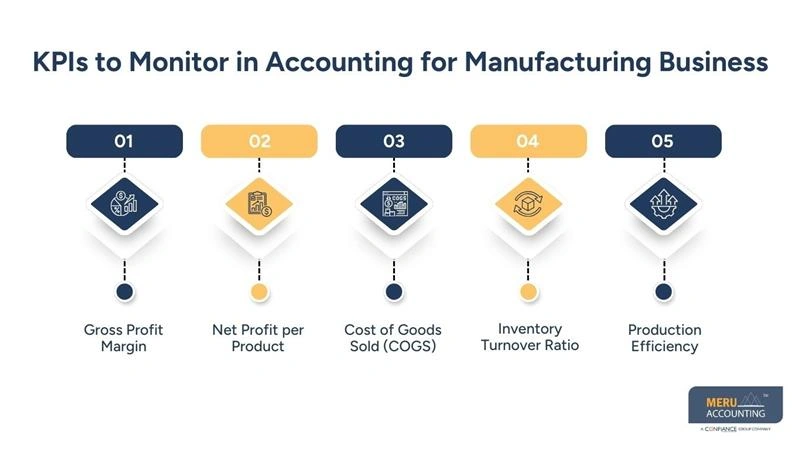
Cost of Goods Sold (COGS)
Monitoring COGS per product highlights inefficiencies in production. Higher than expected COGS signals areas where costs can be reduced.
Inventory Turnover Ratio
Helps track how quickly inventory is sold and whether slow-moving items are causing losses. Products that stay too long in inventory may tie up capital and reduce profits.
Production Efficiency
Measures output versus input to identify resource wastage and underperforming products. Improving efficiency ensures resources are used effectively and costs are minimized.
Meru Accounting's Solutions for Cost Control and Profit Growth in Manufacturing Businesses
Expertise in Accounting for Manufacturing Business
Meru Accounting specializes in tracking costs, monitoring KPIs, and identifying loss-making products for manufacturing companies. Our experience helps businesses understand exactly which products are profitable and which need improvement.
Customized Manufacturing Cost Accounting
We provide tailored services that focus on product-level cost tracking and efficiency improvements. Each solution is designed to fit the unique needs of your manufacturing operations.
Advanced Reporting Tools
Our team uses advanced accounting tools to give clear insights into your profitability per product. These reports make it easy to see trends and make informed financial decisions quickly.
Strategic Pricing Assistance
Meru Accounting helps set pricing strategies informed by detailed cost data to ensure better profits. Pricing recommendations are based on accurate numbers, helping maximize revenue without losses.
Ongoing Support
We provide regular financial reviews and guidance to keep your manufacturing business profitable. Continuous monitoring ensures issues are spotted early and corrective actions can be taken on time.
Key Takeaways
- Accounting for manufacturing business is essential to spot loss-making products.
- Manufacturing cost accounting helps track all production costs accurately.
- Early detection of unprofitable products prevents financial loss.
- Proper accounting supports pricing, resource allocation, and strategic decisions.
- Meru Accounting provides expert services to ensure efficient accounting for manufacturing businesses.
FAQs
By tracking all costs like materials, labor, and overhead, you can see which products cost more to make than they earn.
It’s the process of calculating the total cost of making each product. It helps you find unprofitable products and improve pricing.
Reports like product-level profit and loss statements, cost analysis, and variance reports clearly show which items are losing money.
Regularly, ideally monthly or quarterly, to spot loss-making products early and make timely decisions.
You can consider adjusting its price, reducing production costs, improving efficiency, or discontinuing the product.


