




Accounting for manufacturing companies is closely connected to how inventory is measured and reported. Manufacturing businesses handle raw materials, production costs, and finished goods, all of which must be valued correctly to reflect true business performance.
Inventory valuation helps manufacturers understand actual production costs and present accurate financial results. In accounting for manufacturing companies, inventory is often the largest asset on the balance sheet.
When inventory is not valued properly, it can affect profits, tax calculations, and management decisions. This is why inventory valuation methods are a core part of manufacturing accounting, supporting financial accuracy, cost measurement, and effective business planning.
What You Will Learn From This Blog
- Explanation of inventory valuation in accounting for manufacturing companies using simple language and practical examples.
- Understanding the meaning and importance of inventory valuation in manufacturing accounting.
- Overview of the different types of inventory used by manufacturing businesses.
- Description of the most common inventory valuation methods used in manufacturing.
- Guidance on selecting the right inventory valuation method for a business.
- Insight into how inventory valuation affects profit, financial reports, and business decisions.
What Is Inventory Valuation In Manufacturing Accounting?
Inventory valuation in manufacturing accounting is the process of assigning a monetary value to inventory items, including raw materials, work-in-progress, and finished goods. These valuations take into account not only the cost of materials but also labor and production overhead, ensuring that the recorded value reflects the total cost of production.
Accurate inventory valuation is essential for maintaining reliable financial records and supporting overall production accounting processes. Inventory valuation plays a critical role in determining the cost of goods sold, which directly impacts reported profit and financial performance.
By assigning the correct value to inventory, manufacturers can calculate production costs accurately, avoid misstatements in financial reporting, and ensure that pricing decisions are based on true production costs. This helps businesses maintain competitive pricing while protecting profit margins.
In addition, inventory valuation ensures consistency and transparency in manufacturing accounting records. It allows management and stakeholders to make informed decisions regarding budgeting, resource allocation, and financial planning.
Proper valuation is also essential for compliance with accounting standards and tax regulations, making it a foundational element of accounting for manufacturing companies.
Key Types Of Inventory In Manufacturing Companies
In accounting for manufacturing companies, inventory is grouped based on production stages.
Raw Materials
These are the basic inputs used in the manufacturing process. Raw materials form the foundation of production and are essential for creating finished products.
Work In Progress (WIP)
Items that are partially completed but not yet ready for sale fall under work in progress. WIP helps track costs incurred at different stages of production.
Finished Goods
Finished goods are completed products that are ready for sale to customers. They represent the final stage of the production process and are a key part of inventory valuation.
Production Supplies
These include items used during manufacturing that are not part of the final product. Production supplies help maintain smooth operations on the factory floor.
Packaging Inventory
Packaging inventory consists of materials used to pack and ship finished goods. Proper tracking ensures products are delivered safely and efficiently.
Overview Of Inventory Valuation Methods Used In Accounting For Manufacturing Companies
Manufacturers use different valuation methods in accounting for manufacturing companies, depending on cost flow and reporting needs.
First-In, First-Out (FIFO) Method
This method assumes that the oldest inventory costs are recorded as sold first. It is useful when prices are rising, as it matches older, lower costs against current revenue.
Last-In, First-Out (LIFO) Method
LIFO assumes that the newest inventory costs are sold first. This method can reduce taxable income in times of rising prices, but may not reflect the actual physical flow in accounting for manufacturing companies.
Weighted Average Cost Method
This method calculates an average cost for all inventory units. It smooths out price fluctuations and is simple to apply across large volumes of stock.
Specific Identification Method
Each inventory item is tracked and valued individually. This method is ideal for high-value or unique items where exact costing is required.
Standard Cost Method
Inventory is valued using preset cost estimates rather than actual costs, a practice sometimes used in accounting for manufacturing companies for simplicity and efficiency.
Choosing The Right Inventory Valuation Method In Accounting For Manufacturing Companies
Selecting the right method in accounting for manufacturing companies depends on business operations and reporting goals.
Type Of Products
High-value or custom items may require specific tracking to ensure accurate costing. This helps in precise profit calculation for each product.
Cost Fluctuations
Frequent changes in material or production costs can affect which method is most suitable. Choosing the right method helps maintain stable financial reporting.
Tax Considerations
Some valuation methods can impact taxable income and overall tax liability. Proper selection ensures compliance and optimal tax management.
Reporting Consistency
Using a consistent method across periods improves clarity in financial statements. It also makes comparisons over time more reliable.
Manufacturing Accounting Systems
The chosen method should integrate smoothly with existing accounting processes. This ensures accurate tracking and reporting without extra administrative burden.
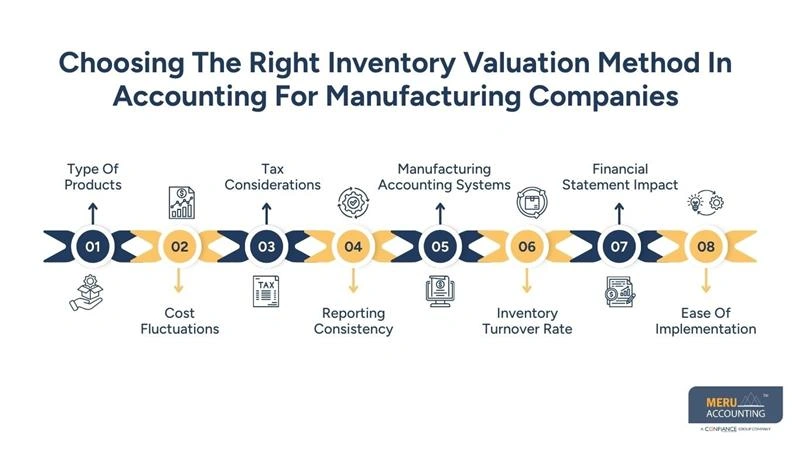
Inventory Turnover Rate
High-turnover products in accounting for manufacturing companies may benefit from methods like FIFO to reflect actual cost flow accurately. Choosing the right approach helps in inventory planning.
Financial Statement Impact
Different methods can affect reported profits and asset values. Selecting a method aligned with business strategy ensures more accurate reporting.
Ease Of Implementation
Some methods are easier to apply and maintain than others. Simpler methods reduce errors and administrative effort in day-to-day accounting.
Comparison Of Inventory Valuation Methods For Manufacturing Companies
Comparing inventory valuation methods helps manufacturers choose the most suitable approach in accounting for manufacturing companies. Each method has its advantages and limitations depending on inventory type, cost trends, and reporting needs.
Inventory Valuation Method | Advantages | Limitations | Best Suited For |
First-In, First-Out (FIFO) | Reflects current inventory costs; shows higher profits during rising prices | Can overstate profits and increase taxes in inflationary periods | General inventory with stable cost items |
Last-In, First-Out (LIFO) | Reduces taxable income during rising prices | Ending inventory may be understated; less accurate reporting | Commodities or industries with fluctuating prices |
Weighted Average Cost | Smooths out price fluctuations; simple to apply | May not reflect actual cost of individual items | Large volumes of similar or uniform stock |
Specific Identification | Highly accurate; tracks cost for each item | Time-consuming; impractical for large inventories | High-value, unique, or customized products |
Standard Cost | Helps in budgeting and cost control; simplifies variance analysis | Needs frequent updates to remain accurate | Mass production or standardized manufacturing |
Impact Of Inventory Valuation On Financial Reporting And Decision-Making
Inventory valuation has a direct effect on the results shown in accounting for manufacturing companies.
Profit Measurement
Different valuation methods can change the reported profit figures for a period. Accurate measurement ensures that financial results reflect true business performance.
Tax Calculations
Inventory valuation affects taxable income and, consequently, the tax liability. Choosing the right method can optimize tax planning while remaining compliant.
Cash Flow Planning
Accurate inventory values help manufacturers manage cash flow more effectively. Proper valuation ensures sufficient liquidity for operations and investments.
Cost Management
Clear inventory valuation highlights areas of waste or inefficiency in production. This allows management to control costs and improve operational efficiency.
Manufacturing Accounting Reports
Reliable inventory valuation strengthens the accuracy of manufacturing accounting statements. It ensures that internal and external stakeholders can make informed decisions based on trustworthy data.
How Meru Accounting Supports Manufacturing Inventory Valuation
Meru Accounting supports accounting for manufacturing companies by providing accurate, structured, and compliant inventory valuation services. Key areas of support include:
Manufacturing Industry Experience
The team has deep knowledge of production accounting requirements. This ensures inventory valuation aligns with industry practices.
Proper Cost Allocation
Material, labor, and overhead costs are assigned correctly to inventory. This allows for accurate calculation of production costs.
Inventory Method Support
Guidance is provided in selecting the most suitable inventory valuation method. This ensures methods match business operations and reporting needs.
Compliance And Accuracy
Records are maintained according to accounting standards and regulations. This helps prevent errors and ensures financial integrity.
Ongoing Manufacturing Accounting Support
Regular reviews and updates help maintain inventory accuracy over time. This keeps financial statements reliable and current.
Enhanced Decision-Making
Accurate inventory valuation helps management make better decisions regarding production, pricing, and investments.
Financial Performance Insights
Detailed inventory tracking provides insights into cost efficiency, profit margins, and areas for improvement.
Key Takeaways
- Inventory valuation is essential as it reflects the true cost of manufacturing inventory.
- Selecting the right valuation method matters because different methods can lead to different financial results.
- Accurate data is crucial in manufacturing accounting to ensure reliable and trustworthy reporting.
- Consistency in using one valuation method improves clarity and comparability in financial statements.
- Expert guidance can enhance inventory valuation accuracy and overall accounting for manufacturing companies.
FAQs
The main methods include FIFO (First-In, First-Out), LIFO (Last-In, First-Out), Weighted Average, Specific Identification, and Standard Cost.
Inventory valuation affects the cost of goods sold, which changes the profit reported in financial statements.
The best method depends on the type of products, cost flow, and reporting requirements of the company.
Accurate inventory valuation helps track production costs, calculate taxes correctly, and determine product pricing.
Inventory should be valued at the end of each accounting period or before preparing financial statements.


