


Understanding your finances in real-time is essential for making informed business decisions. Cloud based bookkeeping has become a dependable solution, enabling businesses to access financial data instantly, streamline accounting processes, and gain valuable insights into their operations.
As more companies embrace remote work and operate across multiple locations, cloud-based tools are increasingly adopted to ensure accuracy, save time, and enhance overall financial management.
What You Will Learn From This Blog
- How cloud-based bookkeeping improves business efficiency
- Key benefits of cloud-based bookkeeping for modern businesses
- How cloud based bookkeeping services transform financial management
- Features to look for when choosing cloud-based bookkeeping services
- Importance of real-time financial insights and their impact on decision-making
- How cloud accounting helps with compliance and tax filing
- Challenges and considerations when adopting cloud-based bookkeeping
- Tips for selecting the right cloud based bookkeeping services for your business
What Is Cloud Based Bookkeeping?
Cloud based bookkeeping is the process of managing a company’s financial records online using secure cloud software instead of traditional desktop systems.
All financial data is stored on remote servers, allowing businesses to access it anytime and from anywhere with an internet connection. This approach eliminates the need for manual record-keeping and ensures that financial information is always up-to-date.
Unlike traditional bookkeeping, which relies on offline software and manual entries, cloud-based bookkeeping offers real-time updates, automatic backups, and multi-user access.
Businesses can view and update records simultaneously across multiple devices, including desktops, laptops, tablets, and smartphones. This accessibility enables teams to collaborate efficiently, even when working remotely or from different locations.
Cloud-based platforms also prioritize security and efficiency. They use encryption, multi-factor authentication, and regular backups to protect sensitive financial data from unauthorized access or loss.
Additionally, routine tasks such as invoice creation, bank reconciliations, and report generation can be automated. This automation not only saves time but also reduces human errors, making bookkeeping more accurate and reliable for modern businesses.
Benefits Of Cloud Based Bookkeeping For Modern Businesses
- Businesses can update financial records in real-time, reducing the need for manual data entry and repetitive tasks.
- Adopting cloud based bookkeeping services eliminates the need for extensive IT infrastructure and reduces paper usage, helping companies save both money and resources.
- Multiple team members can work on the same financial records simultaneously, improving coordination and collaboration across departments.
- Real-time access to financial data enables business owners to make informed decisions quickly.
- Cloud-based bookkeeping platforms update automatically, ensuring businesses always use the latest version with enhanced features and security.
- These systems are scalable and can grow with the business, accommodating new users, additional features, and increased transaction volumes without major changes.
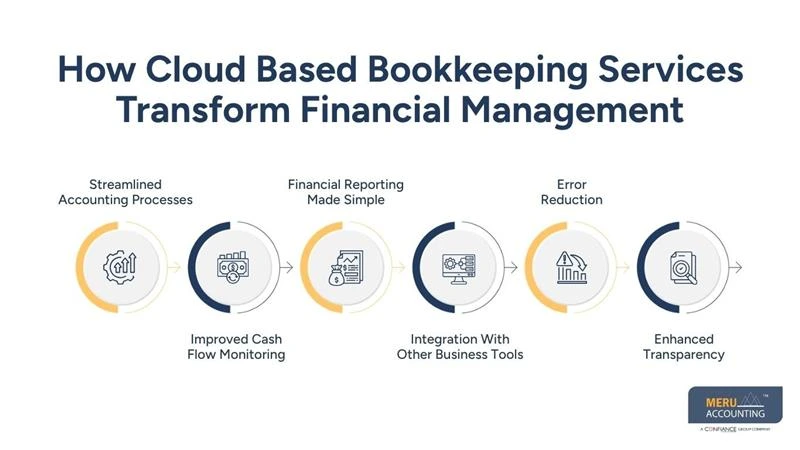
How Cloud Based Bookkeeping Services Transform Financial Management
Streamlined Accounting Processes
Cloud-based bookkeeping services offer automated invoicing, recurring payments, and instant reporting to simplify daily accounting tasks.
Using cloud based bookkeeping reduces manual work, allowing accountants and business owners to focus on analyzing financial data instead of repetitive entries.
Improved Cash Flow Monitoring
Businesses can track income, expenses, and outstanding invoices in real-time, helping them manage cash flow effectively.
Early visibility into finances allows quick action to address any potential cash flow issues before they escalate.
Financial Reporting Made Simple
Cloud based bookkeeping services provide pre-built templates and dashboards for financial statements, making reporting faster and more accurate.
Managers and owners can generate detailed reports instantly to gain actionable insights into the company’s performance.
Integration With Other Business Tools
Cloud-based bookkeeping services often integrate with payroll software, e-commerce platforms, and payment gateways.
This reduces manual data transfers, ensures consistency across systems, and saves time on repetitive tasks.
Error Reduction
Cloud accounting uses automation and real-time synchronization to minimize mistakes that commonly occur with manual bookkeeping.
Accurate data entry improves trust in financial records and helps businesses make reliable decisions.
Enhanced Transparency
All authorized users can access the same up-to-date financial data, improving clarity and accountability.
Shared visibility promotes better collaboration between teams and supports informed decision-making across the organization.
Key Features To Look for in Cloud-Based Bookkeeping Services
User-Friendly Interface
A simple and intuitive interface makes it easy for all team members to use the system. Even those without accounting experience can navigate and manage financial data efficiently.
Automated Reconciliation
Cloud based bookkeeping allows bank transactions to be automatically matched with invoices, saving time. This feature also reduces errors and ensures accurate record-keeping.
Multi-Currency Support
Businesses dealing with international clients can manage multiple currencies easily. It simplifies foreign transactions and helps maintain accurate financial reporting.
Customizable Reports
Reporting options can be tailored to match the specific needs of a business. This allows managers to analyze financial data clearly and make informed decisions.
Secure Data Storage
Financial information is protected using encrypted servers and regular backups. This ensures sensitive data remains safe from loss or unauthorized access.
Access Controls
Role-based permissions allow only authorized personnel to view or edit data. This improves security and ensures accountability within the organization.
Common Challenges of Outsourcing Accounts Receivable on Xero and How to Overcome Them
Data Security Concerns
Ensure your provider has strict security protocols and access control to protect sensitive financial data. Regular audits and encrypted systems can further safeguard your information.
Communication Gaps
Maintain regular updates and clear communication channels with your AR team to avoid misunderstandings. Setting expectations and scheduled check-ins help keep everyone aligned.
Delayed Access to Information
Choose providers who offer real-time access and detailed reports on AR status when you outsource accounts receivable on Xero, leveraging Xero accounting services for complete transparency. This ensures you can quickly act on overdue accounts or discrepancies.
Integration Issues
Ensure your Xero account and other tools integrate smoothly with the outsourced service provider to avoid delays. Proper integration also helps reduce manual data entry and errors.
Dependence on External Team
Establish clear processes and backup plans to maintain control even when AR tasks are outsourced. Having documentation and contingency plans ensures continuity in case of team changes.
Real-Time Financial Insights: Why They Matter
Instant Access to Financial Data
With cloud based accounting services, businesses no longer need to wait for end-of-month reports; financial data is available instantly.
This immediate access helps teams respond quickly to financial changes and stay proactive.
Monitoring Profitability
Real-time insights help business owners see which products or services are performing well. It also highlights areas where expenses can be reduced to improve overall profitability.
Identifying Trends Quickly
Business trends, such as rising costs or declining sales, can be spotted early. Early detection allows companies to take corrective action before issues escalate.
Better Forecasting
Cloud accounting ensures accurate, up-to-date data, supporting better financial forecasting and budgeting. Businesses can plan ahead confidently and allocate resources more effectively.
Faster Decision-Making
Access to current financial information allows leaders to make decisions quickly. This reduces delays and ensures opportunities are seized before competitors.
Transparency for Stakeholders
Investors, lenders, and partners can access accurate financial data instantly. Shared transparency builds trust and strengthens relationships with key stakeholders.
How Cloud Based Bookkeeping Helps With Compliance And Tax Filing
Staying Updated With Tax Rules
Cloud-based bookkeeping services often include tax modules that update automatically with current regulations. This ensures businesses remain compliant without manually tracking changing tax laws.
Simplified Tax Reporting
Automated reporting features reduce manual effort and minimize errors in tax filings. It allows accountants to prepare accurate reports quickly, saving time and resources.
Document Organization
Receipts, invoices, and other tax-related documents can be stored digitally for easy retrieval during audits. Organized digital records make it simple to find and provide documentation when needed.
Tracking Deductible Expenses
Real-time bookkeeping helps businesses identify deductible expenses and manage tax liabilities effectively. This ensures maximum eligible deductions are claimed, reducing overall tax burden.
Filing Accuracy
Automatic calculations and reconciliations minimize the chances of misreported figures on tax returns. It improves confidence in filings and reduces the risk of penalties from errors.
Audit Readiness
With organized records and digital trails, companies are better prepared for audits and inspections. Everything is accessible quickly, making the audit process smoother and less stressful.
Challenges And Considerations When Adopting Cloud Accounting
Internet Dependence
Since data is stored online, a stable internet connection is required to access and update records.
Without reliable connectivity, businesses may face delays in bookkeeping tasks and reporting.
Data Security Concerns
When using cloud based bookkeeping, businesses must ensure the service meets industry-standard security protocols.
Proper security ensures sensitive financial information is protected from unauthorized access or breaches.
Learning Curve
Switching from traditional bookkeeping may require training employees to use cloud-based systems effectively.
Investing time in learning ensures the team can take full advantage of automation and real-time features.
Integration With Existing Systems
Not all cloud-based bookkeeping services integrate seamlessly with legacy software or business tools.
Verifying compatibility beforehand prevents workflow disruptions and data transfer errors.
Subscription Costs
While often cost-effective, monthly or annual subscription fees should be factored into the budget.
Understanding pricing structures ensures businesses select a solution that fits both needs and finances.
Vendor Reliability
Selecting a reliable cloud accounting provider ensures minimal downtime and consistent technical support.
Reliable vendors provide quick assistance in case of issues, keeping bookkeeping operations smooth.
Choosing The Right Cloud Based Bookkeeping Services For Your Business
Assess Your Business Needs
Identify features your business requires, such as payroll, invoicing, or multi-currency support, before selecting a service.
Understanding your needs ensures the chosen platform fits your workflow and growth plans.
Check Security Measures
Ensure the provider offers encryption, backup solutions, and compliance with data protection regulations.
Strong security measures protect sensitive financial information from breaches or loss.
Evaluate Ease of Use
Test the cloud based bookkeeping services interface to ensure it is user-friendly and accessible for your team.
A simple system reduces training time and increases adoption across your organization.
Review Customer Support
Reliable customer support is essential to quickly resolve issues or answer questions.
Prompt support ensures minimal disruption to daily bookkeeping operations.
Compare Costs
Look at subscription pricing, hidden fees, and scalability options to select a cost-effective solution.
Evaluating costs carefully helps avoid unexpected expenses and keeps your budget on track.
Read Reviews And Testimonials
Research feedback from other businesses to gauge the provider’s reliability and service quality.
Learning from others’ experiences helps choose a trustworthy and effective service.
How Meru Accounting Supports Businesses With Cloud Based Bookkeeping Services
- Meru Accounting provides expert advice on setting up and managing cloud-based bookkeeping systems tailored to your business needs.
- We offer customized cloud based bookkeeping services to match your industry, size, and workflow requirements.
- Our team helps businesses migrate smoothly from traditional accounting systems to cloud platforms without losing data.
- Meru Accounting offers continuous support and training to ensure your team uses the software effectively.
- We assist in integrating cloud-based bookkeeping services with other business tools such as payroll, CRM, and inventory management.
- Our services ensure your books are accurate, compliant, and ready for tax filing or audits at any time.
Contact Meru Accounting to simplify your bookkeeping and gain real-time financial insights. Our expert team ensures your cloud-based bookkeeping is accurate, compliant, and tailored to your business needs.
Key Takeaways
- Cloud accounting allows real-time access to financial data
- Businesses save time and reduce errors through automated processes
- Cloud based bookkeeping services improve cash flow monitoring and reporting
- Features like multi-currency support, automated reconciliation, and secure storage are essential
- Real-time insights support better decision-making and accurate forecasting
- Choosing the right service involves assessing needs, security, ease of use, and cost
- Meru Accounting offers expert cloud based accounting services tailored to business requirements
FAQs
Cloud accounting and bookkeeping manage financial records online using secure software. Data is stored in the cloud, allowing access and updates from any device.
Businesses save time, reduce errors, and gain real-time financial insights. Teams can collaborate easily, helping owners make faster and more informed decisions.
Reputable platforms use encryption, regular backups, and secure servers. These measures protect sensitive financial information from unauthorized access or loss.
Financial records can be accessed from desktops, laptops, tablets, or mobile devices. An internet connection allows convenient and flexible access from anywhere.
Financial data is organized, expenses are tracked, and reports are generated automatically. This approach simplifies tax filing and keeps businesses compliant with regulations.


