




Introduction to COGS and Its Importance in Business
In the world of accounting and business management, understanding your financial metrics accurately is essential to running a successful enterprise. Among the various financial metrics, Cost of Goods Sold (COGS) holds a critical position. COGS reflects the direct costs attributable to the production of goods sold by a company. Accurately calculating COGS not only influences your business’s profitability analysis but also impacts tax calculations, pricing strategies, and inventory management.
This comprehensive guide explores what a COGS calculator is, how to calculate the cost of goods sold, and why mastering this calculation is important for any business dealing with physical products.
What Is Cost of Goods Sold (COGS)?
Cost of Goods Sold (COGS) refers to the total direct costs incurred to produce the goods that a business sells during a particular accounting period. Unlike operating expenses or indirect costs, COGS includes only those costs directly tied to the production of the goods.
Components of COGS typically include materials, labor costs directly associated with production, and overhead costs directly related to manufacturing. COGS does not include indirect expenses such as distribution costs and sales force expenses.
Why Is COGS Important?
- Profitability Analysis: Subtracting COGS from Revenue gives you Gross Profit, a key indicator of your business’s financial health.
- Inventory Management: Helps businesses understand how much it costs to maintain inventory.
- Tax Purposes: Accurate COGS reporting can reduce taxable income, impacting the amount businesses owe in taxes.
- Pricing Strategy: Knowing the exact cost helps in setting profitable and competitive prices.
Understanding the Basics of a COGS Calculator
A COGS calculator is a tool — often automated or spreadsheet-based — designed to help businesses compute the cost of goods sold accurately and efficiently. These calculators simplify complex calculations by inputting various cost components and outputting a precise COGS figure.
Features of a COGS Calculator
- Input Flexibility: Allows the user to enter multiple cost inputs such as raw materials, labor, and overhead.
- Inventory Adjustment: Takes into account opening and closing inventory for accurate calculation.
- Cost Breakdown: Provides detailed segmentation of costs to understand each component’s contribution.
- Report Generation: Generates reports for accounting, tax, and management use.
How to Calculate Cost of Goods Sold: Step-by-Step Guide
The calculation of COGS is fundamental but requires careful attention to various cost components and inventory management records. The basic formula for calculating Cost of Goods Sold is:
| Formula | Description |
|---|---|
| COGS = Opening Inventory + Purchases during the Period – Closing Inventory | Starting inventory plus purchases made, minus the ending inventory, gives the total cost of goods sold. |
Step 1: Determine Opening Inventory
The opening inventory is the value of merchandise on hand at the start of the accounting period. It forms the baseline for calculating COGS, so accurate records and inventory valuation are essential.
Step 2: Add Purchases Made During the Period
This includes all direct costs associated with buying or manufacturing goods during the period. Purchases can include raw materials, components, and finished products purchased for resale.
Step 3: Calculate Closing Inventory
The ending or closing inventory is the value of goods still available at the end of the accounting period. This figure can be determined through physical inventory counts or inventory management software.
Step 4: Apply the COGS Formula
Using the opening inventory, purchases, and closing inventory, apply the formula to get the cost of goods sold for the specific period.
Detailed Breakdown of the Components Affecting COGS
An accurate COGS calculation hinges upon understanding all the included components and how they impact final figures. Components influencing COGS include:
Raw Materials
The direct raw materials used to manufacture products constitute a substantial portion of COGS. Tracking costs, discounts, and purchase timing is important in valuation.
Direct Labor
Labor costs directly linked to production (wages, benefits) must be included in COGS. This excludes administrative salaries and other indirect labor expenses.
Manufacturing Overhead
Costs such as factory rent, utilities, and depreciation related to production equipment are allocated as part of manufacturing overhead and included in COGS.
Freight-In and Shipping Costs
Shipping costs associated with bringing raw materials to the production facility are usually considered part of COGS while outbound shipping generally is categorized as an operating expense.
COGS Calculation Methods: FIFO, LIFO, and Weighted Average
Inventory valuation methods directly impact the COGS calculation. The choice of method depends on accounting practice, tax strategy, and business requirements.
First-In, First-Out (FIFO)
FIFO assumes that the oldest inventory items are sold first. This method aligns with the natural flow of many businesses and affects the COGS with older, usually cheaper costs.
Last-In, First-Out (LIFO)
LIFO assumes that the newest inventory is sold first. This approach may reduce tax liability during inflationary periods but is less common internationally due to regulatory limitations.
Weighted Average Cost
This method averages out the cost of all inventory available during the period, smoothing out fluctuations in purchase prices.
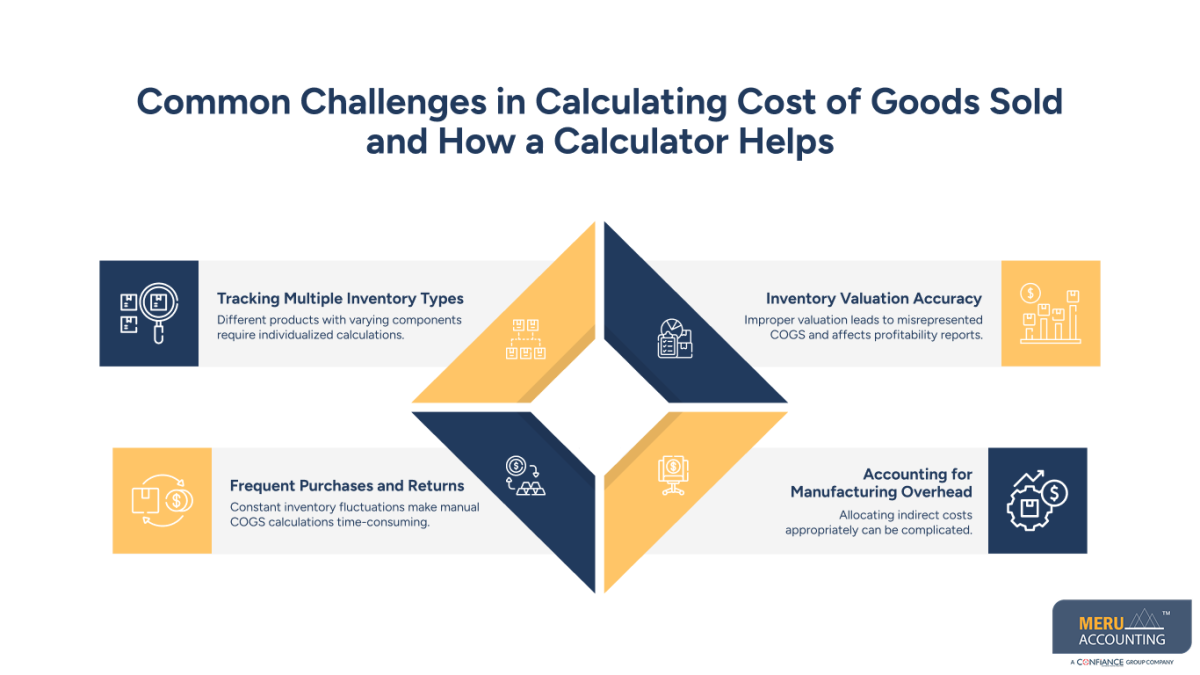
Common Challenges in Calculating Cost of Goods Sold and How a Calculator Helps
Calculating COGS manually can be a daunting and error-prone task, especially for businesses handling large volumes of products and complex inventory systems. Common challenges include:
- Tracking Multiple Inventory Types: Different products with varying components require individualized calculations.
- Inventory Valuation Accuracy: Improper valuation leads to misrepresented COGS and affects profitability reports.
- Frequent Purchases and Returns: Constant inventory fluctuations make manual COGS calculations time-consuming.
- Accounting for Manufacturing Overhead: Allocating indirect costs appropriately can be complicated.
A reliable COGS calculator automates these tasks by integrating data inputs, performing consistent calculations, and minimizing human error.
How to Choose the Right COGS Calculator for Your Business
Choosing an appropriate COGS calculator depends on your business size, industry complexity, and accounting system integration requirements.
Considerations for Selecting a COGS Calculator
- Scalability: Can the calculator handle your current and projected production volume?
- Integration: Does it integrate with your inventory, accounting, and ERP systems?
- Flexibility: Can it accommodate different inventory valuation methods?
- User-Friendliness: Is the interface intuitive and easy for your staff to use?
- Reporting Capabilities: Does it generate detailed reports for management and auditors?
- Cost: What are the pricing plans and value offered by the calculator?
Popular Types of COGS Calculators
- Spreadsheet-Based Calculators: Excel or Google Sheets templates customized for COGS calculation.
- Standalone Software: Dedicated accounting software that includes COGS calculators as a feature.
- Cloud-Based Solutions: Web applications offering real-time COGS calculations and integrations.
- Custom ERP Modules: Enterprise systems with integrated COGS analytics and inventory control.
Conclusion
Understanding and calculating Cost of Goods Sold accurately is fundamental to a business’s financial health, pricing strategy, and tax compliance. A COGS calculator simplifies this process by enabling precise and efficient computations based on detailed cost inputs and inventory data.
By mastering the calculation techniques and utilizing these tools, businesses can gain critical insights into production costs, optimize inventory management, and ultimately maximize profitability. Whether you use basic spreadsheet calculators or advanced ERP modules, the key lies in accurate data input and regular reconciliation to ensure the calculated COGS reflects your true production costs.
FAQs
What is a COGS calculator?
A COGS calculator is a tool used to determine the Cost of Goods Sold, which represents the direct costs attributable to the production of the goods sold by a company.
How do I calculate Cost of Goods Sold using a calculator?
To calculate Cost of Goods Sold, input the beginning inventory, add purchases made during the period, and subtract the ending inventory. The formula is: COGS = Beginning Inventory + Purchases – Ending Inventory.
Why is it important to calculate Cost of Goods Sold?
Calculating Cost of Goods Sold is essential for assessing a company’s profitability, pricing products accurately, and preparing financial statements.
Can a COGS calculator help small businesses?
Yes, a COGS calculator simplifies the process of tracking and calculating production costs, which helps small businesses manage expenses and improve financial planning.
What information do I need to use a COGS calculator effectively?
To use a COGS calculator, you need data on beginning inventory, purchases or production costs during the period, and ending inventory.


