




Taxes can feel overwhelming—especially when you sit down with your documents and think, “How do you calculate your tax return correctly?” Whether you are an individual taxpayer, freelancer, or business owner, understanding the process helps you stay compliant, avoid costly mistakes, and make confident financial decisions.
When you approach tax season with clarity and preparation, you reduce stress and improve financial accuracy. This complete step-by-step guide walks you through how to calculate your tax return in 2026 using a structured and practical approach.
What You Will Learn From This Blog
- How law accounting services help law firms manage their finances daily.
- Top law office accounting solutions are available to improve bookkeeping and reporting.
- Ways outsourcing law accounting services can save time and enhance accuracy.
- Key features to look for when choosing law office accounting solutions.
- Strategies to integrate accounting solutions with legal practice management software.
By the end of this guide, you’ll have a clear understanding of how to streamline financial processes in your law firm using expert accounting solutions.
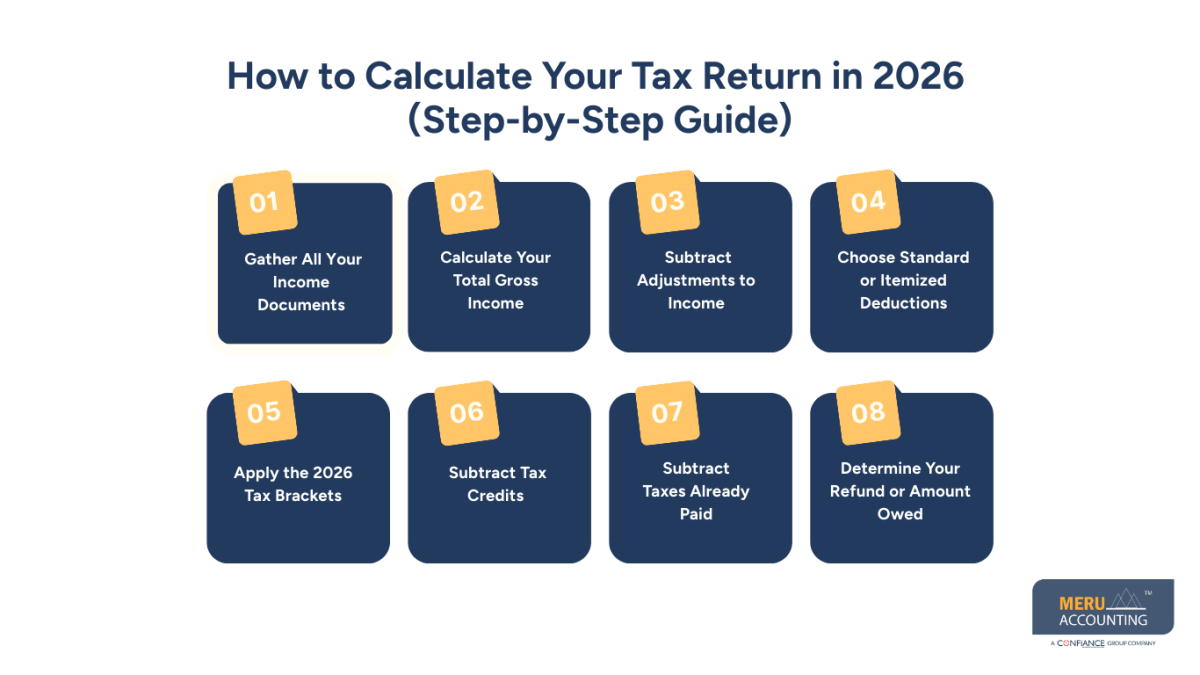
Step 1: Gather All Your Income Documents
The first step to calculate your tax return is identifying your total income. Without accurate records, every calculation that follows may be incorrect.
Depending on your situation, your income documents may include:
- Salary or wages (W-2 forms in the U.S.)
- Freelance or contractor income (1099 forms)
- Business income
- Rental income
- Interest and dividends
- Capital gains
- Other miscellaneous income
Before beginning calculations, ensure you collect every relevant document. Missing even one income source can lead to errors or notices from tax authorities later.
Practical tip: Maintain digital copies of your documents organized by year and income type. A simple folder system makes the process smoother and far less stressful.
Step 2: Calculate Your Total Gross Income
Once you gather your documents, add up all sources of income.
Example:
- Salary: $70,000
- Freelance income: $10,000
- Interest income: $1,000
Total Gross Income = $81,000
This number becomes your starting point when you calculate your tax return. Accuracy at this stage is critical because deductions and credits are based on this figure.
Step 3: Subtract Adjustments to Income
 Before applying deductions, you may reduce your gross income through eligible adjustments, such as:
- Retirement contributions
- Student loan interest
- Health Savings Account (HSA) contributions
- Self-employment tax deduction
After subtracting these, you arrive at your Adjusted Gross Income (AGI).
Your AGI is important because many deductions and credits depend on it. Calculating this correctly ensures you do not miss valuable tax benefits.
Step 4: Choose Standard or Itemized Deductions
To continue the process and calculate your tax return accurately, you must reduce your taxable income through deductions.
You generally have two options:
1. Standard Deduction
A fixed amount set by tax authorities.
2. Itemized Deductions
If your eligible expenses exceed the standard deduction, you may itemize, including:
- Mortgage interest
- Medical expenses
- Charitable donations
- State and local taxes
Choose the option that provides the greater financial benefit.
Taxable Income = AGI – Deductions
This step determines how much of your income will actually be taxed.
Step 5: Apply the 2026 Tax Brackets
Once your taxable income is determined, apply the appropriate 2026 tax brackets.
The tax system is progressive, meaning:
- The first portion of your income is taxed at a lower rate
- Additional portions are taxed at higher rates
A common mistake when trying to calculate your tax return independently is applying one flat rate to all income. Each bracket must be applied correctly to the income within that specific range.
This calculation determines your total tax liability.
- The first portion of your income is taxed at a lower rate
Step 6: Subtract Tax Credits
Tax credits reduce the amount of tax you owe directly, dollar for dollar.
Common credits include:
- Child Tax Credit
- Earned Income Tax Credit
- Education credits
- Energy efficiency credits
For example:
If your tax liability is $8,000 and you qualify for $2,000 in credits:
New Tax Liability = $6,000
This stage is crucial because credits can significantly lower your final tax bill.
Step 7: Subtract Taxes Already Paid
Next, subtract:
- Federal tax withheld from your salary
- Estimated quarterly payments
- Advance payments (if applicable)
Example:
- Total tax liability: $6,000
- Taxes already paid: $7,500
- Refund: $1,500
If you paid only $5,000, you would owe $1,000 instead.
Step 8: Determine Your Refund or Amount Owed
This final calculation answers the key question: Will you receive a refund or owe additional tax?
Refund (or Balance Due) = Taxes Paid – Total Tax Liability
This completes the structured process to calculate your tax return.
Special Situations in 2026
If You Are Self-Employed
If you are self-employed, you must:
- Calculate net profit (Income – Business Expenses)
- Pay self-employment tax
- Consider quarterly estimated payments
Proper expense tracking can significantly reduce your taxable income.
If You Own a Small Business
You may qualify for:
- Qualified Business Income (QBI) deduction
- Depreciation deductions
- Business mileage deductions
Professional guidance ensures you maximize legal savings while remaining compliant.
Common Mistakes When Calculating Your Tax Return
Even simple tax returns can contain errors. Common issues include:
- Missing income documents
- Incorrect filing status
- Overlooking deductions
- Applying the wrong tax bracket
- Failing to reconcile payments
Small errors can create penalties, delays, or additional payments.
Why Accuracy Matters in 2026
Tax authorities increasingly rely on digital tracking and automated systems. Errors may result in:
- Notices and penalties
- Interest charges
- Refund delays
- Increased audit risk
Understanding how to calculate your tax return properly reduces these risks. However, a professional review adds another layer of accuracy and protection.
Should You Calculate Your Tax Return Yourself?
You may manage it independently if your income is straightforward and deductions are limited.
Professional preparation is advisable if you have:
- Multiple income streams
- Business ownership
- Rental properties
- Investment income
- International income
- Major financial changes
In many cases, expert guidance results in greater savings and reduced risk.
Simple Example: Tax Calculation Overview
Suppose you have:
- Salary: $75,000
- Retirement contribution: $5,000
- Standard deduction applied
Step 1: Gross Income = $75,000
Step 2: Adjusted Gross Income = $70,000
Step 3: Subtract standard deduction
Step 4: Apply tax brackets
Step 5: Subtract credits
Step 6: Compare with taxes withheld
Following a structured method ensures transparency and accuracy in your calculations.
Benefits of Professional Tax Support
Learning how to calculate your tax return gives you financial awareness. However, professional support provides additional advantages:
- Time savings
- Prevention of costly errors
- Audit readiness
- Long-term tax planning
- Improved cash flow forecasting
- Strategic financial guidance
Taxes are not just about filing forms—they are about protecting your financial future.
Conclusion
Understanding how to calculate your tax return in 2026 empowers you to manage your financial responsibilities with clarity and confidence. By organizing your income records, applying deductions accurately, calculating taxable income correctly, using eligible credits, and reconciling taxes paid, you can determine whether you will receive a refund or owe additional tax.
However, tax calculation goes beyond simple arithmetic. It requires precision, regulatory awareness, and thoughtful financial planning. Even small errors can result in penalties, delayed refunds, or missed savings opportunities.
With structured preparation and professional oversight when needed, you can approach tax season confidently, knowing your return is accurate, compliant, and aligned with your financial goals.
FAQs
Income forms (W-2, 1099), business or investment records, and proof of deductions and credits.
Adjusted Gross Income is your total income minus eligible adjustments like retirement contributions or student loan interest.
Choose the option that lowers your taxable income the most.
Tax rates are progressive and set by the Internal Revenue Service—different portions of income are taxed at different rates.
If taxes paid are higher than your total tax liability, you receive a refund. If lower, you owe the difference.


