
Managing financial liabilities is one of the most critical responsibilities for any business dealing with long-term debt obligations. Among these, mortgage payable plays a key role in shaping balance sheets, cash flow planning, and financial decision-making. However, as organizations grow, maintaining accuracy in mortgage-related liabilities becomes increasingly complex.
Many businesses today are turning to an accounts payable service provider or outsourced bookkeeping teams to ensure precision, compliance, and real-time financial visibility. These professionals bring structured processes, automation tools, and domain expertise that significantly improve how long-term mortgage obligations are recorded and reported. In this blog, we will explore how outsourced bookkeeping teams help businesses maintain accuracy, reduce reporting errors, and strengthen liability management.
What You Will Learn From This Blog
By the end of this article, you will understand:
- What mortgage payable means in business accounting
- Why managing mortgage payable internally can be challenging
- How outsourced bookkeeping teams improve accuracy in mortgage payable tracking
- The role of an accounts payable service provider in liability reporting
- Best practices for reconciliation and reporting of mortgage payable
- How Meru Accounting supports businesses with reliable mortgage payable management
What Is Mortgage Payable and How It Impacts Business Liabilities
Mortgage payable refers to the long-term financial obligation a business owes when it secures funds through a mortgage. This liability is typically tied to real estate or fixed assets and is repaid over an extended period with interest.
From an accounting perspective, this liability is recorded on the balance sheet and affects multiple financial areas such as:
- Long-term liability reporting
- Cash flow forecasting
- Interest expense calculations
- Asset valuation accuracy
- Debt-to-equity ratio analysis
Proper tracking of mortgage obligations ensures financial transparency. Even a small error in recording can distort financial statements and lead to incorrect decision-making.
This is why many organizations rely on an accounts payable service provider to handle structured recording and reporting of such long-term liabilities.
Common Challenges in Managing Mortgage Payable Internally
Handling mortgage payable internally may seem manageable for small businesses, but as operations grow, several challenges arise:
Manual Errors in Recording
When mortgage liability entries are handled manually, there is a high risk of data entry mistakes, especially in interest calculations and amortization schedules. These small errors can accumulate over time and significantly distort overall financial statements.
Lack of Real-Time Updates
Without automation, updates to outstanding mortgage balances may be delayed, leading to outdated financial reports. This delay often impacts management decisions that rely on accurate liability figures.
Complex Interest Calculations
Businesses often struggle with accurately calculating interest on mortgage liability, especially when variable rates are involved. Even minor miscalculations can affect long-term financial forecasting and profitability analysis.
Poor Reconciliation Practices
Improper reconciliation between bank statements and mortgage liability records can create discrepancies in financial reporting. These inconsistencies may also trigger issues during audits or internal reviews.
Limited Expertise
Internal teams may lack deep accounting expertise, which affects the accuracy of mortgage liability reporting and compliance. This often results in inefficient handling of complex financial structures and repayment schedules.
Compliance Risks
Incorrect reporting of mortgage liability can lead to compliance issues during audits or financial reviews. In some cases, it may even result in penalties or reputational risks for the business.
These challenges highlight why many businesses prefer working with an experienced accounts payable service provider to manage loan obligation efficiently.
Key Benefits of Outsourcing Mortgage Payable Management
Outsourcing bookkeeping functions has become a strategic move for businesses aiming to improve financial accuracy. Here’s how outsourcing helps with long-term liability management:
Improved Accuracy in Financial Records
Outsourced teams ensure every mortgage-related entry is recorded correctly, reducing errors in financial statements. This also helps maintain consistency across monthly and yearly reporting cycles, especially when multiple loan components are involved.
Timely Reporting
A professional accounts payable service provider ensures liability reports are updated regularly, helping businesses make informed decisions. This real-time visibility supports better cash flow planning and financial forecasting.
Better Compliance and Audit Readiness
Accurate tracking of long-term loan obligations ensures smoother audits and compliance with accounting standards. It also reduces last-minute stress during financial inspections and regulatory checks.
Cost Efficiency
Instead of maintaining a full in-house accounting team, outsourcing reduces operational costs significantly. Businesses can allocate these saved resources toward growth and core operations.
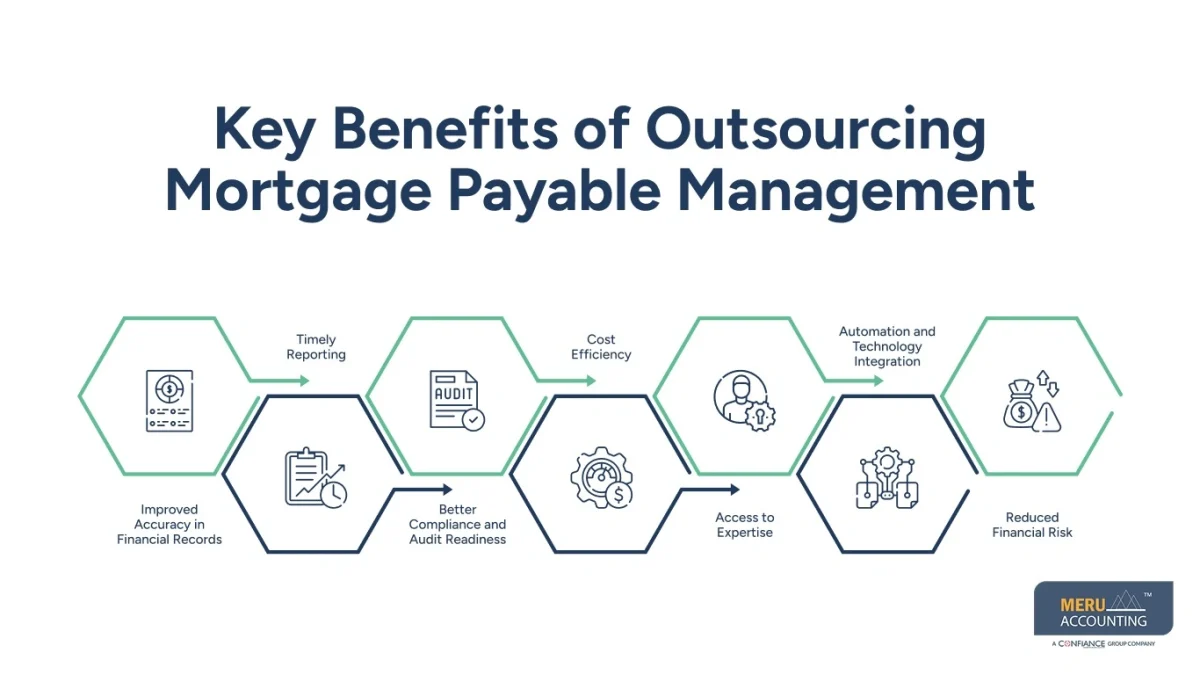
Access to Expertise
Outsourced professionals bring specialized knowledge in handling loan amortization, repayment schedules, and liability reporting. Their experience also helps in identifying and correcting potential accounting issues early.
Automation and Technology Integration
Modern accounts payable service provider firms use advanced tools to track and reconcile liabilities automatically. These systems reduce manual workload and improve processing speed and accuracy.
Reduced Financial Risk
Accurate tracking of financial obligations minimizes the risk of misstatements and reporting errors. This ultimately strengthens investor confidence and supports long-term financial stability.
Mortgage Payable Reconciliation and Reporting Best Practices
To maintain accuracy in long-term liability accounting, businesses should adopt structured reconciliation and reporting practices.
Regular Reconciliation
Ensure balances are reconciled monthly with lender statements to avoid discrepancies. This also helps identify any unnoticed errors or missing entries early in the process.
Maintain Amortization Schedules
A clear amortization schedule helps track principal and interest portions accurately. It also provides better visibility into long-term repayment obligations and interest impact.
Use Accounting Software
Modern tools help automate tracking, reducing manual errors. These systems also generate real-time reports that improve decision-making efficiency.
Segregate Financial Responsibilities
Assign different roles for recording and reviewing financial entries to improve accuracy. This separation of duties also reduces the risk of fraud or internal misreporting.
Monitor Interest Rate Changes
Any changes in interest rates must be immediately reflected in financial calculations. Timely updates ensure reports remain accurate and aligned with lender terms.
Work With an Accounts Payable Service Provider
An experienced accounts payable service provider ensures structured handling of long-term liabilities, reducing errors in reporting and reconciliation. Their expertise also helps maintain compliance with accounting standards and audit requirements.
Maintain Documentation
Keep proper documentation for all financial transactions for audit and compliance purposes. Well-organized records also make financial reviews faster and more efficient.
These practices help businesses maintain accurate liability reporting and ensure financial transparency.
Meru Accounting’s Mortgage Payable Management Services
At Meru Accounting, we understand how critical accurate financial reporting is for business growth. Our specialized services are designed to simplify and strengthen long-term liability management.
As a trusted accounts payable service provider, we offer end-to-end support for tracking, reconciliation, and reporting of mortgage-related obligations. Our team ensures every entry is recorded with precision and aligned with compliance standards.
Our Services Include:
- Complete tracking and management of mortgage-related liabilities
- Monthly reconciliation of accounts
- Automated reporting systems for real-time insights
- Interest calculation and amortization tracking
- Audit-ready documentation and compliance support
- Dedicated bookkeeping support from experienced professionals
By partnering with Meru Accounting, businesses gain full visibility and control over their financial obligations, ensuring accuracy and reduced risk.
We act as a reliable accounts payable service provider, helping businesses streamline their financial operations and focus on growth while we handle the complexity of liability management.
Our Expert Perspective
Based on our experience, long-term loan obligations are often more complex than many businesses initially expect. Even small errors in tracking, interest allocation, or reconciliation can gradually affect overall financial accuracy and reporting quality. Without a structured approach, records can quickly become inconsistent as financial structures grow more complex.
In most cases, businesses handling this internally face challenges in maintaining accuracy and timely updates. Working with an experienced accounts payable service provider helps bring consistency, stronger controls, and improved reporting discipline. When managed through a reliable system, businesses gain clearer liability visibility and more confident decision-making for long-term stability.
Key Takeaways
- Long-term mortgage payables are critical liabilities that require accurate and consistent tracking for reliable financial reporting.
- Managing these liabilities internally can increase the chances of errors, delays, and reporting inefficiencies as complexity grows.
- Outsourcing to an accounts payable service provider helps improve accuracy, strengthen compliance, and ensure better financial control.
- Structured reconciliation processes are essential to maintain correct and up-to-date liability records.
- Automation combined with expert oversight significantly enhances reporting accuracy and reduces manual workload.
FAQs
Mortgage payable refers to the long-term liability a business owes on borrowed funds secured by property or assets.
Accurate tracking of mortgage payable helps businesses maintain financial transparency and proper liability reporting.
An accounts payable service provider ensures accurate recording, reconciliation, and reporting of long-term mortgage obligations, improving overall financial accuracy.
Errors in mortgage payable can lead to financial misstatements, compliance issues, and poor decision-making, especially in long-term financial planning.
Meru Accounting provides end-to-end mortgage payable services including tracking, reconciliation, reporting, and compliance support as a trusted accounts payable service provider, ensuring accurate and reliable financial records.