



When managing your business finances, deciding between a tax preparer vs accountant can significantly impact your financial health. Understanding their differences ensures you get the right professional for your business needs.
Choosing wisely helps you save money, remain compliant, and make informed financial decisions. Choosing the right professional goes beyond just filing taxes.
While both tax preparers and accountants handle financial matters, their expertise, approach, and level of involvement in your business can vary greatly.
Knowing what each offers allows you to match your business needs with the right skills, ensuring smooth operations, accurate compliance, and long-term financial stability.
What You Will Learn From This Blog
- The distinct roles and responsibilities in the tax preparer vs accountant debate, helping you decide which professional suits your business needs.
- Key differences in skills, services, and expertise between tax preparers and accountants.
- Scenarios to consider in the tax preparer vs accountant discussion, highlighting when to hire each or outsource tax accounting.
- Cost considerations to guide your decision between the two.
- Factors to evaluate before selecting a professional for your business.
- Real-world examples showing how businesses benefit from hiring the right financial expert.
Who Is A Tax Preparer? Roles, Responsibilities, And Expertise
Definition Of A Tax Preparer
A tax preparer is a professional who specializes in preparing and filing tax returns for individuals and businesses. They ensure compliance with tax laws and help maximize deductions and credits.
Core Responsibilities
Tax preparers primarily focus on tax-related tasks such as reviewing financial statements, completing tax forms, and filing returns on time. Their work ensures you meet government tax obligations.
Expertise Required
Tax preparers need knowledge of local and federal tax regulations, tax credits, deductions, and filing deadlines. Many are certified professionals, such as CPAs or enrolled agents.
Scope Of Work
Tax preparers handle basic bookkeeping, tax calculations, and audits support. They may not provide broader financial planning or strategic advice beyond taxes.
Ideal For Businesses
Tax preparers are suitable for small to medium-sized businesses that need accurate tax filing and want to stay compliant. Making them a good choice when deciding between a tax preparer vs accountant or when considering to outsource tax accounting.
Who Is An Accountant? Key Functions And Business Impact
Definition Of An Accountant
An accountant manages, analyzes, and reports financial information for a business. Unlike tax preparers, their role extends beyond taxes to include overall financial strategy.
Core Responsibilities
Accountants handle bookkeeping, payroll, budgeting, financial reporting, and tax planning. They provide insights to improve profitability and guide business decisions.
Expertise Required
Accountants are trained in financial management, auditing, taxation, and regulatory compliance. Many hold professional qualifications such as CPA or CA.
Scope Of Work
Accountants offer a holistic view of a company’s financial health, which is a key differentiator in the tax preparer vs accountant debate. This comprehensive perspective helps businesses make informed financial decisions.
Ideal For Businesses
Accountants are ideal for medium to large businesses with complex financial needs. Helping business owners make informed decisions in the tax preparer vs accountant scenario or when choosing to outsource tax accounting.
Tax Preparer vs Accountant: Comparison Of Skills And Services
Category | Tax Preparer | Accountant |
Education and Certification | Often have specialized tax training. | Typically have a broader finance and accounting education with certifications like CPA. |
Focus Areas | Focus on compliance and filing. | Focus on financial management, reporting, and strategy. |
Client Interaction | Usually work seasonally around tax deadlines. | Provide ongoing support throughout the year. |
Technology and Tools | Use accounting software for tax-related tasks. | May employ more advanced systems for financial planning and analysis. |
Problem-Solving and Advice | Focus on solving tax-related issues. | Provide financial advice and future planning. |
Outsourcing Options | Businesses can outsource tax accounting to experts when navigating the tax preparer vs accountant decision, ensuring they get the right mix of services and compliance support. | Businesses can outsource tax accounting depending on complexity and ongoing financial needs. |
When To Hire A Tax Preparer For Your Business Needs
Simple Tax Filing
If your business has straightforward income and expenses, a tax preparer is sufficient for accurate filing, making the tax preparer vs accountant decision simpler. This ensures compliance without adding unnecessary complexity to your financial management.
Seasonal Support
Tax preparers are ideal for handling tasks during tax season or for businesses that need temporary assistance, especially for small businesses evaluating the tax preparer vs accountant option or considering to outsource tax accounting for seasonal workload.
Maximizing Deductions
Tax preparers help identify deductions, credits, and benefits to minimize tax liabilities. They ensure you don’t miss opportunities to save on taxes.
Compliance Assurance
Hiring a tax preparer ensures all filings meet government regulations, reducing the risk of penalties. They keep you up to date with any changes in tax laws.
Cost-Effective Solution
Tax preparers often charge less than accountants, making them ideal for small businesses or startups. This provides professional help without straining your budget.
When To Hire An Accountant For Strategic Financial Management
Comprehensive Financial Oversight
Accountants monitor all financial activities, not just taxes, giving a full picture of your business’s health. This helps identify issues early and make informed decisions.
Financial Planning And Forecasting
They assist with budgeting, cash flow management, and long-term financial planning. This ensures your business stays on track to meet future goals.
Business Expansion Guidance
Accountants provide advice for scaling operations, securing loans, or attracting investors. Their insights can help avoid costly mistakes during growth.
Audit Support
They help prepare and manage audits, ensuring accuracy and regulatory compliance. This is a key benefit when comparing tax preparer vs accountant or considering to outsource tax accounting.
Tax Planning And Strategy
Accountants can also handle tax planning to reduce liabilities and integrate it with broader financial goals. This ensures your tax strategy aligns with overall business objectives.
Cost Considerations: Tax Preparer vs Accountant
Category | Tax Preparer | Accountant |
Hourly Rates | Typically charge lower hourly rates due to the narrower scope of work. | Usually charge higher rates because they provide broader financial services. |
Project-Based Fees | More cost-effective for one-time tax filings. | May require ongoing fees for continuous financial support and planning. |
Long-Term Investment | Suitable for short-term or seasonal needs. | Higher upfront cost but provides continuous support that can lead to long-term financial savings. |
Outsourcing Options | Can outsource tax accounting for specific tasks to save time and effort. | Can outsource tax accounting as part of a broader financial management strategy. |
Hidden Costs | Minimal additional costs for basic tax services. | Additional services like bookkeeping, payroll, or audit support may increase overall costs. |
Key Considerations When Choosing Between a Tax Preparer and an Accountant
Business Size
Small businesses may only need a tax preparer, while larger businesses benefit from an accountant’s comprehensive services. This is a key factor when evaluating tax preparer vs accountant options.
Larger organizations often have more complex reporting needs that require continuous oversight.
Financial Complexity
Complex financial structures, multiple revenue streams, or international transactions often require an accountant.
An accountant can help organize and simplify complicated finances for better decision-making.
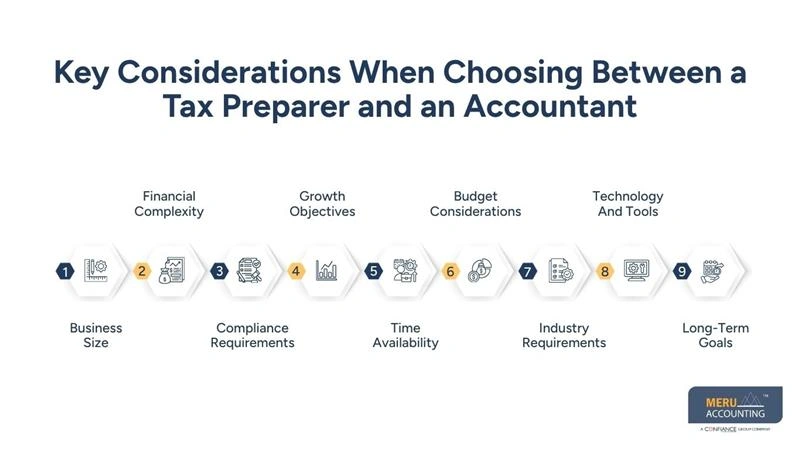
Compliance Requirements
If strict tax compliance is your priority, a tax preparer can handle the core tasks effectively. They ensure deadlines are met and minimize the risk of penalties or audits.
Growth Objectives
Businesses planning expansion, investment, or loans should consider an accountant for strategic guidance. Accountants can create financial models and forecasts to support growth initiatives.
Time Availability
Evaluate how much time you can spend managing finances; accountants can handle more tasks, freeing up your time. Delegating financial management allows you to focus on running and growing your business.
Budget Considerations
Determine how much you are willing to spend on professional services.
While tax preparers are generally more affordable, accountants provide value through broader services that may justify higher costs.
Industry Requirements
Some industries, like manufacturing or international trade, have unique accounting and tax needs. Choosing the right professional ensures your business meets all regulatory and reporting obligations.
Technology And Tools
Consider whether your business needs professionals who can work with advanced accounting software, a factor often weighed in the tax preparer vs accountant decision, and when outsourcing tax accounting for efficiency.
Accountants often utilize tools for forecasting, analysis, and detailed reporting, while tax preparers focus on filing and compliance.
Long-Term Goals
Think about where you want your business to be in the next 3–5 years. An accountant can align financial strategies with long-term objectives, while a tax preparer ensures current compliance.
Case Studies: Real-World Examples Of Tax Preparer vs Accountant Decisions
Small Retail Store: Choosing a Tax Preparer
A local retail store hired a tax preparer to manage seasonal tax filing and optimize deductions. This approach helped the store save time, reduce errors, and stay fully compliant without paying for ongoing accounting services.
The tax preparer also provided guidance on eligible expenses, ensuring the store claimed all possible deductions, highlighting the benefits of choosing the right professional in the tax preparer vs accountant debate or when you outsource tax accounting.
Startup Tech Company: Partnering With an Accountant
A growing startup outsourced tax accounting and hired an accountant for year-round financial planning, a smart approach when weighing the tax preparer vs accountant options. The accountant ensured accurate reporting, efficient budgeting, and strategic financial guidance to support the company’s expansion plans.
In addition, the accountant helped the startup set up financial systems and dashboards for tracking performance in real time. This allowed the founders to make informed decisions and plan for future investments without worrying about compliance issues.
Why Choose Meru Accounting For Tax Preparer vs Accountant Services
- Meru Accounting has a skilled team providing both tax preparation and accounting services to businesses of all sizes.
- Our services are customized based on your business needs, industry, and financial complexity.
- Meru Accounting follows structured workflows to ensure accurate tax filings, reporting, and financial analysis.
- We offer outsource tax accounting services that help you manage costs efficiently while staying compliant and receiving strategic support.
- We have experience serving clients across countries, which allows us to navigate diverse tax regulations and accounting standards effectively.
Key Takeaways
- Tax preparers specialize in tax filing, compliance, and deductions.
- Accountants offer broader financial services including bookkeeping, auditing, planning, and strategic advice.
- Businesses with simple finances often benefit from hiring a tax preparer.
- Companies seeking long-term planning and complex financial oversight should hire an accountant.
- Cost, business size, complexity, and growth plans are crucial factors in making the right choice between a tax preparer vs accountant or deciding whether to outsource tax accounting for efficiency.
- Outsourcing tax accounting can provide expert support while reducing operational costs.
- Meru Accounting offers both tax preparation and accounting services to meet varying business needs.
FAQs
A tax preparer handles tax filing, while an accountant manages taxes plus overall business finances.
Hire a tax preparer if your business finances are simple and you mainly need tax compliance.
Outsourcing tax accounting provides expert tax filing, saves time, and reduces errors.
Yes, an accountant can file taxes and also provide financial advice for business growth.
A tax preparer is cheaper for simple filings, but an accountant adds value for complex finances.


