

Meru Accounting

How to Hire Financial Analyst: Top Tips for Identifying the Right Candidate Across Industries

Contents
Want to learn more?
Subscribe for business tips, tax updates, financial fundamental and more


    How to Hire Financial Analyst: Top Tips for Identifying the Right Candidate Across Industries

    Hiring the right financial professional can quietly shape the future of your business. Numbers do not just sit in reports. They tell stories, signal risks, and open doors to growth. That is why understanding how to hire financial analyst is not just a hiring task, it is a strategic decision.

    Many businesses rush the process. They scan resumes, conduct quick interviews, and make decisions based on surface level impressions. But a financial analyst plays a deeper role. They interpret data, guide decisions, and often influence long term planning.

    If you are unsure about how to hire financial analyst, you are not alone. Whether you are a growing company, an established enterprise, or even searching for a financial analyst for startups, the process requires clarity, patience, and the right approach.

    This guide will walk you through everything you need to know in a simple and practical way.

    What You Will Learn From This Blog

    In this blog, you will understand:

    • The real role of a financial analyst in modern businesses
    • A clear and structured approach on how to hire financial analyst
    • The essential skills that separate average candidates from great ones
    • How hiring needs change across industries
    • Why choosing the right financial analyst for startups is different from hiring for large companies
    • How expert financial services can simplify your hiring and analysis needs

    By the end, you will feel more confident about how to hire financial analysts without second guessing your decisions.

    What Does a Financial Analyst Do?

    Before you learn about hiring a financial analyst, it helps to understand what they actually do.

    A financial analyst studies financial data and converts it into useful insights. They look at trends, prepare reports, and support decision making. But their role is not limited to spreadsheets.

    Here is what they typically handle:

    1. Data Analysis

    They examine financial statements, identify patterns, and highlight risks or opportunities. This helps businesses make informed decisions.

    2. Forecasting and Budgeting

    They predict future financial performance based on current data. This is especially important when working with a financial analyst, where projections guide growth.

    3. Financial Reporting

    They prepare detailed reports that explain the financial health of a company in a simple way.

    4. Strategic Support

    They assist management in planning investments, cost control, and expansion strategies.

    5. Industry Insights

    A skilled analyst understands market trends and competitors, which becomes crucial when deciding about hiring financial analyst for specific industries.

    A good analyst does not just work with numbers. They translate numbers into meaning.

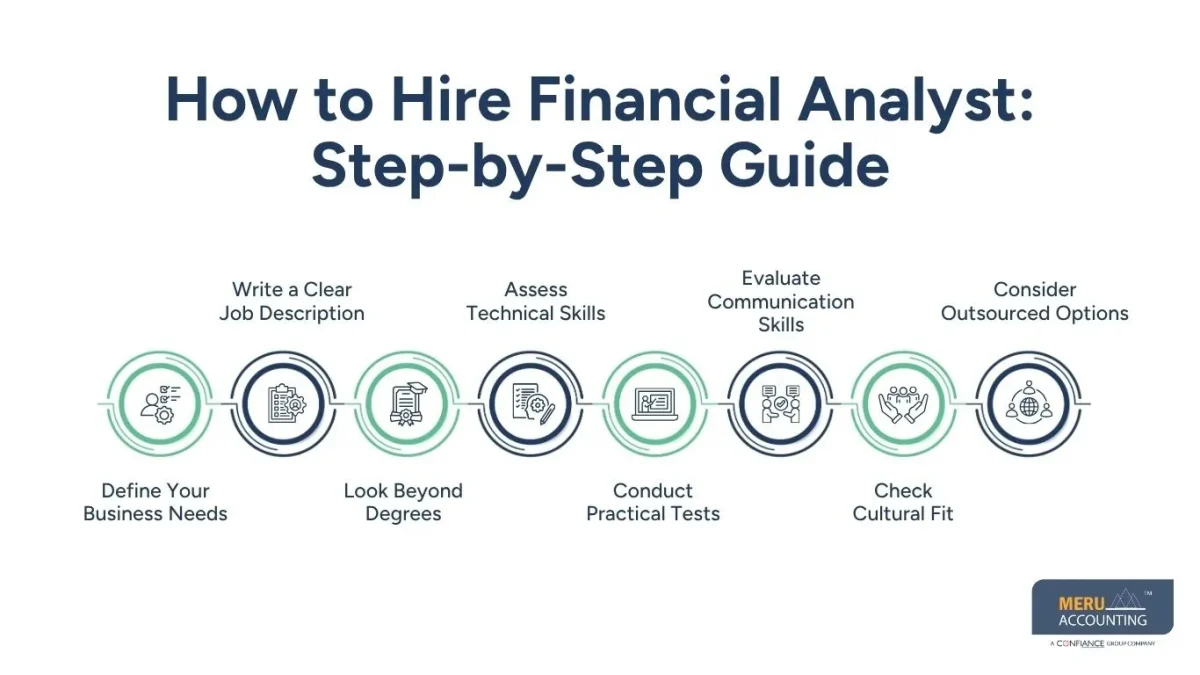
    How to Hire Financial Analyst: Step-by-Step Guide

    If you are wondering how to hire financial analyst, following a structured approach can make the process much smoother.

    Step 1: Define Your Business Needs

    Start by asking what you really need.

    Do you need help with forecasting, reporting, or investment analysis?
    Are you looking for a full time role or project based support?

    For example, hiring a financial analyst for startups often means focusing on cash flow management and growth projections. This is different from hiring for a large corporation.

    Clarity at this stage helps avoid confusion later.

    Step 2: Write a Clear Job Description

    A vague job description leads to mismatched candidates.

    When planning about hiring financial analyst, include:

    • Key responsibilities
    • Required tools and software knowledge
    • Industry experience
    • Expected outcomes

    If you are hiring a financial analyst for startups, mention adaptability and multi tasking as important traits.

    Step 3: Look Beyond Degrees

    Education matters, but it should not be the only factor.

    Many businesses make mistakes when thinking about hiring financial analyst by focusing only on qualifications.

    Instead, evaluate:

    • Practical experience
    • Problem solving ability
    • Communication skills

    A candidate who can explain complex data simply is often more valuable than one with just strong academic credentials.

    Step 4: Assess Technical Skills

    Financial analysts rely on tools and techniques.

    When deciding hiring financial analyst, check for:

    • Excel proficiency
    • Financial modeling skills
    • Data interpretation ability
    • Familiarity with accounting systems

    For a financial analyst, flexibility in using different tools is often more useful than expertise in one system.
    how to hire financial analyst

    Step 5: Conduct Practical Tests

    Resumes do not show everything.

    Give candidates a real world scenario. Ask them to analyze data or create a short report. This step is essential when learning how to hire financial analyst effectively.

    It shows how they think, not just what they claim.

    Step 6: Evaluate Communication Skills

    A financial analyst must explain numbers to non financial people.

    During interviews, observe how clearly they speak. This is especially important when hiring a financial analyst for startups, where teams are smaller and communication is constant.

    Step 7: Check Cultural Fit

    Skills matter, but mindset matters too.

    When deciding how to hire financial analyst, ensure the candidate fits your company culture. A mismatch here can affect teamwork and productivity.

    Step 8: Consider Outsourced Options

    Sometimes, hiring full time is not necessary.

    Many businesses now prefer outsourcing instead of going through the entire process of hiring financial analyst. This is particularly useful for startups or growing firms.

    A financial analyst can be hired on a flexible basis for startups, saving both time and cost.

    Key Skills to Look for in a Financial Analyst

    Understanding how to hire financial analyst also means knowing what skills to prioritize.

    1. Analytical Thinking

    They should be able to break down complex data and identify meaningful patterns. They also need to connect these patterns to real business outcomes and decisions.

    2. Attention to Detail

    Small errors in financial analysis can lead to big consequences. A strong eye for detail ensures accuracy and builds trust in financial reporting.

    3. Communication Skills

    They must present insights clearly to decision makers. This helps ensure that financial data is understood and acted upon effectively across teams.

    4. Technical Expertise

    Knowledge of financial tools and software is essential. They should also be comfortable learning new systems as business needs evolve.

    5. Business Understanding

    A good analyst understands how businesses operate, not just numbers. This allows them to align financial insights with overall business goals.

    6. Adaptability

    This is especially important for a financial analyst for startups, where roles often evolve quickly. They should be comfortable handling changing priorities and uncertain situations.

    7. Problem Solving Ability

    They should not just report issues but also suggest solutions. A proactive approach helps businesses address challenges before they grow bigger.

    When thinking about how to hire financial analyst, these skills should guide your evaluation process.

    Industry-Specific Hiring Considerations

    The approach to hiring a financial analyst changes depending on your industry.

    1. Startups

    Hiring a financial analyst for startups requires a different mindset.

    • Focus on flexibility
    • Look for someone comfortable with uncertainty
    • Prioritize forecasting and cash flow management skills

    A financial analyst often handles multiple roles for startups, so versatility is key.

    2. Manufacturing

    Here, cost control and inventory analysis are critical.

    When deciding how to hire financial analyst, look for candidates with experience in:

    • Cost accounting
    • Supply chain analysis
    • Budget optimization

    3. Financial Services

    This sector demands precision and compliance knowledge.

    A strong understanding of regulations is essential when learning how to hire financial analyst in this field.

    4. Retail and E commerce

    Customer behavior and sales trends matter most.

    Look for analysts who can:

    • Analyze sales data
    • Understand pricing strategies
    • Track seasonal trends

    5. Technology Companies

    Tech businesses rely heavily on growth metrics.

    A financial analyst for startups in tech should be comfortable with:

    • Revenue models
    • Investment analysis
    • Rapid scaling strategies

    Each industry shapes the answer to how to hire financial analyst in its own way.

    Meru Accounting’s Financial Analysis Services

    Hiring internally is not always simple. The process of how to hire financial analyst can take time, effort, and resources. This is where Meru Accounting can support your business.

    At Meru Accounting, we offer professional financial analysis services tailored to your needs. Whether you are a startup or an established company, our experts act as an extension of your team.

    What We Offer:

    1. Expert Financial Analysis

    Our team provides accurate and actionable insights to help you make informed decisions. This removes the stress of figuring out how to hire financial analyst on your own.

    2. Flexible Support

    We understand that every business is different. Whether you need ongoing support or project based analysis, we adapt to your requirements.

    3. Startup Focused Solutions

    If you are looking for a financial analyst for startups, our services are designed to handle cash flow, forecasting, and growth planning effectively.

    4. Cost Effective Approach

    Instead of investing time and money into hiring, training, and managing a full time analyst, you can access expert services at a lower cost.

    5. Industry Experience

    Our professionals bring experience across multiple industries, making it easier to handle diverse financial challenges.

    Choosing Meru Accounting means you do not have to struggle with how to hire financial analyst. You get reliable expertise without the complexity.

    Key Takeaways

    • Understanding how to hire financial analyst is essential for business growth
    • A structured hiring process leads to better results
    • Skills, communication, and cultural fit matter more than just qualifications
    • Hiring a financial analyst for startups requires flexibility and adaptability
    • Industry needs should guide your hiring decisions
    • Outsourcing financial analysis can be a smart and efficient alternative

    FAQs

    Start by defining your business needs clearly. Understand what tasks you want the analyst to handle. This makes the process of how to hire financial analyst more focused and effective.

    While degrees in finance or accounting are helpful, practical skills and experience matter more when deciding about hiring financial analyst.

    yes, hiring a financial analyst for startups requires someone adaptable, flexible, and comfortable working in dynamic environments.

    Yes, outsourcing is a great option if you want to avoid the complexity of hiring a financial analyst while still getting expert support.

    Analytical thinking is crucial. However, communication skills are equally important when considering how to hire financial analyst.