




Filing taxes can feel overwhelming, especially if you are unfamiliar with the forms and processes involved. For most U.S. taxpayers, Form 1040 is the primary document used to report income, claim deductions, and determine tax liability. Understanding what is a 1040 income tax return is essential for individuals, freelancers, and business owners to remain compliant and maximize potential tax benefits.
At Meru Accounting, we help taxpayers across the United States navigate the complexities of federal tax filing. This guide explains what is a 1040 income tax return, who needs to file it, how it works, and best practices for accurate and timely submission.
What Is a 1040 Income Tax Return?
A 1040 income tax return is the standard federal form used by U.S. taxpayers to report their income to the Internal Revenue Service (IRS). It serves as the foundation for calculating your tax liability, claiming deductions and credits, and determining whether you owe taxes or are eligible for a refund.
Form 1040 collects information about your:
- Wages, salaries, and tips
- Business income (if self-employed)
- Investment income such as dividends and capital gains
- Retirement distributions
- Certain tax credits and deductions
Understanding what is a 1040 income tax return allows you to file accurately and take full advantage of legal tax-saving opportunities.
Who Needs to File a 1040 Income Tax Return?
Not every U.S. resident is required to file Form 1040, but many are. Filing requirements depend on factors such as income, age, filing status, and dependency. Generally, you must file if:
- Your income exceeds the standard deduction for your filing status
- You are self-employed and earn more than $400
- You owe additional taxes, such as household employment tax or alternative minimum tax
- You received advance premium tax credits for health insurance
Even if your income is below the threshold, you may choose to file a 1040 income tax return to claim a refund of federal tax withheld or qualify for refundable credits.
Key Sections of Form 1040
Form 1040 is organized to capture essential financial information for accurate tax reporting. Understanding its structure is important for filing efficiently.
Personal Information
This section requires your name, Social Security number, and filing status (single, married filing jointly, married filing separately, head of household, or qualifying widow(er)).
Income
All sources of income must be reported here, including:
- Wages, salaries, and tips (from W-2 forms)
- Interest and dividend income
- Business income (Schedule C)
- Capital gains (Schedule D)
- Rental income
- Other miscellaneous income
Accurate reporting ensures correct tax liability and prevents IRS issues.
Adjustments to Income
Adjustments reduce your total income to arrive at your Adjusted Gross Income (AGI). Common adjustments include:
- Retirement plan contributions
- Student loan interest
- Health Savings Account contributions
- Self-employment tax deduction
Your AGI is crucial because it determines eligibility for many credits and deductions.
Deductions
Taxpayers can choose between:
- Standard Deduction: A fixed amount based on filing status
- Itemized Deductions: Includes mortgage interest, charitable contributions, medical expenses, and state and local taxes
Deducting the appropriate amount reduces taxable income and may lower your overall tax liability.
Tax Credits
Tax credits reduce your tax owed directly. Common credits include:
- Child Tax Credit
- Earned Income Tax Credit
- Education credits
- Energy-efficient home credits
Applying all eligible credits accurately is essential for minimizing your tax liability.
Taxes Paid and Refund or Amount Owed
After calculating your total tax liability and subtracting credits and taxes already paid through withholding or estimated payments, you can determine whether you:
- Are due a refund
- Owe additional tax
Form 1040 also provides space to indicate how you want your refund delivered, such as direct deposit.
Schedules Attached to Form 1040
Depending on your financial situation, you may need additional schedules:
- Schedule 1: Additional income and adjustments
- Schedule 2: Additional taxes (such as AMT)
- Schedule 3: Nonrefundable credits
- Schedule C: Business income for self-employed taxpayers
- Schedule D: Capital gains and losses
- Schedule E: Rental and partnership income
Using the correct schedules ensures your 1040 income tax return is complete and accurate.
Common Mistakes to Avoid When Filing Form 1040
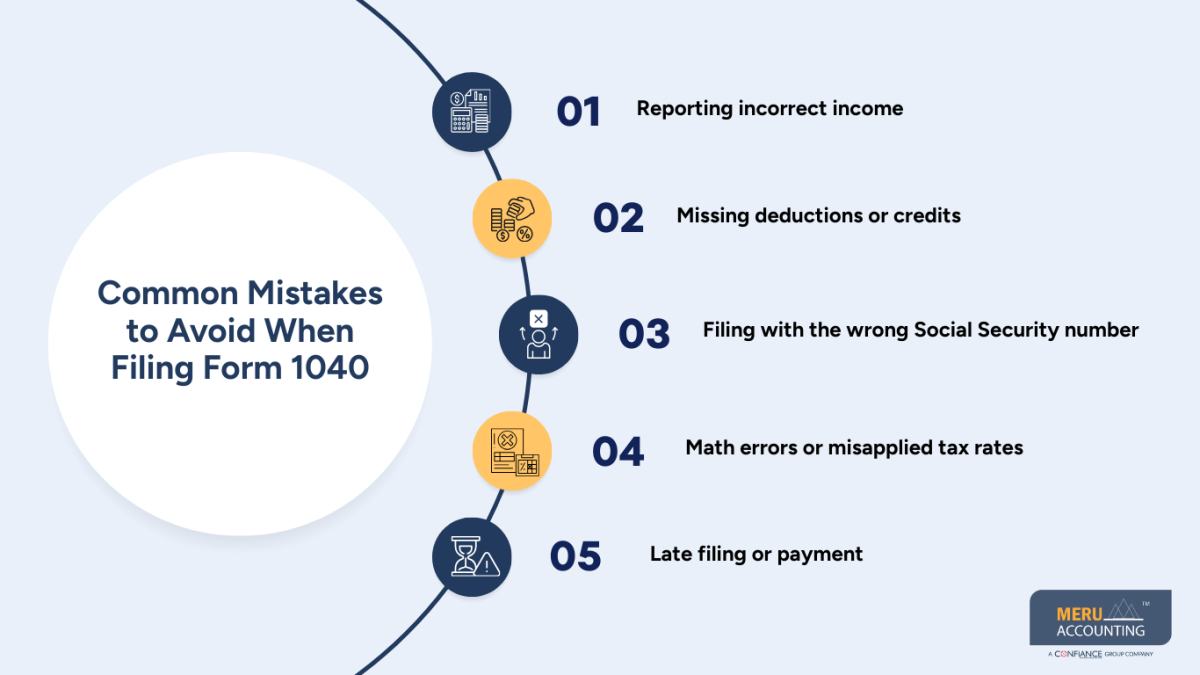
Even small errors can lead to delays, penalties, or audits. Common mistakes include:
- Reporting incorrect income
- Missing deductions or credits
- Filing with the wrong Social Security number
- Math errors or misapplied tax rates
- Late filing or payment
Double-checking information and consulting professionals can help avoid these errors.
Why Filing a 1040 Income Tax Return Accurately Matters
Filing an accurate 1040 income tax return has several benefits:
- Prevents penalties and interest
- Ensures eligibility for refunds
- Reduces risk of IRS audits
- Helps with financial planning
- Maintains compliance with federal tax laws
Even small mistakes can have long-term financial consequences, making accuracy essential.
How Meru Accounting Can Help
At Meru Accounting, we help individuals and businesses understand what is a 1040 income tax return and prepare it efficiently and accurately. Our services include:
- Preparing federal and state 1040 income tax returns
- Reviewing income and deduction eligibility
- Identifying all eligible tax credits
- Ensuring compliance with the latest IRS regulations
- Filing electronically for faster refunds
By working with experienced professionals, you can file confidently, knowing your return is accurate and optimized for legitimate savings.
Tips for Filing Your 1040 Income Tax Return
- Organize Your Documents: Keep W-2s, 1099s, receipts, and prior-year returns in one place.
- Calculate AGI Carefully: Your adjusted gross income affects deductions and credits.
- Choose the Right Deduction Method: Compare standard vs. itemized deductions for the most benefit.
- Apply All Eligible Credits: Credits directly reduce taxes owed.
- Check for Accuracy: Verify Social Security numbers, bank account details, and totals.
Following these tips ensures a smooth filing process and reduces the risk of errors.
Conclusion
Understanding what is a 1040 income tax return is essential for every U.S. taxpayer. Form 1040 serves as the foundation for reporting income, claiming deductions, and calculating tax liability. Filing accurately ensures compliance, prevents penalties, and maximizes your eligible refunds.
With professional guidance from Meru Accounting, you can simplify the process, ensure every section is completed correctly, and take advantage of all available deductions and credits. Whether you are an individual, freelancer, or small business owner, understanding and preparing your 1040 income tax return properly is key to confident and compliant tax filing.
FAQs
It is the standard federal tax form used to report income and calculate taxes.
Wages, business income, interest, dividends, capital gains, and other taxable income.
Adjusted Gross Income is total income minus eligible adjustments.
It prevents penalties, delays, and IRS issues.
It is a fixed amount that reduces your taxable income based on filing status.


