




Introduction to Owner’s Equity on a Balance Sheet
Owner’s equity, also referred to as shareholders’ equity or net assets, is a critical element of a company’s financial statements, particularly the balance sheet. It represents the residual interest in the assets of a business after deducting liabilities. Understanding owner’s equity is essential for business owners, investors, and financial analysts as it provides insight into the company’s financial health, capital structure, and value.
This article delves deeply into the definition of owner’s equity, its components, how it fits into balance sheet components, and why it matters to every business. Whether you are a startup founder or a seasoned finance professional, this comprehensive guide will enhance your knowledge about owner’s equity and its impact on financial reporting and analysis.
What Is Owner’s Equity?
Owner’s equity is the ownership interest held by shareholders in a corporation or by owners in other business forms such as sole proprietorships or partnerships. It reflects the amount of money that would theoretically be returned to shareholders if all assets were liquidated and all debts paid off.
Owner’s equity can be calculated using the fundamental accounting equation:
| Accounting Equation Element | Formula |
|---|---|
| Assets | = Liabilities + Owner’s Equity |
| Owner’s Equity | = Assets − Liabilities |
This equation shows owner’s equity as what remains after subtracting a company’s total liabilities from its total assets. The balance sheet components are designed to reflect this relationship with assets on one side and liabilities and owner’s equity on the other, ensuring the statement balances perfectly.
Key Components of Owner’s Equity
Owner’s equity is not a monolithic figure; it consists of several important components. Each element provides specific information about the nature and source of the equity held in the company. Understanding these components helps in evaluating financial statements more accurately.
Paid-in Capital
Paid-in capital, also known as contributed capital, is the amount of cash or other assets that shareholders have invested directly in the business through the purchase of stock. This component includes:
- Common stock at par value
- Additional paid-in capital (amount paid over par value)
- Preferred stock
Retained Earnings
Retained earnings represent the cumulative net income or profit of the company that has not been distributed to shareholders as dividends but retained for reinvestment or debt repayment. Retained earnings grow or shrink based on the company’s profitability and dividend policy.
Treasury Stock
Treasury stock refers to shares that the company has repurchased from the market. These shares are held by the company and reduce owner’s equity because they are essentially shares taken out of circulation.
Other Comprehensive Income
Other comprehensive income (OCI) includes unrealized gains and losses that are not reflected in the net income but affect equity, such as foreign currency translation adjustments, unrealized gains or losses on certain investments, and pension plan adjustments.
How Owner’s Equity Fits into Balance Sheet Components
The balance sheet is divided primarily into three parts: assets, liabilities, and owner’s equity. Each section contains several important accounts and categories that represent the financial position of a company at a specific point in time.
Assets
Assets are economic resources that the company owns and expects to benefit from in the future. They include current assets such as cash and accounts receivable, as well as non-current assets like property, plant, equipment, and intangible assets.
Liabilities
Liabilities are obligations the company owes to external parties. These are usually debts or other financial responsibilities payable to creditors, including loans, accounts payable, and accrued expenses.
Owner’s Equity
Owner’s equity is the claim by the owners on the company’s assets after all liabilities have been deducted. It is critical to note that owner’s equity balances the accounting equation and provides the net worth of the company.
Why Understanding Owner’s Equity Matters to Every Business
Owner’s equity serves multiple vital purposes for business owners and stakeholders. Proper comprehension and management of equity can affect decision-making, capital raising strategies, and valuation assessments.
- Financial Health Indicator: A positive and growing owner’s equity typically signifies a company is profitable and able to sustain operations.
- Investor Confidence: Investors examine owner’s equity to assess the value of their investments and the company’s ability to generate returns.
- Creditworthiness: Lenders evaluate equity levels to determine financial stability and the risk associated with lending.
- Dividend Distribution Decisions: Companies use retained earnings to decide on dividend payments; hence, understanding the equity statement helps in dividend policy formulation.
- Business Valuation: Owner’s equity is a foundational figure in business valuation models like book value, return on equity, and others.
Analyzing Owner’s Equity for Different Business Structures
Owner’s equity varies depending on the business structure such as sole proprietorships, partnerships, and corporations. Each has unique characteristics regarding how equity is recorded and reported.
Sole Proprietorships
In a sole proprietorship, owner’s equity represents the owner’s capital account, which includes initial investment, additional contributions, and retained profits less any withdrawals made by the owner.
Partnerships
For partnerships, owner’s equity accounts are maintained separately for each partner. Each partner’s equity reflects their share of contributions, profits, losses, and withdrawals.
Corporations
In corporations, owner’s equity encompasses contributed capital from shareholders and retained earnings accumulated over time. Corporations issue stock certificates and have detailed equity accounts for tracking shareholders’ investments and earnings.
Common Owner’s Equity Accounts Explained
| Account | Description |
|---|---|
| Common Stock | Represents shares issued to investors at par value as part of initial or subsequent capital raising. |
| Additional Paid-In Capital | Amount paid by investors over the par value of stock issued. |
| Retained Earnings | Cumulative earnings not paid out as dividends. |
| Treasury Stock | Repurchased shares held by the company, shown as a reduction in equity. |
| Accumulated Other Comprehensive Income | Unrealized gains or losses not recorded in profit and loss but adjusted in equity. |
| Owner’s Capital Account (Sole Proprietorship/Partnership) | Represents individual owners’ equity contributions and withdrawals. |
Common Transactions Affecting Owner’s Equity
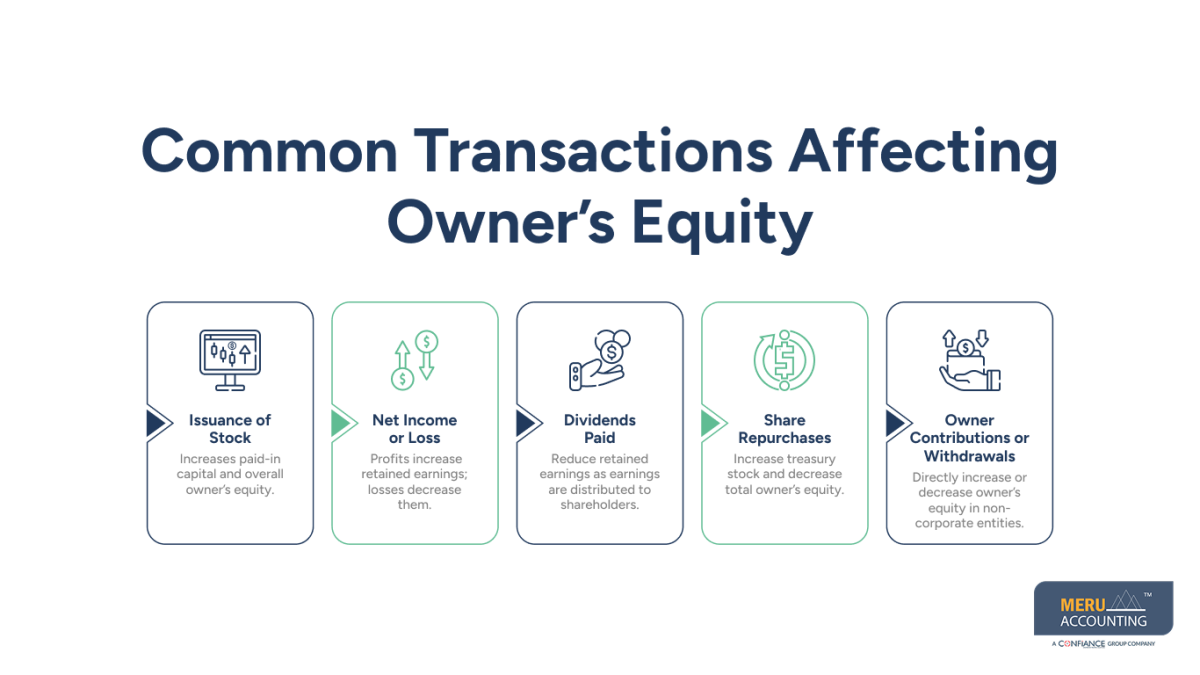
Various business transactions influence owner’s equity accounts, directly impacting the financial position of the company. These transactions are recorded in the owner’s equity section of the balance sheet to provide an accurate picture of ownership value.
- Issuance of Stock: Increases paid-in capital and overall owner’s equity.
- Net Income or Loss: Profits increase retained earnings; losses decrease them.
- Dividends Paid: Reduce retained earnings as earnings are distributed to shareholders.
- Share Repurchases: Increase treasury stock and decrease total owner’s equity.
- Owner Contributions or Withdrawals: Directly increase or decrease owner’s equity in non-corporate entities.
How to Calculate Owner’s Equity Step-by-Step
Calculating owner’s equity is straightforward if you have access to the relevant financial data. Below is a step-by-step approach to determine owner’s equity using balance sheet components:
- Identify total assets: Add together all current and non-current assets.
- Identify total liabilities: Sum all current and long-term liabilities.
- Subtract total liabilities from total assets using the formula: Owner’s Equity = Assets − Liabilities.
- Verify components: Check that paid-in capital, retained earnings, and other equity accounts reconcile with the calculated equity.
This calculation provides a quick snapshot of the company’s net value attributable to owners.
Meru Accounting: Your Partner in Financial Expertise
Meru Accounting is a trusted name in financial services, offering comprehensive accounting solutions tailored to meet the needs of businesses of all sizes. With expertise in balance sheet components, tax consulting, financial analysis, and bookkeeping, Meru Accounting empowers businesses to maintain accurate financial records and make informed decisions. Their team of professionals ensures compliance with accounting standards and provides strategic insights that help companies optimize their financial health and grow sustainably.
Common Challenges in Understanding Owner’s Equity
Despite its importance, owner’s equity can sometimes be difficult to interpret due to several factors:
- Complex Capital Structures: Companies with multiple classes of stock, preferred shares, and convertible securities can complicate equity calculations.
- Non-Cash Transactions: Contributions of assets other than cash or equity issued for services can lead to valuation challenges.
- Interpreting Other Comprehensive Income: Since OCI does not impact net income, understanding its effect on equity requires careful review.
- Changes in Accounting Policies: Revisions to accounting principles can alter equity reporting, leading to restatements.
Conclusion: The Importance of Mastering Owner’s Equity
Owner’s equity is a cornerstone of financial accounting and business management. By understanding its key components and relationship to balance sheet components, business owners and financial professionals can better assess company value, make strategic decisions, and communicate financial health to stakeholders. The knowledge gained from mastering owner’s equity extends beyond accounting, influencing investment choices, credit negotiations, and long-term business planning.
Whether you are managing a small business or analyzing a multinational corporation, a robust grasp of owner’s equity will serve as a powerful tool in achieving financial clarity and success.
FAQs
What is owner’s equity on a balance sheet?
Owner’s equity represents the residual interest in the assets of a business after deducting liabilities. It reflects the ownership value held by the business owner(s).
What are the key components of owner’s equity?
The key components include contributed capital (such as common stock or owner’s investment), retained earnings, and additional paid-in capital.
How does owner’s equity differ from liabilities on the balance sheet?
Owner’s equity represents the owner’s claim on the business’s assets, while liabilities are obligations the business owes to external parties.
Why is owner’s equity important for a business?
Owner’s equity indicates the financial health and stability of a business, showing what the owners truly own after all debts are paid.
Can owner’s equity be negative on a balance sheet?
Yes, owner’s equity can be negative if a business has accumulated losses or excessive withdrawals that exceed its invested capital and retained earnings.


