
An accountant for a startup plays a key role in helping SaaS founders manage rapid growth, control costs, and keep financial records accurate from day one. In SaaS businesses, income, subscriptions, and customer churn move quickly, so strong financial systems are needed to stay stable.
Many SaaS founders focus on product and sales, but often miss structured financial planning. This is where an accountant for a startup becomes important. With the right guidance, founders can understand cash flow, pricing impact, and long-term profit plans.
An accounting firm for startups also brings structured systems that help track subscriptions, revenue timing, and tax needs in a simple way.
What You Will Learn From This Blog
- Helps SaaS founders manage revenue, expenses, and financial reporting to support steady and structured growth.
- Covers issues like cash flow gaps, rising costs, and unclear profit visibility during rapid scaling.
- Ensures subscription income is recorded correctly and allocated across billing cycles for accurate reporting.
- Supports planning of income and expenses to maintain smooth cash flow and avoid shortages.
- Uses key metrics like MRR, CAC, and churn rate to guide better business decisions.
- Highlights common mistakes such as poor expense tracking, weak reporting, and incorrect revenue recognition.
- Improves financial accuracy, reduces risk, and helps founders scale their SaaS business with better control.
Understanding the Role of an Accountant for a Startup in SaaS Growth
Revenue Tracking And Subscription Models
An accountant for a startup helps SaaS founders manage recurring income from monthly or yearly subscriptions. SaaS income is not one-time, so timing matters. Proper tracking ensures founders understand how much money is earned each month, not just what is billed.
Cost Structure Clarity
SaaS companies spend on cloud services, tools, and support teams. A financial expert breaks down these costs clearly. This helps founders see which areas are consuming cash faster than expected.
Financial Planning For Scale
An accounting company for startups helps plan for future hiring, marketing spend, and infrastructure growth. This ensures SaaS companies grow without financial pressure.
Compliance And Tax Support
SaaS businesses often operate in multiple regions. A financial professional helps ensure that all tax regulations are properly complied with. This reduces the risk of penalties and keeps financial reporting accurate.
Investor Reporting Readiness
Investors need clean reports before funding decisions. An accountant for a startup prepares structured financial statements. This builds trust and improves funding chances.
Key Financial Challenges SaaS Founders Face During Scaling
Unstable Cash Flow Timing
SaaS income is spread over time, which creates cash gaps and short-term planning pressure. An accountant for a startup helps manage these gaps with proper tracking and structured financial control for better stability.
High Customer Churn Impact
When users cancel subscriptions, revenue drops quickly and affects overall business predictability. An accounting firm for startups helps track churn patterns and understand customer loss behavior for better retention planning.
Complex Subscription Billing
Monthly, yearly, and trial plans make billing complex and harder to manage consistently. An accountant for a startup simplifies this structure and ensures accurate revenue recording across all billing cycles.
Rising Operating Costs
Cloud hosting, software tools, and support systems increase as user demand grows. An accounting professional for a startup helps control and monitor cost growth to maintain a healthy financial balance.
Limited Financial Visibility
Many founders do not see real profit clearly due to scattered financial data and weak reporting. An accounting company for startups improves reporting clarity and gives a more accurate view of business performance.
How An Accounting Firm For Startups Supports Revenue Recognition In SaaS
Understanding ASC 606 Standards
Revenue in SaaS must follow proper rules like ASC 606 (FASB). An accountant for a startup ensures correct recognition timing. This helps avoid reporting errors and compliance issues.
Subscription Revenue Allocation
Income must be spread across service periods. An accounting company for startups handles this allocation correctly. It ensures revenue is matched with the actual service delivered.
Deferred Revenue Tracking
Payments received in advance must be recorded properly. A startup accounting professional ensures correct treatment. This keeps financial statements accurate and balanced.
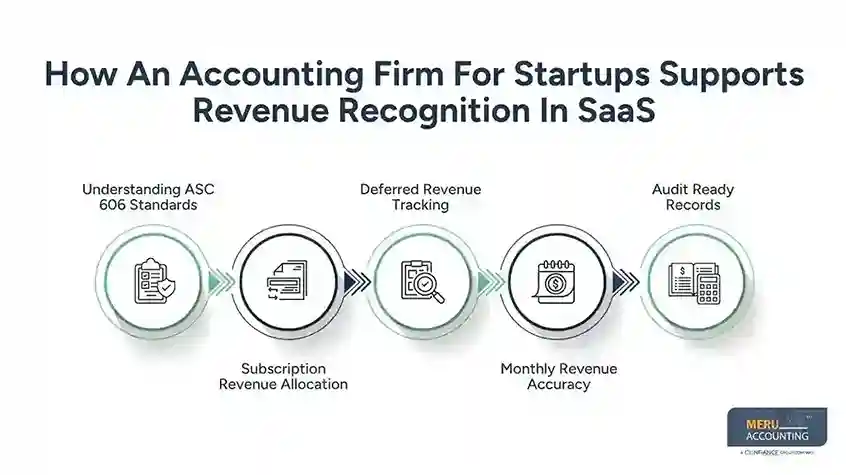
Monthly Revenue Accuracy
Monthly reports show real performance. A startup accountant ensures numbers are reliable. This helps founders track true business growth each month.
Audit Ready Records
Clean records reduce audit stress. An accounting firm for startups prepares structured reports. It also makes financial review faster and smoother for investors and auditors.
Cash Flow Management Strategies For Sustainable SaaS Expansion
Predicting Cash Inflow And Outflow
An accountant for a startup helps forecast money coming in and going out with better accuracy. This avoids sudden cash shortages and supports smoother financial planning.
Managing Subscription Delays
Delayed payments can affect day-to-day operations and planned expenses. An accounting firm for startups tracks delays clearly and helps reduce payment risks.
Controlling Fixed Costs
Rent, software tools, and staff costs must stay balanced for stable growth. An accounting professional for a startup monitors fixed spending to prevent overspending issues.
Emergency Cash Planning
Unexpected expenses can arise during scaling and affect operations. An accountant for a startup builds safety buffers to handle such financial pressure.
Improving Payment Collection Cycles
Faster collections improve liquidity and overall financial stability. A startup-focused accounting firm helps optimize billing cycles to support quicker cash inflow.
Budgeting and Forecasting for High-Growth SaaS Companies
Building Realistic Growth Plans
An accountant for a startup creates growth-based budgets aligned with actual business capacity. This helps avoid overspending during early scale stages and keeps financial control stable.
Revenue Forecast Accuracy
Future income must be estimated carefully using past data and trends. An accounting firm for startups uses data-based forecasting to improve planning accuracy and reduce guesswork.
Expense Planning Control
All departments must follow defined budgets to maintain financial discipline. A startup accountant tracks deviations and helps identify overspending early so corrective actions can be taken in time.
Scenario Planning For Growth
Different growth outcomes are planned based on best, average, and low performance cases. A startup accountant prepares multiple scenarios to support better decision-making and long-term planning.
Funding Requirement Estimation
SaaS founders often require external funding to scale their operations. A financial advisory team helps estimate capital requirements clearly to improve investor readiness.
Burn Rate Analysis
Understanding monthly burn rate is essential for SaaS survival. An accountant for a startup tracks how fast cash is being used and helps extend the runway.
Profitability Timeline Planning
Founders need clarity on when the business may become profitable. An accounting firm for startups builds structured timelines for financial sustainability.
KPI Tracking And Financial Reporting For Data-Driven Decisions
Monthly Recurring Revenue (MRR) Tracking
MRR is key in SaaS as it shows stable monthly income performance. An accountant for a startup tracks this metric closely to measure predictable growth trends.
Customer Lifetime Value Analysis
CLV shows the long-term value generated from each customer relationship. A finance specialist calculates it accurately to support better pricing and customer retention decisions.
Customer Acquisition Cost Review
CAC reflects how much is spent to acquire each new customer. An accounting professional for a startup tracks the cost per customer to improve marketing efficiency.
Profit Margin Monitoring
Margins show the real financial health of a SaaS business. An accounting professional for a startup ensures accurate margin reporting for better decision-making.
Financial Dashboard Creation
Dashboards provide quick and clear financial insights for founders. An accounting firm for startups builds simple reporting systems for daily tracking.
Common Mistakes SaaS Founders Make Without A Dedicated Accountant
- Many founders record income incorrectly due to a lack of structured systems. An accountant for a startup prevents this issue by ensuring proper revenue recognition and timing accuracy for SaaS models.
- Untracked expenses reduce profit visibility and make financial planning more difficult. A financial management team addresses this issue by properly organizing and categorizing all business expenses.
- Without proper planning, SaaS businesses often face sudden cash shortages during scaling. An accountant for startups improves stability by forecasting inflows and outflows in advance.
- Reports become unclear and inconsistent without structured financial processes. An accountant for a startup improves accuracy and ensures clear reporting for better decision-making.
- Late filings can lead to penalties and compliance stress for SaaS founders. An accounting firm for startups ensures timely compliance and smooth tax preparation throughout the year.
Benefits of Hiring A Specialized Accountant for a Startup Vs In-House Accounting
Lower Operational Cost
Hiring an accountant for a startup is often more cost-effective than maintaining a full in-house finance team, especially for early-stage SaaS companies with limited budgets.
Access To Expert Knowledge
An accounting firm for startups brings SaaS-specific experience and understanding of subscription models, revenue recognition, and scaling challenges.
Better Financial Systems
Structured systems improve tracking, reporting, and decision-making accuracy. An accountant for a startup ensures proper setup and smooth financial workflows.
Scalability Support
As SaaS companies grow, their financial requirements become more complex and constantly evolving. A professional finance team adapts its support to match the changing needs of the business.
Reduced Risk Errors
Expert review reduces financial mistakes and reporting issues. An accounting professional for a startup improves accuracy, compliance, and overall financial trustworthiness.
How Meru Accounting Supports SaaS Founders
Meru Accounting supports SaaS founders with structured financial services designed for fast-growing digital businesses. As a trusted accounting firm for startups, we help manage revenue tracking, budgeting, and compliance with simple and clear systems.
Our team of experts works as an extension of your business, acting as your accountant for a startup to ensure smooth financial operations. We also support subscription revenue models, investor reporting, and cash flow planning.
With strong experience in SaaS accounting, Meru Accounting ensures founders get clear financial visibility, better decision-making support, and reduced operational stress. Our systems are designed to scale with your business growth while keeping reports accurate and easy to understand.
Key Takeaways
- SaaS growth needs structured financial control
- An accountant for a startup helps manage revenue timing and cash flow
- An accounting firm for startups improves forecasting and reporting
- KPI tracking supports better business decisions
- Avoiding financial mistakes improves long-term stability
- Expert support reduces stress and improves accuracy
FAQs
An accountant for a startup manages revenue tracking, expenses, and financial reports for SaaS companies in a simple and structured way.
SaaS income is subscription-based and complex. An accounting firm for startups helps manage this complexity clearly.
An accountant for a startup tracks income timing and expenses to prevent cash shortages.
Yes, an accounting firm for startups often provides expert support at a lower cost and scales easily.
Yes, even early-stage startups benefit from an accountant for a startup because it avoids costly financial mistakes.