



Accounting for construction contractors is very different from regular business accounting. It involves job costing, progress billing, retainage, payroll, equipment costs, and cash flow tracking across many projects at the same time.
When these tasks are handled using fragmented systems, problems grow quickly. Many contractors still rely on separate tools for estimating, invoicing, payroll, and reporting, which creates confusion and errors.
In the first stages of accounting for construction contractors, accurate data flow is critical. If systems do not talk to each other, financial clarity is lost.
This blog explains how fragmented systems affect contractors, how they damage reporting and cash flow, and how online accounting software for contractors helps bring everything together in one place.
What You Will Learn From This Blog
- Understand what fragmented accounting systems look like in construction accounting and how they affect daily financial work.
- Learn how fragmented systems create financial risks by reducing accuracy and making reports less reliable.
- See how disconnected tools limit visibility into job costs and make it harder to track project expenses correctly.
- Recognize why managing payments, expenses, and cash flow becomes more difficult when systems are not connected.
- Explore how online accounting software for contractors helps bring financial data into one place and reduces these problems.
What Are Fragmented Systems In Construction Accounting?
Fragmented systems in construction accounting occur when contractors rely on separate tools for different tasks, such as invoicing, payroll, and expense tracking, making accounting for construction contractors more complicated and error-prone.
Using multiple software programs creates gaps in data, making it difficult to maintain consistency across financial records.
Manual data entry is another major issue with fragmented systems. Often, the same information has to be entered into several tools, increasing the chances of errors and discrepancies. This not only slows down accounting processes but also makes it harder to trust the data.
Without a central financial view, contractors struggle to see real-time performance. Key insights about project costs, cash flow, and overall financial health are delayed or incomplete, making it difficult to perform reliable accounting for construction contractors and informed project planning.
Additionally, reporting suffers under fragmented systems. Reports may be missing critical information or lack accuracy, limiting the ability to track profitability and monitor ongoing projects effectively. Integrating accounting tools can help solve these issues by providing a single, unified system for all financial data.
Common Causes Of Fragmentation In Accounting For Construction Contractors
Legacy Software
Older accounting tools were not built for construction needs, making them unsuitable for modern accounting for construction contractors. They often cannot handle complex job costing or project tracking efficiently.
Department-Based Tools
Different teams use different systems without coordination. This leads to data silos and inconsistent financial information, complicating accounting for construction contractors.
Spreadsheet Dependence
Spreadsheets are still widely used but lack automation. They also increase the risk of errors and make real-time reporting difficult.
Budget Constraints
Many contractors delay system upgrades to reduce costs, but this can create inefficiencies in accounting for construction contractors. This short-term saving can result in long-term inefficiencies and financial inaccuracies.
Lack Of Planning
Accounting systems grow without a clear long-term plan. Over time, this creates fragmented processes that are hard to manage or integrate.
How Fragmented Systems Impact Financial Accuracy And Reporting
Data Mismatch
Numbers often do not match across multiple systems, causing confusion in accounting for construction contractors and complicating reconciliations. This creates difficulty reconciling accounts and tracking actual project performance.
Higher Error Rates
Manual transfer of data between tools increases the likelihood of mistakes. Errors can lead to incorrect billing, lost revenue, and misinformed decisions.
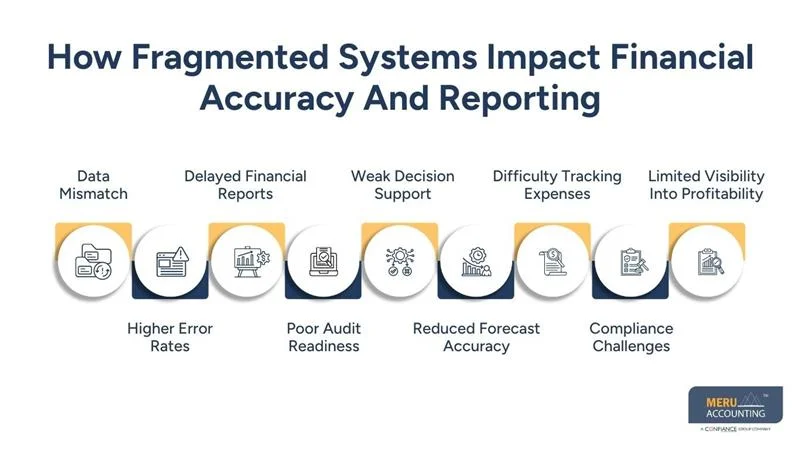
Delayed Financial Reports
Reports take much longer to prepare, verify, and distribute accurately. Delayed insights prevent timely management decisions and project adjustments.
Poor Audit Readiness
Incomplete and inconsistent records make audits complicated and stressful, posing risks in accounting for construction contractors compliance. Auditors may flag issues that require time-consuming corrections and explanations.
Weak Decision Support
Management decisions rely on data that is incomplete or delayed. This reduces confidence in forecasting, budgeting, and strategic planning.
Reduced Forecast Accuracy
Financial forecasts are less reliable because data is inconsistent and outdated. Inaccurate predictions can result in poor cash flow management and planning.
Difficulty Tracking Expenses
Expense tracking becomes inefficient and prone to errors across projects. Untracked costs may accumulate unnoticed, affecting profitability and budgets.
Compliance Challenges
Fragmented systems increase risks of failing to meet tax requirements. Non-compliance can result in penalties, fines, or legal complications.
Limited Visibility Into Profitability
It is harder to determine which projects are truly profitable accurately. Managers may make wrong investment or resource allocation decisions based on incomplete data.
The Effect Of Disconnected Tools On Job Costing And Project Profitability
Incomplete Cost Tracking
Project expenses are often not assigned correctly to the right project, a common issue faced in accounting for construction contractors. This makes it hard to see the total costs for each phase.
Delayed Cost Updates
Project managers frequently receive cost information too late for adjustments. Late updates prevent timely decision-making and increase project risk.
Budget Overruns
Lack of visibility into expenses causes uncontrolled budget overspending frequently. Overspending can reduce profit margins and affect overall project success.
Reduced Profit Insight
It becomes difficult to determine true profitability for each project. Without accurate profit insight, contractors struggle to make informed choices.
Planning Challenges
Future bids are created using inaccurate or incomplete historical data. This leads to unrealistic estimates and missed opportunities on new projects.
Cash Flow Challenges Caused By Fragmented Accounting Systems
Slow Invoicing
Invoices are often delayed due to missing or incomplete financial data, which directly impacts accounting for construction contractors and cash flow management. Delayed invoicing slows down payments and affects overall cash flow.
Payment Tracking Issues
Contractors struggle to track received and pending client payments accurately, complicating cash flow and accounting for construction contractors. This creates uncertainty and makes managing project cash flow difficult.
Retainage Confusion
Retainage amounts are frequently not tracked properly across multiple systems. Unclear retainage can lead to disputes and delayed project revenue.
Payroll Delays
Disconnected payroll systems cause delays in paying employees and staff. Late payroll affects staff satisfaction and project workforce efficiency.
Vendor Payment Errors
Missed or duplicate payments hurt relationships with key vendors and suppliers. Payment errors can result in penalties and disrupt supply chain operations.
How Online Accounting Software For Contractors Solves Fragmentation
Centralized Financial Data
All financial data is stored securely in a single system. This provides a complete view of cash flow and expenses, simplifying accounting for construction contractors.
Automated Data Flow
Information moves automatically between accounting, payroll, and project modules. Automation reduces manual entry errors and saves significant time.
Real-Time Reporting
Contractors can view updated financial reports anytime they need. Real-time reports improve decision-making and project management accuracy.
Better Job Costing
Project costs are tracked accurately by task, project, and phase. This helps contractors determine profitability and control expenses effectively.
Improved Compliance
Tax filings and reporting requirements are easier to manage correctly. Integrated systems reduce the risk of penalties or missed deadlines, ensuring compliant and reliable accounting for construction contractors.
Steps To Transition From Fragmented Systems To Integrated Accounting
Review Current Tools
List all accounting, payroll, and project management tools currently used. Understanding current tools helps identify inefficiencies and integration needs.
Identify Gaps
Find where data is duplicated, missing, or causing reporting issues. Gaps indicate where improvements are most needed for smooth transition.
Choose Construction-Focused Software
Select online accounting software for contractors designed for construction projects. Ensure the software includes job costing, invoicing, and reporting features.
Train Your Team
Provide training so staff can use the new system effectively. Well-trained employees ensure smooth adoption and minimal errors.
Monitor And Improve
Regularly review system performance to identify areas for optimization, ensuring continuous improvement in accounting for construction contractors. Continuous improvement ensures accurate accounting and better project control.
How Meru Accounting Supports Construction Contractors
Construction Accounting Expertise
Meru Accounting understands the daily challenges of construction accounting tasks. Our expertise helps contractors maintain accurate records and financial control.
System Integration Support
We assist contractors in moving from fragmented tools to integrated systems. Connected systems improve efficiency, reduce errors, and save valuable time.
Accurate Job Costing
Our team ensures every project cost is tracked correctly. Accurate job costing helps contractors measure profitability and control expenses.
Cash Flow Management
We help contractors improve billing cycles and manage payments efficiently. Better cash flow ensures projects are completed on schedule and budget.
Ongoing Accounting Support
Our accounting services grow alongside the changing needs of businesses. Continuous support ensures smooth operations and financial stability for contractors.
Streamline your construction accounting today with expert support from Meru Accounting. Contact us to simplify your finances and grow your business efficiently.
Key Takeaways
- Fragmented systems and disconnected tools lead to errors and delays, increasing financial risk.
- Lack of integration makes job costing difficult, leaving project profitability unclear.
- Delayed invoicing and payments create unstable cash flow, affecting daily operations.
- Using centralized systems improves control, accuracy, and overall financial planning.
- Online accounting software for contractors simplifies accounting, reporting, and project management.
FAQs
Fragmented systems happen when contractors use multiple tools for payroll, billing, and job costing that don’t connect. This makes tracking costs and finances harder.
They can cause errors in financial reports, delay invoicing, and make it difficult to track project profitability accurately.
Yes, it centralizes financial data, automates entries, and ensures accurate reporting across all projects.
Contractors may experience cash flow issues, missed payments, inaccurate job costing, and challenges during audits.
Start by reviewing current tools, identifying gaps, adopting online accounting software for contractors, and training staff for smooth integration.


