




Manufacturing companies often run into a common problem: some products look profitable on paper but actually lose money when all costs are counted. Accounting for manufacturing business is the key tool that helps you spot these unprofitable products early.
With the right accounting approach, you can identify which products drain your profits and make better decisions to improve your overall margins.
In this blog, we will explain how manufacturing cost accounting helps you track product profitability, find hidden costs, and fix the issues before they become serious.
What You Will Learn From This Blog
By the end of this blog, you will understand:
- What does accounting for a manufacturing business means
- How manufacturing or production cost accounting tracks costs and profits
- How to find hidden costs that make products unprofitable
- How to use cost accounting to spot unprofitable products
- Common reasons products lose money
- Steps to fix unprofitable products
- Why outsourcing manufacturing cost accounting can save time and money
Understanding Accounting for Manufacturing Business
Accounting for manufacturing business is not the same as regular accounting. A manufacturing company has unique costs like raw materials, labor, machine time, production waste, and inventory storage. If these costs are not tracked accurately, you may think a product is profitable when it is not.
Manufacturing accounting focuses on:
- Tracking production costs
- Monitoring inventory values
- Recording overhead costs
- Calculating cost per unit
- Checking profitability per product
The main goal is to understand the real cost of each product and identify which products earn profit and which ones cause losses.
What is Manufacturing Cost Accounting?
Manufacturing cost accounting is a system used to record, track, and analyze all costs related to manufacturing a product, and it is a key part of accounting for manufacturing businesses.
This includes direct costs like raw materials and labor, and indirect costs like utilities, rent, machine maintenance, and quality checks.
Manufacturing cost accounting helps businesses:
- Calculate the accurate cost of goods sold (COGS)
- Track cost per unit
- Monitor production efficiency
- Control overhead costs
- Measure product profitability
This accounting method is essential for manufacturing companies because it shows the real cost of production and is a crucial part of accounting for manufacturing businesses, helping managers make smart decisions.
How Cost Accounting Reveals Product Profitability
To understand product profitability, you must know the full cost of producing each item through accounting for manufacturing business.
1. Direct Material Cost
This includes raw materials used to make the product. For example, in a furniture company, wood and screws are direct materials.
2. Direct Labor Cost
This includes wages paid to workers who directly make the product. For example, workers who assemble furniture.
3. Manufacturing Overhead
These are indirect costs that support production, such as:
- Machine maintenance
- Factory rent
- Electricity
- Quality checks
- Supervisors’ salaries
When all these costs are added together, you get the true cost of producing a product, a key output of accounting for manufacturing businesses.
Production cost accounting calculates the cost per unit by dividing the total manufacturing cost by the number of units produced. This helps you know if a product is profitable or not.
Identifying Hidden Costs in Manufacturing
Many manufacturing businesses miss hidden costs that slowly reduce profit unless they use accounting for manufacturing businesses to track them. Accounting for manufacturing business helps reveal these hidden costs so you can act before they cause losses.
Here are some common hidden costs:
1. Wastage and Scrap
When raw materials are wasted or scrap is produced, it increases the cost of production. Without proper tracking, this cost may be ignored.
2. Machine Downtime
When machines stop working, production slows down. This increases labor cost and reduces output. Cost accounting tracks downtime and shows how it affects profit.
3. Quality Issues
Defective products lead to returns, repairs, and extra labor. Manufacturing cost accounting helps track quality issues and their cost impact, a vital function in accounting for manufacturing businesses.
4. Storage and Inventory Holding
Storing finished goods or raw materials for long periods increases cost. Storage costs, insurance, and spoilage add up over time.
5. Inefficient Processes
When production steps are slow or unnecessary, labor and overhead costs rise. Cost accounting highlights inefficient areas.
Using Manufacturing Cost Accounting to Spot Unprofitable Products
The main advantage of production cost accounting is that it reveals product profitability clearly. Here’s how it works:
Track Costs by Product
Manufacturing cost accounting records all costs for each product. This includes raw materials, labor, overhead, and waste.
Calculate Cost Per Unit
Cost accounting calculates the total cost for each product and divides it by the number of units produced. This gives the real cost per unit.
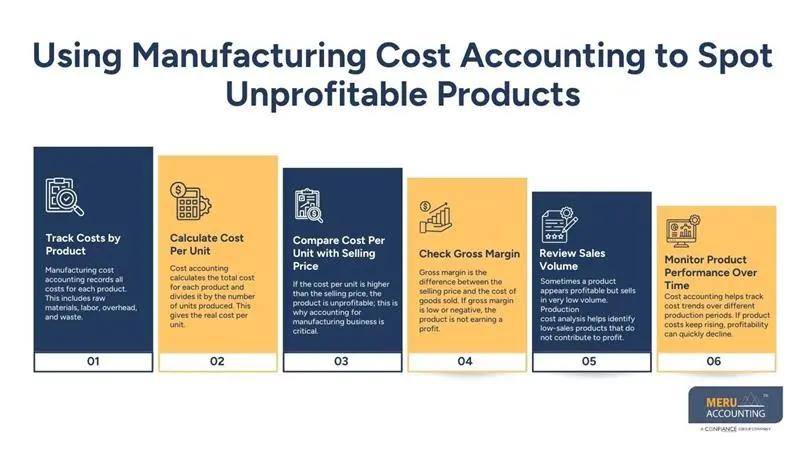
Compare Cost Per Unit with Selling Price
If the cost per unit is higher than the selling price, the product is unprofitable; this is why accounting for manufacturing business is critical.
Even if the selling price is higher, hidden costs may still reduce profit.
Check Gross Margin
Gross margin is the difference between the selling price and the cost of goods sold. If gross margin is low or negative, the product is not earning a profit.
Review Sales Volume
Sometimes a product appears profitable but sells in very low volume. Production cost analysis helps identify low-sales products that do not contribute to profit.
Monitor Product Performance Over Time
Cost accounting helps track cost trends over different production periods. If product costs keep rising, profitability can quickly decline.
Common Reasons Products Become Unprofitable
Here are some common reasons manufacturing products lose profit:
1. Incorrect Pricing
If the selling price is set without accurate cost information, profit is lost.
2. Rising Raw Material Costs
Raw material prices can increase unexpectedly. If prices are not updated in costing, profit drops.
3. High Waste or Scrap
Too much waste increases production cost. Cost accounting helps identify the waste source.
4. Low Production Efficiency
Slow production or frequent machine breakdowns increase the cost per unit.
5. Overhead Costs
High overhead costs such as rent, utilities, and supervision can reduce profit.
6. Poor Inventory Management
Excess inventory leads to storage costs, spoilage, and blocked cash flow.
7. Low Sales Volume
A product may be profitable per unit but sells too little to cover fixed costs.
Steps to Fix Unprofitable Products
Once you identify unprofitable products using manufacturing cost accounting, here are the steps to fix the issue in accounting for manufacturing business:
Recalculate Product Cost
Review the product cost and include all hidden costs. Ensure the cost per unit is accurate.
Adjust Pricing
If the product cost is higher than expected, increase the selling price if the market allows.
Reduce Waste
Identify where waste occurs and reduce scrap. This lowers the cost per unit.
Improve Production Efficiency
Reduce machine downtime and improve workflow. Better efficiency lowers labor and overhead costs.
Reduce Overhead Costs
Review overhead expenses and cut unnecessary costs. For example, reduce energy use or negotiate rent.
Focus on High-Profit Products
Stop producing products with low profit and focus on products with high margins.
Improve Inventory Management
Reduce excess inventory and avoid stockpiling raw materials. This lowers storage cost and improves cash flow.
Benefits of Outsourcing Manufacturing Cost Accounting
Outsourcing manufacturing cost accounting can be a smart decision for many businesses. It saves time and helps ensure accuracy.
Here are the benefits:
1. Expert Cost Tracking
Outsourced accounting teams specialize in manufacturing cost analysis. They can accurately track costs and identify unprofitable products.
2. Save Time
Manufacturing accounting requires detailed tracking. Outsourcing frees up time for business owners to focus on production and growth.
3. Better Decision Making
With accurate cost data, you can make better decisions about pricing, product mix, and production processes.
4. Reduce Errors
In-house accounting may miss hidden costs. Outsourcing reduces errors and improves accuracy.
5. Improve Profit Margins
With accurate cost accounting, you can identify unprofitable products and improve profit margins.
Why Choose Meru Accounting for Manufacturing Cost Accounting?
Meru Accounting specializes in providing accounting services designed for manufacturing businesses. The focus is on helping manufacturers identify unprofitable products, control costs, and improve profit margins through accurate financial insights.
Accurate Cost Tracking
All manufacturing costs, such as raw materials, labor, and overhead, are tracked in detail. This ensures product costs reflect actual production expenses without missing any key items.
Product Profitability Analysis
Cost per unit and gross margin are calculated for each product. This makes it easier to see which products generate profit and which reduce margins.
Identify Hidden Costs
Hidden costs like waste, downtime, and inefficient workflows are identified clearly. Addressing these areas helps reduce unnecessary expenses and improve efficiency.
Custom Reports
Clear and easy-to-understand reports are prepared for better decision-making. These reports help management review costs, pricing, and product performance quickly.
Help Improve Profit Margins
Guidance is provided on pricing strategies, cost reduction, and product mix decisions. This supports long-term profitability and better financial control.
Key Takeaways
- Accounting for manufacturing business is essential to know the real cost of each product.
- Manufacturing cost accounting helps track direct and indirect costs accurately, a key aspect of accounting for manufacturing businesses.
- Hidden costs like waste, machine downtime, and quality issues can make products unprofitable, which accounting for manufacturing business can reveal.
- Cost accounting helps identify unprofitable products and suggests steps to fix them.
- Outsourcing production cost accounting can save time and improve accuracy.
- Meru Accounting provides expert cost accounting support for manufacturing businesses.
FAQs
Accounting for manufacturing business tracks full production costs for each product. It compares costs with the selling price to show which products are losing money.
Manufacturing cost accounting calculates the true cost per unit, including overhead. This helps manufacturers understand real profit margins for each product.
Hidden costs like waste, downtime, and storage are often ignored. Production cost accounting includes these costs to show the real profit.
Product costs should be reviewed regularly and whenever costs change. This helps avoid losses and supports better pricing decisions.
Yes, outsourcing accounting for manufacturing businesses improves cost accuracy. It helps identify unprofitable products and focus on higher-margin items.


