




Manufacturing is a complex business. Every product goes through several stages: raw materials, labor, production, storage, and delivery. If any of these steps are not tracked accurately, pricing becomes a guessing process. This is where accounting for manufacturing companies becomes essential.
Manufacturing accounting is the system that helps businesses track costs, measure profit, and set the right prices. It provides the data needed to make smart decisions about product pricing and margins. Without it, companies may underprice products, lose profits, or miss important cost issues that can hurt the business.
What You Will Learn From This Blog
In this blog, you will learn:
- Why accounting for manufacturing companies matters in pricing decisions
- How manufacturing accounting improves cost accuracy
- How to identify profitable and unprofitable products
- How inventory accounting affects pricing strategies
- How to Control Overhead Costs Using Manufacturing Cost Management
- How to use accounting data for break-even analysis
- How outsourced accounting can improve pricing visibility
- Which reports are most useful for pricing decisions
Understanding the Role of Accounting for Manufacturing Companies in Pricing Decisions
The price of a product is not just based on the cost of raw materials. Pricing must also include labor, overhead, packaging, shipping, and even the cost of unsold inventory. This is why accounting for manufacturing companies is critical.
Manufacturing accounting provides the true cost of each product. This helps businesses set prices that cover all costs and still generate profit. It also helps manufacturers adjust pricing when costs rise, such as raw material price increases or labor wage changes.
Without accurate industrial accounting, companies may set prices too low and lose money, or too high and lose customers.
Accounting for Manufacturing Companies and Profitability Challenges
Manufacturing businesses face several challenges that can directly impact profitability, which is why accurate accounting for manufacturing companies is essential.
If these issues are not tracked and managed properly, companies may lose money without realizing it. Some common profitability challenges include:
1. Raw Material Cost Changes
Raw material prices can fluctuate due to market demand, supply chain issues, or currency changes, making accounting for manufacturing companies crucial.
2. Production Delays
Delays in production can increase labor and overhead costs. When production schedules are disrupted, companies may miss delivery deadlines, lose customers, or incur additional expenses.
3. Waste and Scrap
During manufacturing, some materials may get wasted or become scrap. If waste is not recorded accurately, the true cost of production will be underestimated, leading to wrong pricing decisions.
4. Labor Cost Increases
Labor costs can rise due to wage hikes, overtime, or increased staffing needs. If labor is not tracked correctly, the production cost per unit becomes inaccurate, affecting margins. Accounting for manufacturing companies helps record labor costs accurately.
5. Overhead Costs That Are Hard to Track
Overhead includes costs like utilities, equipment maintenance, rent, and quality control, which are captured through accounting for manufacturing companies.
These costs are often indirect and difficult to allocate properly to products, making it harder to calculate accurate product costs.
6. Inventory Holding Costs
Holding inventory involves storage, insurance, and handling costs. Excess inventory can increase these costs and reduce cash flow, while low inventory can cause stockouts and lost sales.
Key Cost Components Tracked Through Manufacturing Accounting
To understand pricing and margins, accounting for manufacturing companies tracks:
1. Raw Material Costs
This includes all materials used in production, from basic parts to packaging.
2. Direct Labor Costs
This is the cost of employees directly involved in making the product.
3. Manufacturing Overhead
These are indirect costs such as factory rent, utilities, equipment maintenance, and quality checks.
4. Production Costs
This includes machine costs, setup costs, and any additional production expenses.
5. Inventory Costs
Inventory costs include storage, insurance, and handling fees.
Manufacturing accounting keeps all these costs organized so businesses can see the true cost of making each product.
How Accounting for Manufacturing Companies Improves Cost Accuracy
Accurate costing is the foundation of good pricing. Accounting for manufacturing companies helps improve cost accuracy by:
- Tracking costs per product to identify the exact cost of each item.
- Recording labor hours and production time to ensure labor costs are accurate.
- Tracking waste and scrap to capture the true cost of materials.
- Monitoring machine usage to record machine operating and maintenance costs.
- Recording overhead costs in real time for accurate cost allocation.
When all costs are tracked accurately, businesses can set prices that cover costs and ensure profit.
Using Accounting for Manufacturing Companies to Identify Profitable and Unprofitable Products
One major benefit of accounting for manufacturing companies is the ability to identify profitable and unprofitable products.
Using industrial accounting data, you can compare:
- Product sales revenue
- Total production costs
- Overhead costs
- Profit margins
If a product has low profit or is losing money, manufacturing accounting will highlight it. This allows companies to:
- Raise the price
- Reduce production costs
- Stop producing the product
- Improve the product design
This helps manufacturers focus on the most profitable products.
The Impact of Manufacturing Accounting on Gross Margin Analysis
Gross margin is the difference between sales revenue and the cost of goods sold (COGS). It shows how much profit is made before expenses like rent and salaries.
Manufacturing cost tracking provides accurate COGS by recording all production costs. This helps businesses calculate gross margin correctly.
With a correct gross margin, companies can:
- Companies can set prices based on real profit rather than estimates.
- The firms can compare product profitability more accurately.
- Companies can identify products with low margins and take action.
- The firms can adjust pricing or reduce costs to improve profit.
How Accurate Inventory Accounting Supports Better Pricing Strategies
Inventory is a major part of manufacturing. Incorrect inventory accounting can cause big pricing problems.
If inventory is overvalued, profit appears higher than it is. If inventory is undervalued, profit appears lower. Both situations can lead to wrong pricing decisions.
Effects of Incorrect Inventory Valuation
- If inventory is overvalued, profit appears higher than it actually is, which can lead to underpricing products.
- If inventory is undervalued, profit appears lower, which can result in setting prices too high or missing profit opportunities.
Inventory Valuation Methods Used in Industrial Accounting
Accounting for manufacturing companies ensures inventory is valued correctly by using methods such as:
- FIFO (First In, First Out)
- LIFO (Last In, First Out)
- Weighted Average Cost
Benefits of Correct Inventory Valuation
- Correct inventory valuation helps manufacturers set the right price.
- Accurate inventory accounting supports better margin decisions and improves profitability.
Work-in-Progress (WIP) Tracking and Its Role in Margin Optimization
Work-in-progress (WIP) refers to products that are still being made and are not yet finished.
WIP tracking is a key part of accounting for manufacturing companies. It helps businesses:
- Track partially completed products to know what is in production at any time.
- Record labor and materials used in WIP to capture accurate production costs.
- Monitor production stages to identify delays and production flow issues.
- Measure production efficiency to find areas where time or resources are being wasted.
- Estimate the total cost of unfinished products to plan pricing and production budgets accurately.
WIP tracking helps identify bottlenecks and cost issues, improving margin decisions and pricing strategies.
How Accounting for Manufacturing Companies Helps Control Overhead Costs
Overhead costs can easily get out of control if not tracked properly, which is why accounting for manufacturing companies is essential. Manufacturing accounting helps by:
- Tracking utility costs to monitor energy consumption and reduce waste.
- Monitoring factory rent to ensure space costs are accurately recorded.
- Tracking equipment maintenance to prevent unexpected repair expenses.
- Recording indirect labor costs to capture support staff expenses accurately.
- Monitoring other indirect costs to identify areas where overhead can be reduced.
When overhead costs are tracked accurately, businesses can allocate them correctly to products. This ensures the product price covers all costs, not just direct costs.
Pricing Models Supported by Manufacturing Accounting Systems
Manufacturing financial systems support various pricing models, such as:
Cost-Plus Pricing
This pricing method adds a fixed profit margin to the total cost of production.
Value-Based Pricing
This pricing method is based on customer value and product quality.
Competitive Pricing
This pricing method sets prices based on competitor prices and market trends.
Tiered Pricing
This pricing method offers different prices for different customer segments.
Industrial accounting helps determine the right model by providing accurate cost data.
How Software Improves Accuracy in Manufacturing Finance
Accounting software helps accounting for manufacturing companies by tracking costs and generating reports automatically. This improves accuracy and supports better pricing decisions. Software can:
Track Raw Material Usage
Accounting software tracks raw material usage to ensure material costs are recorded accurately.
Record Labor Costs
Accounting software records labor costs to capture the actual cost of production.
Track Inventory Levels
Accounting software tracks inventory levels to avoid stockouts and reduce excess inventory.
Generate Profit and Loss Reports
Accounting software generates profit and loss reports to review financial performance quickly.
Provide Real-Time Cost Data
Accounting software provides real-time cost data to help make timely pricing decisions.
How Outsourced Accounting for Manufacturing Companies Improves Pricing Visibility
Many manufacturing companies outsource their accounting to experts. Outsourced accounting helps by:
Providing Accurate Cost Tracking
Outsourced accounting ensures all production costs are tracked correctly and recorded on time.
Generating Timely Financial Reports
Outsourced accounting provides regular financial reports that help businesses monitor performance and pricing.
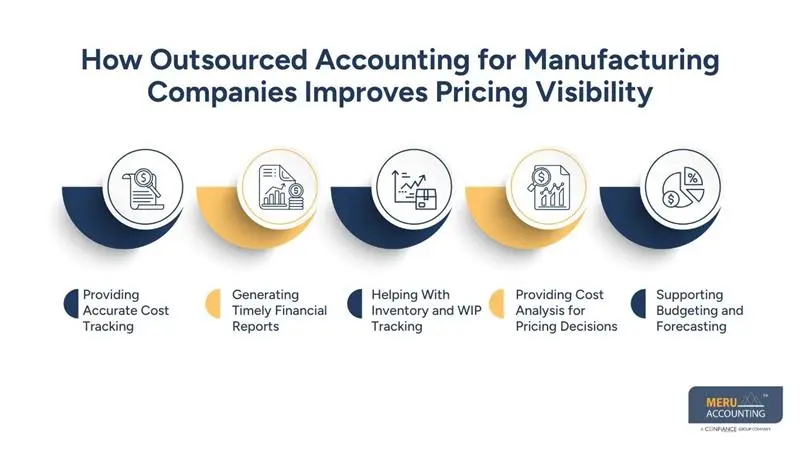
Helping With Inventory and WIP Tracking
Outsourced accounting supports accurate tracking of inventory and work-in-progress, ensuring true product costs.
Providing Cost Analysis for Pricing Decisions
Outsourced accounting offers a detailed cost analysis that helps businesses set prices based on real data.
Supporting Budgeting and Forecasting
Outsourced accounting helps create budgets and forecasts, which support better pricing and margin planning.
Outsourced accounting gives manufacturers better visibility into costs and margins, leading to better pricing decisions.
Key Financial Reports from Manufacturing Accounting That Guide Pricing Decisions
Manufacturing accounting generates key reports that help with pricing:
Cost of Goods Sold (COGS) Report
This report shows the total cost of producing goods sold, helping businesses understand true production costs.
Gross Margin Report
Financial report reveals the difference between sales revenue and production costs, helping manufacturers see profit levels.
Inventory Valuation Report
This report shows the value of inventory on hand, helping ensure pricing decisions reflect accurate inventory costs.
Work-in-Progress (WIP) Report
Financial report tracks the cost of unfinished products, helping businesses monitor production stages and costs.
Overhead Cost Report
Financial report breaks down indirect costs such as utilities, rent, and maintenance, helping allocate overhead accurately.
Profitability Report by Product
This report shows which products are most and least profitable, guiding pricing and production decisions.
These reports help manufacturers make informed pricing and margin decisions.
Why Choose Meru Accounting for Manufacturing Accounting Services?
At Meru Accounting, we understand how critical accurate cost tracking is for manufacturing companies. Our services help manufacturers improve pricing and profit margins through:
Expert Industrial Accounting
- Specialized accounting support designed specifically for manufacturing businesses.
- This ensures your financial records reflect the true nature of your production process.
Accurate Cost Tracking and Inventory Management
- All production costs and inventory values are tracked accurately.
- This helps prevent underpricing and avoids unexpected cost overruns.
WIP Tracking and Overhead Allocation
- Work-in-progress is monitored, and overhead costs are allocated correctly.
- This gives a clear view of production stages and helps reduce hidden costs.
Customized Financial Reporting
- Reports are tailored to match your business needs and goals.
- These reports help you understand performance and make smarter pricing decisions.
Real-Time Visibility Into Profitability
- Profit margins and product performance are tracked in real time.
- This helps you respond quickly to cost changes and market demand.
Support for Pricing Decisions and Margin Optimization
- Pricing strategies are based on accurate data and cost analysis.
- This improves profit margins and helps you stay competitive in the market.
We help manufacturing businesses make the right pricing decisions based on accurate data.
Key Takeaways
- Accounting for manufacturing companies is essential for accurate pricing.
- Manufacturing accounting tracks costs like raw materials, labor, and overhead.
- Accurate cost data helps identify profitable and unprofitable products.
- Inventory and WIP tracking support better margin decisions.
- Outsourced accounting improves cost visibility and pricing accuracy.
- Financial reports like COGS and gross margin help guide pricing strategies.
FAQs
Manufacturing accounting is a system that tracks all costs in production, including materials, labor, and overhead.
It helps companies know the true cost of products, which is necessary for correct pricing and profit.
It provides accurate cost data, which helps set prices that cover costs and generate profit.
WIP tracking records costs for products that are still in production, helping monitor progress and cost efficiency.
Yes, outsourcing accounting provides expert support, accurate reports, and better cost visibility for pricing decisions.


