




Accounting for manufacturing is a critical function that allows companies to track their production costs, optimize operations, and uncover areas where savings are possible. Proper accounting practices provide insights into the financial health of a manufacturing business and empower managers to make informed decisions that boost profitability.
By implementing a structured accounting system, manufacturing companies can identify inefficiencies, reduce waste, and ensure sustainable growth.
In this blog, we will explore how accounting for manufacturing helps businesses identify cost-saving opportunities, the role of a manufacturing accountant, and practical steps to enhance financial efficiency in manufacturing operations.
What You Will Learn From This Blog
By the end of this blog, you will understand:
- The fundamentals of accounting for manufacturing
- Why accurate cost tracking is crucial for profitability
- The key responsibilities of a manufacturing accountant
- How to identify waste and inefficiencies in production
- Strategies to use financial data for cost-saving decisions
- Practical steps to implement cost-saving measures in manufacturing
Understanding Accounting for Manufacturing
Accounting for manufacturing is different from standard business accounting because it focuses on the costs associated with producing goods. Unlike service-based companies, manufacturing businesses deal with raw materials, labor, and overhead, which all need careful tracking.
A manufacturing accountant plays a central role in this process. They ensure that every cost, from materials purchased to machine maintenance, is accurately recorded and analyzed. Proper accounting for manufacturing helps businesses understand the exact cost of each product, enabling better pricing decisions, improved budgeting, and more efficient operations.
Key aspects of accounting for manufacturing include:
- Recording direct costs, such as raw materials and labor
- Tracking indirect costs, like utilities, rent, and equipment depreciation
- Monitoring inventory levels and production efficiency
- Analyzing cost trends to highlight areas for improvement
By focusing on these areas, companies can make informed financial decisions that directly impact profitability.
Why Accounting for Manufacturing Is Essential to Boost Profitability
Provides Clear Visibility of Production Costs
Accounting for manufacturing gives businesses a complete view of all costs involved in production. This visibility helps prevent:
- Overproduction
- Overspending
- Incorrect product pricing
Without accurate cost tracking, these issues can significantly reduce profit margins.
Identifies Cost-Saving Opportunities
An industrial accountant plays a key role in analyzing production data to uncover ways to save money, such as:
- Reducing material waste
- Negotiating better rates with suppliers
- Optimizing labor usage
Helps Control Waste in Production
For instance, if scrap rates are higher than expected, a professional accountant can:
- Identify the specific stage in production where waste occurs
- Provide insights for corrective actions
Implementing these measures ensures resources are used efficiently, costs are reduced, and overall profitability is improved.
Supports Accurate Pricing Decisions
By understanding the true cost of production, businesses can:
- Set competitive yet profitable pricing
- Avoid underpricing or overpricing products
- Make informed decisions on product lines
Enhances Budgeting and Financial Planning
Accounting for manufacturing helps companies create realistic budgets and forecasts by:
- Tracking all production-related expenses
- Anticipating future cost trends
- Allocating resources more effectively
Improves Operational Efficiency
With clear cost insights, businesses can streamline operations, such as:
- Adjusting production schedules to minimize idle time
- Optimizing labor and machine utilization
- Reducing unnecessary expenditures
Key Responsibilities of a Manufacturing Accountant in Cost Management
An industrial accountant has several responsibilities that directly contribute to cost management and efficiency:
Tracking Production Costs
An industrial accountant monitors all costs involved in production, including materials, labor, and overhead. Accurate tracking ensures that the company knows the true cost of manufacturing each product.
Budgeting and Forecasting
They help create realistic budgets and forecast production costs for future periods. This allows management to plan effectively and avoid unnecessary expenses.
Cost Analysis
The accountant analyzes cost data to identify trends, inefficiencies, or unexpected expenses. This helps in making informed decisions to reduce costs.
Inventory Management Support
Proper accounting for manufacturing ensures accurate inventory records, preventing overstocking or stockouts, which can tie up capital unnecessarily.
Reporting
A skilled accountant prepares detailed reports on production costs, variances, and profitability, helping management make strategic decisions.
Through these responsibilities, the manufacturing accountant acts as a critical guide for companies seeking to reduce costs while maintaining product quality.
Understanding Direct and Indirect Production Costs
A key component of accounting for manufacturing is differentiating between direct and indirect production costs:
Direct Costs
These are costs directly linked to manufacturing a product, such as raw materials, labor, and specific machine usage. For instance, the cost of steel used to manufacture machinery parts is a direct cost.
Indirect Costs
These costs are not tied to a specific product but are necessary for production, such as factory rent, utilities, and equipment maintenance.
A manufacturing accountant carefully allocates both direct and indirect costs to determine the total cost of production. Understanding these costs allows businesses to identify areas where expenses can be reduced without compromising quality.
Identifying Waste and Inefficiencies in Manufacturing Processes
Accounting for manufacturing also helps businesses pinpoint waste and inefficiencies in their processes. A skilled accountant reviews financial data and production reports to detect patterns of overuse or underutilization.
Common sources of waste include:
- Excess raw materials leading to inventory write-offs
- Unproductive labor hours
- Overproduction of products not immediately in demand
- Machine downtime or inefficient machine usage
- Poorly managed supply chains are causing delays or excess stock
- Inefficient energy or utility usage in production
By identifying these inefficiencies, a professional accountant can recommend strategies to reduce waste, such as better scheduling, optimized inventory management, or improved workforce allocation.
Identifying Waste and Inefficiencies in Manufacturing Processes
Accounting for manufacturing also helps businesses pinpoint waste and inefficiencies in their processes. A skilled accountant reviews financial data and production reports to detect patterns of overuse or underutilization.
Common sources of waste include:
- Excess raw materials leading to inventory write-offs
- Unproductive labor hours
- Overproduction of products not immediately in demand
- Machine downtime or inefficient machine usage
- Poorly managed supply chains are causing delays or excess stock
- Inefficient energy or utility usage in production
By identifying these inefficiencies, a professional accountant can recommend strategies to reduce waste, such as better scheduling, optimized inventory management, or improved workforce allocation.
Using Financial Data to Make Strategic Manufacturing Decisions
Accounting for manufacturing provides valuable financial data that supports strategic decision-making. Companies can use this data to:
- Adjust production schedules based on cost trends
- Negotiate better terms with suppliers
- Invest in more cost-effective machinery
- Decide on pricing strategies that maintain profitability
An industrial accountant plays a central role in translating raw financial data into actionable insights. For example, if a certain product has high production costs but low sales, management can choose to modify the design, reduce production, or focus on more profitable products.
How a Manufacturing Accountant Supports Sustainable Cost Savings
A manufacturing accountant does more than track costs—they actively support sustainable cost savings by:
Monitoring Cost Variances
Identifying discrepancies between budgeted and actual costs allows timely interventions.
Analyzing Efficiency
Comparing production data over time highlights areas for improvement.
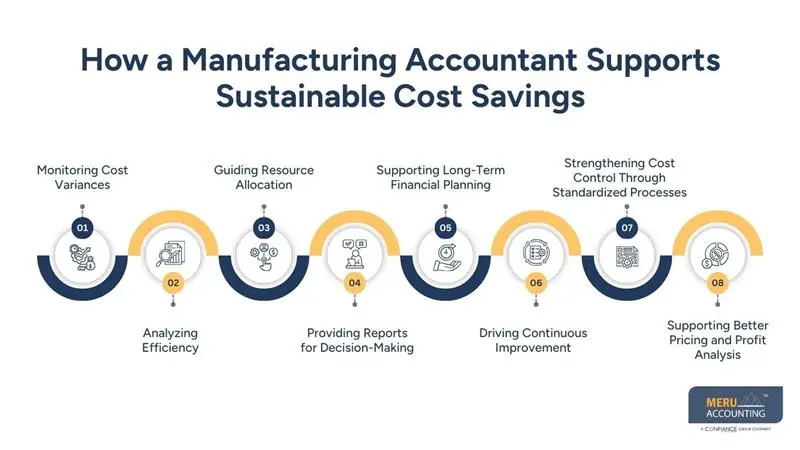
Guiding Resource Allocation
Ensuring materials, labor, and equipment are used effectively reduces unnecessary expenses.
Providing Reports for Decision-Making
Accurate, regular financial reporting helps management take corrective measures quickly.
Supporting Long-Term Financial Planning
A skilled accountant helps forecast future costs, allowing companies to plan budgets and investments more effectively.
Driving Continuous Improvement
By consistently analyzing cost data, a professional accountant identifies recurring inefficiencies and recommends process improvements, ensuring long-term cost savings.
Strengthening Cost Control Through Standardized Processes
Establishing consistent cost tracking and reporting methods improves accuracy and reduces errors. Standardized processes make it easier to compare performance across production cycles and identify cost issues early.
Supporting Better Pricing and Profit Analysis
Clear cost insights help determine accurate product pricing and profit margins. By understanding true production costs, businesses can avoid underpricing and protect long-term profitability.
By consistently analyzing and reporting cost data, a manufacturing accountant helps ensure that cost-saving measures are both effective and long-term.
Practical Steps to Implement Cost-Saving Measures in Manufacturing
Companies can take several practical steps to implement cost-saving measures based on insights from accounting for manufacturing:
Conduct Regular Cost Audits
Review all production costs periodically to identify inefficiencies or overspending.
Optimize Inventory Management
Avoid excess inventory that ties up capital and increases storage costs.
Improve Labor Allocation
Ensure employees are assigned efficiently to reduce idle time and maximize productivity.
Analyze Supplier Costs
Compare suppliers and negotiate better rates to lower raw material costs.
Invest in Energy Efficiency
Monitor utility usage and invest in energy-saving technologies for long-term savings.
Reduce Scrap and Waste
Implement quality control measures to minimize defective products and material waste.
Use Data for Production Planning
Utilize cost data to schedule production efficiently, reducing downtime and resource waste.
By following these steps, businesses can maximize cost savings while maintaining quality and operational efficiency.
Services Provided by Meru Accounting for Manufacturing Companies
At Meru Accounting, we provide specialized accounting for manufacturing services designed to identify cost-saving opportunities and enhance profitability. Our team of experienced manufacturing accountants offers the following services:
Comprehensive Cost Tracking and Analysis
Comprehensive tracking and analysis of all production costs, including materials, labor, and overhead, provides a clear picture of product expenses. Our experts ensure accurate recording and insightful cost evaluation.
Accurate Inventory Management
Maintaining precise inventory records helps reduce excess stock and manage resources efficiently. We provide ongoing oversight to ensure inventory aligns with production needs.
Budgeting and Financial Forecasting
Realistic budgeting and forecasting allow manufacturers to plan production costs and financial strategies effectively. Our team prepares forecasts tailored to your operational requirements.
Production Cost Reporting and Variance Analysis
Detailed reports identify discrepancies between planned and actual costs, enabling informed decision-making. We analyze variances to highlight areas for cost optimization.
Recommendations for Reducing Waste and Improving Efficiency
Actionable insights based on financial data help optimize processes, reduce waste, and enhance operational efficiency. Our manufacturing accountants provide guidance to implement practical cost-saving measures.
Through these services, Meru Accounting ensures that manufacturing businesses gain the financial clarity and control needed to implement cost-saving measures and maintain sustainable growth.
Key Takeaways
- Accounting for manufacturing is essential to track production costs and identify cost-saving opportunities.
- A manufacturing accountant plays a crucial role in managing costs, analyzing efficiency, and guiding financial decisions.
- Understanding direct and indirect costs is vital for accurate product pricing and cost control.
- Regular analysis of financial and production data helps identify inefficiencies and areas for improvement.
- Implementing cost-saving measures, such as optimizing inventory and reducing waste, enhances profitability.
- Partnering with experts like Meru Accounting ensures businesses achieve sustainable cost savings.
FAQs
Accounting for manufacturing is the process of tracking all costs related to producing goods, including materials, labor, and overhead. It helps businesses understand production costs and manage finances efficiently.
A professional accountant monitors production costs, analyzes efficiency, manages inventory, and provides reports to support cost-saving decisions.
It identifies areas of waste, tracks expenses, and provides insights for better decision-making, allowing businesses to reduce costs and improve profitability.
Yes, even small manufacturers can track costs, optimize resources, and plan budgets effectively, leading to better financial control.
Meru Accounting provides expert manufacturing accountants who manage costs, analyze efficiency, implement cost-saving measures, and help businesses improve profitability.


