




Bookkeeping for construction business is becoming increasingly important as the industry moves from fixed-price contracts to cost-plus models. This shift changes the way expenses, profits, and project costs are tracked, making accurate bookkeeping essential for financial clarity and project success.
Construction contractors face a new set of challenges when managing multiple projects under cost-plus arrangements. With every cost tracked and billed, the need for precise bookkeeping for construction contractors is higher than ever.
This blog explores how construction businesses can adapt their bookkeeping practices to this changing environment.
What You Will Learn From This Blog
- How the construction industry is shifting its contract models.
- Why bookkeeping for construction business must adapt.
- The key differences in bookkeeping between fixed-price and cost-plus projects.
- How construction contractors can manage multiple projects efficiently.
- The most important financial metrics to track for growth.
- Practical tips for simplifying bookkeeping during rapid project expansion.
By the end of this blog, you will understand the tools and practices needed to keep your construction business financially healthy as project pricing changes.
Understanding The Shift In Construction Pricing Models
The construction industry is experiencing a shift in pricing models, moving from traditional fixed-price contracts to cost-plus arrangements. Fixed-price contracts require construction contractors to complete a project for a set amount agreed upon at the start. While this method offers predictability, it can be risky if material costs rise or unexpected challenges occur, as contractors must absorb any extra expenses.
In contrast, cost-plus contracts reimburse contractors for actual project costs, along with an agreed-upon fee or percentage. This approach reduces financial risk for contractors but requires meticulous cost tracking and documentation.
As a result, bookkeeping for construction contractors becomes essential to ensure that all expenses are recorded accurately and reimbursed correctly.
This shift is driven by several factors, including increased project complexity, fluctuating material costs, and a growing demand from clients for transparency in billing. To remain competitive and financially organized, construction businesses must adapt their project management and accounting practices.
Bookkeeping for construction business now plays a key role in maintaining clear financial records, supporting accurate reporting, and helping contractors make informed decisions as project costs and structures evolve.
Why Bookkeeping for Construction Business Needs Specialized Bookkeeping Practices
Detailed Expense Tracking
Unlike fixed-price projects, bookkeeping for construction business requires contractors to record all expenses, including labor, materials, and subcontractor fees.
Timely Reporting
Accurate reporting helps construction contractors bill clients quickly and ensures they are reimbursed for all legitimate expenses.
Managing Cash Flow
Bookkeeping for construction business allows contractors to monitor cash flow and prevent project delays caused by financial shortfalls.
Reducing Errors
Detailed bookkeeping reduces errors in client billing and ensures that every cost is properly documented and justified.
Supporting Decision-Making
Having organized financial records helps contractors make better decisions about project planning, staffing, and material purchases.
Simplifying Tax Preparation
Accurate bookkeeping makes tax preparation easier, ensuring compliance and reducing the risk of penalties.
Enhancing Client Transparency
Clear financial records allow construction contractors to provide clients with detailed reports, building trust and improving client relationships.
Key Differences Between Fixed-Price and Cost-Plus Bookkeeping
Aspect | Fixed-Price Bookkeeping | Cost-Plus Bookkeeping |
Billing Methods | Relies on milestone billing | Requires tracking actual costs and applying the agreed markup or fee |
Expense Documentation | Less detailed; extensive receipts and cost logs not mandatory | Requires receipts, invoices, and detailed cost logs for all expenditures |
Profit Calculation | Profit is predetermined | Profit depends on accurate tracking of costs and applying the agreed percentage |
Budget Management | Budget is fixed and predefined | Allows contractors to adjust budgets in real-time as costs fluctuate |
Client Transparency | Standard reporting; less detailed | Demands clear, detailed reporting to clients, requiring more organized bookkeeping |
Risk Management | Contractor bears most of the financial risk if costs exceed estimates | Client bears most of the cost risk; bookkeeping ensures all expenses are accounted for |
Change Orders | Changes may require renegotiation and contract amendments | Bookkeeping for construction business captures additional costs automatically, simplifying approvals for changes. |
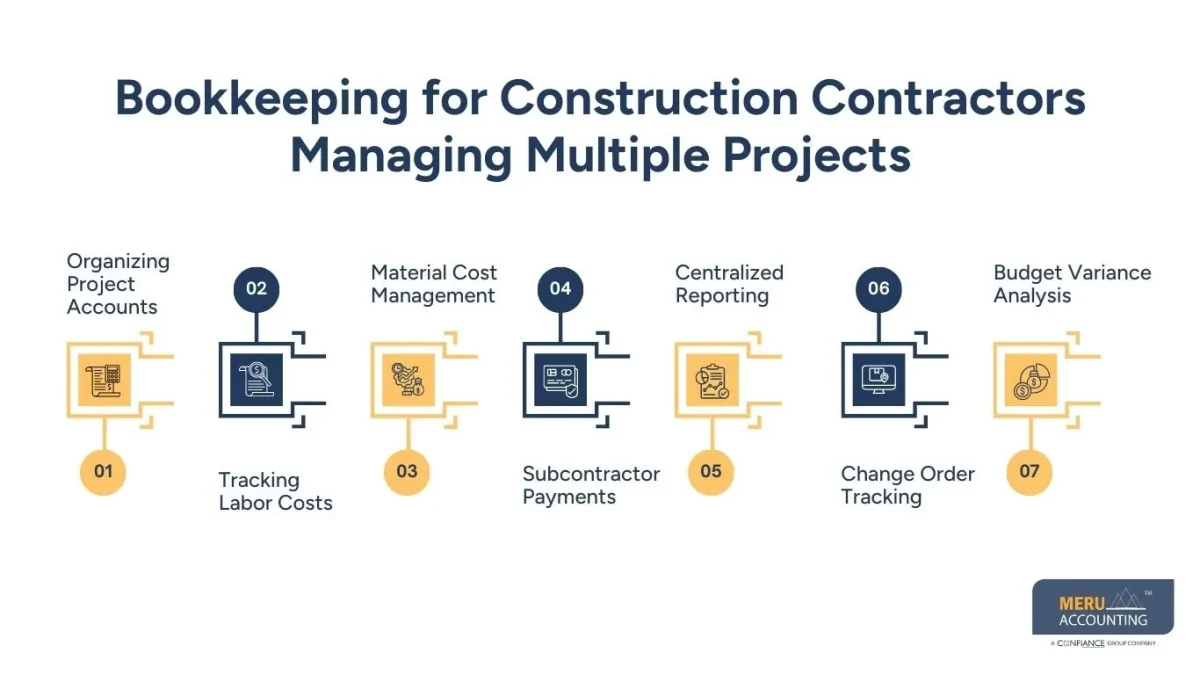
Bookkeeping for Construction Contractors Managing Multiple Projects
Organizing Project Accounts
Each project should have separate accounts to track income, expenses, and subcontractor payments accurately, which is a key aspect of bookkeeping for construction contractors.
Tracking Labor Costs
Detailed time sheets and payroll records are essential for accurate billing and are a critical component of bookkeeping for construction contractors in cost-plus projects.
Material Cost Management
Every purchase must be recorded and matched with project invoices to avoid discrepancies and ensure reimbursement.
Subcontractor Payments
Contractors must manage multiple subcontractor invoices and track payments against each project to maintain financial clarity.
Centralized Reporting
Bookkeeping for construction contractors becomes easier when all project data is centralized, allowing quick access to financial information.
Change Order Tracking
Any modifications to project scope or additional work should be recorded promptly to ensure accurate billing and cost recovery.
Budget Variance Analysis
Comparing actual costs with budgeted amounts for each project is a key function of bookkeeping for construction business, helping identify overspending early.
Financial Key Performance Indicators (KPIs) Every Construction Contractor Should Track
Gross Profit Margin
Measures overall profitability by comparing project revenue to total project costs, supported by accurate bookkeeping for construction business.
Project Cost Variance
Tracks differences between estimated and actual costs to identify budgeting issues early.
Accounts Receivable Aging
Helps contractors track unpaid invoices and improve cash flow management.
Labor Efficiency
Measures productivity by comparing actual labor costs to estimated labor expenses.
Overhead Ratio
Tracks indirect costs, ensuring that administrative expenses are under control and do not eat into profits.
Equipment Utilization Rate
Monitors the usage of machinery and tools to ensure investments are maximized, a valuable insight gained from bookkeeping for construction business.
Change Order Impact
Evaluates the financial effect of scope changes on project profitability, helping contractors adjust budgets and pricing strategies.
Tips for Streamlining Bookkeeping During Rapid Project Growth
Use Project-Specific Accounts
Separate accounts for each project simplify expense tracking and reporting, making bookkeeping for construction business more efficient for cost-plus contracts.
Automate Data Entry
Bookkeeping software can reduce manual work and improve accuracy for bookkeeping for construction business.
Regular Reconciliation
Frequent reconciliation ensures that recorded expenses match actual bank and supplier statements.
Track Subcontractor Work Closely
Detailed records of subcontractor payments prevent disputes and ensure timely reimbursements.
Train Staff in Bookkeeping Practices
Educating your team on bookkeeping for construction contractors ensures consistency and reduces errors.
Monitor Budget Variances in Real-Time
Analyze deviations between planned and actual costs to enable timely adjustments and prevent budget overruns.
Utilize Cloud-Based Reporting
Use cloud-based bookkeeping tools to provide instant access to financial data across multiple projects, improving decision-making and transparency.
Meru Accounting’s Professional Bookkeeping Solutions for Construction Businesses
Managing finances in the construction industry can be complex, making professional bookkeeping for construction contractors essential as projects shift from fixed-price to cost-plus contracts.
Meru Accounting provides specialized bookkeeping solutions that help construction businesses maintain accurate records, control costs, and make informed decisions. With our expertise, contractors can focus on delivering projects while we handle the financial details.
Customized Bookkeeping Solutions
Meru Accounting provides bookkeeping services tailored to construction businesses, helping track costs, labor, and materials efficiently.
Expertise in Cost-Plus Contracts
Our team ensures that bookkeeping for construction contractors aligns with cost-plus contracts, reducing errors and improving transparency.
Cloud-Based Accounting
We use secure, cloud-based software to manage project finances, making it easy to track multiple projects in real-time.
Financial Analysis and Reporting
Meru Accounting delivers insightful reports and KPIs to help construction businesses make informed decisions.
Compliance and Audit Support
Our services ensure all financial records meet regulatory standards and are ready for audits if needed.
Cost Control and Budget Management
Meru Accounting helps construction businesses monitor project budgets closely, identify cost overruns early, and implement strategies to control expenses effectively.
Dedicated Client Support
Our team provides ongoing support and guidance to construction contractors, answering queries, resolving bookkeeping challenges, and ensuring smooth financial operations.
Contact Meru Accounting today to simplify your construction bookkeeping and stay on top of every project cost.
Key Takeaways
- Bookkeeping for construction business is more critical than ever as pricing models shift from fixed-price to cost-plus.
- Accurate expense tracking and timely reporting are essential for cost-plus projects.
- Construction contractors managing multiple projects need organized accounts and clear documentation.
- Monitoring financial KPIs helps contractors make informed decisions and maintain profitability.
- Partnering with professional bookkeeping services like Meru Accounting ensures efficiency, accuracy, and compliance.
FAQs
Bookkeeping for construction business is the process of recording all financial transactions, including costs, revenues, and expenses, to keep project finances accurate.
It focuses on project-based accounting, tracking labor, materials, and subcontractor expenses for each project separately.
Cost-plus requires detailed expense documentation for reimbursement, unlike fixed-price projects, where costs are predetermined.
Yes, by tracking expenses accurately, monitoring KPIs, and managing cash flow, contractors can reduce waste and increase profits.
Project cost summaries, labor cost reports, accounts receivable, and profit reports help track expenses and ensure accurate client billing.


