




Construction businesses do not fail because contractors lack skill on the job site. Most financial problems begin far from the field, inside poorly organized books. When numbers are unclear, decisions are made on guesswork rather than facts. This is exactly why bookkeeping for construction industry matters more than many contractors realize.
Unlike businesses that sell products or fixed services, construction work is always moving. Costs rise and fall, labor hours change daily, and payments arrive in stages. A system that only tracks money in and money out cannot support this level of complexity. Bookkeeping for construction industry must follow each project, each crew, and each dollar from start to finish. Without this structure, growth often creates more chaos instead of more profit.
Many contractors believe financial problems appear suddenly, but they usually build slowly. Projects look busy, cash feels tight, and profits remain unclear. These issues are rarely caused by lack of work. They come from not having construction specific bookkeeping in place. This blog will show you how bookkeeping in construction industry actually works, what makes it different and how a specialized bookkeeper for construction can bring long term stability to your business.
What You Will Learn From This Blog
This blog is designed to give contractors practical clarity, not accounting jargon. By the end, you will understand:
- Why bookkeeping for construction industry is different from general bookkeeping
- What makes construction accounting more complex
- The key components every contractor must track
- The risks of DIY bookkeeping in construction
- How a professional bookkeeper for construction supports business growth
- Why Meru Accounting is built specifically for construction businesses
Whether you are a small contractor or managing multiple large projects, this blog will help you make better financial decisions.
Why Construction Businesses Need Specialized Bookkeeping
Construction businesses do not operate like regular service companies. Each project is unique, costs change constantly, and payments are rarely immediate. This is why bookkeeping in the construction industry requires specialized knowledge.
Key reasons construction needs specialized bookkeeping
- Projects are job based, not product based
- Costs must be tracked per project, not just monthly
- Payments are tied to progress, milestones, or completion
- Retainage delays cash flow
- Change orders affect both cost and revenue
A generic bookkeeper may track income and expenses correctly, but that is not enough. A dedicated bookkeeper for construction understands how projects flow financially and how to track them accurately.
Without proper bookkeeping for construction industry, contractors often face:
- Cash flow shortages
- Underbilling or overbilling
- Inaccurate job profits
- Tax compliance risks
Specialized bookkeeping helps contractors stay in control, even during complex projects.
Why Bookkeeping for Construction Industry Is More Complex
Job Costing vs. Standard Accounting
One of the biggest differences in bookkeeping for construction industry is job costing.
Standard accounting focuses on total business profit. Construction bookkeeping focuses on profit per job.
Each project has its own:
- Labor costs
- Material costs
- Equipment usage
- Subcontractor expenses
- Overhead allocation
A professional bookkeeper for construction tracks these costs separately for every job. This allows contractors to know exactly which projects are profitable and which are not.
Without job costing:
- Contractors guess their margins
- Losses remain hidden
- Future bids become inaccurate
Job costing is the foundation of reliable bookkeeping in the construction industry.
Multiple Projects, Timelines, and Payment Schedules
Most contractors manage several projects at the same time. Each project may have a different start date, end date, billing cycle, and payment terms.
Bookkeeping for construction industry must handle:
- Overlapping project timelines
- Progress billing
- Partial payments
- Delayed collections
A skilled bookkeeper for construction ensures revenue is recorded correctly and matched with the right project costs. This prevents cash flow confusion and inaccurate financial reports.
Without this level of tracking, contractors often feel busy but broke.
Change Orders and Retainage Tracking
Change orders are common in construction. They adjust project scope, cost, and timelines. If not tracked properly, they lead to lost revenue.
Bookkeeping for construction industry ensures:
- Approved change orders are recorded
- Additional costs are tracked
- Extra billing is not missed
Retainage adds another challenge. Clients hold back a portion of payment until the job is complete.
A professional bookkeeper for construction tracks:
- Retainage amounts
- Release schedules
- Outstanding balances
Missing retainage tracking can hurt cash flow and profitability.
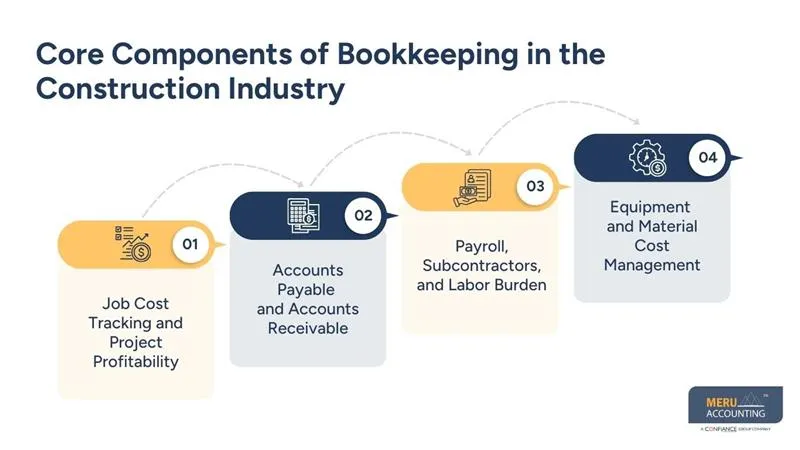
Core Components of Bookkeeping in the Construction Industry
Job Cost Tracking and Project Profitability
Job cost tracking is the heart of bookkeeping in the construction industry. It shows where money is being spent and how each project is performing.
Key elements include:
- Budgeted vs actual costs
- Labor and subcontractor tracking
- Material and equipment allocation
- Profit margins per project
A professional bookkeeper monitors these details regularly, not just at the end of the job. Early insights help contractors fix problems before they grow.
Accounts Payable and Accounts Receivable
Managing cash flow is critical in construction. Bookkeeping for construction industry must carefully balance money going out and money coming in.
Accounts payable includes:
- Supplier invoices
- Subcontractor bills
- Equipment rentals
Accounts receivable includes:
- Progress invoices
- Retainage
- Final payments
A skilled bookkeeper ensures:
- Bills are paid on time
- Invoices are sent correctly
- Overdue payments are followed up
This keeps operations running smoothly without financial strain.
Payroll, Subcontractors, and Labor Burden
Payroll is often the largest expense in construction businesses.
Bookkeeping for construction industry must handle:
- Hourly wages and overtime
- Union and prevailing wage rules
- Payroll taxes
- Workers compensation
Labor burden includes all additional costs beyond wages. A professional bookkeeper allocates labor burden accurately to each job, ensuring true job profitability.
Subcontractor payments require:
- Accurate billing
- Compliance tracking
- Proper expense allocation
Mistakes here can lead to legal and financial risks.
Equipment and Material Cost Management
Construction equipment represents a major investment. Bookkeeping for construction industry must track equipment usage and costs properly.
This includes:
- Depreciation
- Maintenance
- Rental vs ownership costs
- Job specific allocation
Material prices fluctuate often. A reliable bookkeeper tracks material costs in real time to avoid budget overruns and pricing surprises.
Good tracking improves cost control and long term planning.
DIY vs. Hiring a Professional Bookkeeper for Construction
Many contractors try to manage bookkeeping themselves, especially in the early stages. While this may seem cost effective, it often creates problems as the business grows.
DIY bookkeeping challenges
- Time consuming
- High risk of errors
- Limited understanding of construction accounting
- Missed deductions and compliance issues
Bookkeeping for construction industry is not just data entry. It requires industry specific knowledge and experience.
Benefits of hiring a professional
A professional bookkeeper for construction provides:
- Accurate job costing
- Reliable cash flow tracking
- Compliance with tax and labor laws
- Clear financial reporting
Outsourcing bookkeeping for construction industry allows contractors to focus on projects instead of paperwork.
Bookkeeping for Construction Industry With Meru Accounting
Meru Accounting specializes in bookkeeping for construction industry. We understand the unique challenges contractors face every day. By serving all types of businesses in the construction industry, we have gained a lot of experience in its bookkeeping. We help all the types of businesses or individuals involved in the construction industry with accounting and bookkeeping services.
Here’s how Meru Accounting supports contractors:
- Dedicated bookkeeper for construction expertise
- Job costing and project profitability tracking
- Payroll and subcontractor management
- Retainage and change order tracking
- Monthly financial reports designed for contractors
Our systems are built to grow with your business. Whether you manage a few projects or dozens, our bookkeeping for construction industry services bring clarity and control.
With Meru Accounting, contractors gain confidence in their numbers and make better business decisions.
Key Takeaways
- Bookkeeping for construction industry is complex and highly specialized
- Job costing is essential for accurate project profitability
- Cash flow depends on proper billing and retainage tracking
- Payroll and labor burden must be allocated correctly
- Hiring a professional bookkeeper saves time and reduces risk
- Meru Accounting provides construction focused bookkeeping support
FAQs
Because construction uses job based accounting, progress billing, and retainage, which are not part of standard bookkeeping.
Yes. Even small contractors benefit from a professional bookkeeper for construction to track costs accurately and maintain cash flow.
Job costing shows the true cost and profit of each project, which is a core part of bookkeeping for construction industry.
Yes. Proper bookkeeping for construction industry ensures accurate records, deductions, and compliance.
Meru Accounting offers specialized bookkeeping for construction industry with experienced bookkeeper for construction professionals focused on contractor success.


