



Managing finances is one of the biggest challenges in a real estate business. Real estate agents often feel overwhelmed when tracking commissions, income, expenses, and taxes. This is where bookkeeping for real estate agents becomes not just a task but a critical business function.
Using the best software for real estate investors can transform how agents handle finances. With the right tools, bookkeeping becomes faster, more accurate, and less stressful, allowing agents to focus on what they do best—selling and managing properties.
In this blog, we’ll walk you through why bookkeeping is vital, common challenges agents face, the benefits of the right software, and practical steps to simplify your financial management.
What You Will Learn From This Blog
By the end of this guide, you will understand:
- Why bookkeeping for real estate agents is essential for your business growth.
- Common bookkeeping challenges faced by real estate agents.
- How the best software for real estate investors can simplify your accounting processes.
- Key features to look for in bookkeeping software.
- Step-by-step strategies to organize and maintain accurate financial records.
- Tips for choosing software that matches your business size.
- Real-life examples showing how efficient bookkeeping improves profitability.
Why Bookkeeping for Real Estate Agents Matters
Bookkeeping for real estate agents is more than just recording transactions; it’s about creating a clear financial picture of your business. Accurate financial records help you:
- Track income and expenses efficiently.
- Identify profitable properties and investment opportunities.
- Manage taxes with confidence and avoid penalties.
- Prepare detailed financial reports for stakeholders or investors.
- Make data-driven decisions for business growth.
For real estate agents, every commission, rental payment, or repair expense matters. Missing or incorrect entries can lead to financial losses, missed tax deductions, and compliance issues. Implementing strong bookkeeping practices ensures that your financial records are always reliable.
Common Bookkeeping Challenges for Real Estate Agents
Many real estate professionals struggle with bookkeeping because it’s often seen as tedious and time-consuming. Common challenges include:
Tracking Multiple Income Streams
Agents may earn commissions, rental income, and property management fees simultaneously. Keeping these separate can be confusing.
Managing Expenses
In bookkeeping for real estate agents, expenses like repairs, marketing, and office costs must be clearly categorized.
Staying Tax Compliant
Misreporting or missing deductions can lead to fines and audits.
Manual Errors
Spreadsheets are prone to mistakes, especially when managing multiple properties.
Time Constraints
Real estate agents are often busy meeting clients, showing properties, and closing deals, leaving little time for accounting tasks.
These issues often make bookkeeping for real estate agents feel overwhelming without the right tools.
The Benefits of Using the Best Software for Real Estate Investors
Utilizing the best software for real estate investors offers several advantages that traditional bookkeeping methods cannot match:
Automation of Repetitive Tasks
Automation simplifies bookkeeping for real estate agents by reducing manual work and errors.
Real-Time Financial Insights
Instant access to your financial data helps you make timely decisions.
Simplified Tax Filing
Software often integrates tax features, making it easier to report income and claim deductions.
Scalability
Whether you manage one property or a hundred, the software adapts to your growing portfolio.
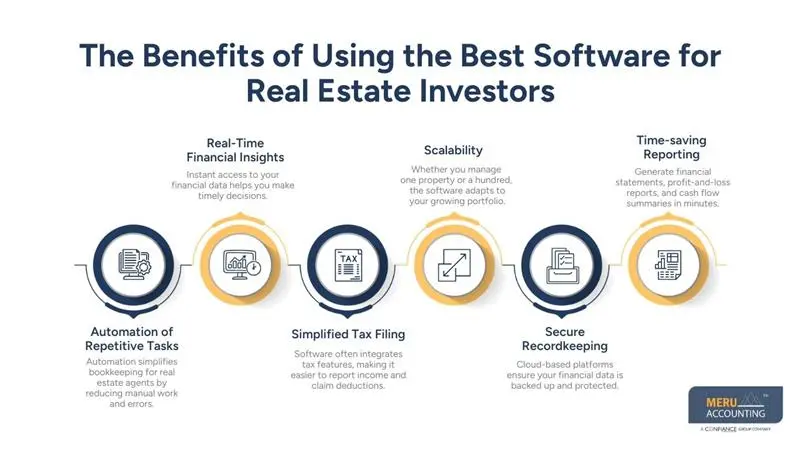
Secure Recordkeeping
Cloud-based platforms ensure your financial data is backed up and protected.
Time-saving Reporting
Generate financial statements, profit-and-loss reports, and cash flow summaries in minutes.
Using software designed specifically for real estate investors ensures that you don’t just track numbers—you gain insights that help you grow your business.
Essential Features to Look for in Bookkeeping Software
Not all bookkeeping software is created equal. When selecting the best software for real estate investors, consider the following features:
Income and Expense Tracking
Ability to record rental income, commissions, and other revenue streams efficiently.
Bank Integration
Connects directly with your bank for automatic transaction updates.
Tax Management
Tools to calculate deductions, track tax deadlines, and prepare forms.
Reporting and Analytics
Generate financial statements, ROI reports, and portfolio performance insights.
Multi-property Management
Manage multiple properties and investment accounts in one place.
Cloud Access
Access your financial data anytime, anywhere, from multiple devices.
User-friendly Interface
Easy to navigate, even for those without an accounting background.
Choosing software with these features will streamline your bookkeeping processes and reduce stress.
Step-by-Step Guide to Simplifying Bookkeeping for Real Estate Agents
Here’s how you can simplify bookkeeping for real estate agents using the right software:
Step 1: Organize Your Accounts
Create separate accounts for personal and business finances. Segregate property income and expenses.
Step 2: Record Transactions Promptly
Log every payment, commission, and expense immediately. Use software to automate categorization.
Step 3: Reconcile Regularly
Regularly match your software records with bank statements to catch errors early.
Step 4: Track Receivables and Payables
Keep a close eye on rent due, commissions owed, and pending bills.
Step 5: Generate Reports
Run weekly or monthly reports to assess cash flow, profits, and property performance.
Step 6: Backup Your Data
Ensure your records are backed up to prevent data loss. Most cloud-based software handles this automatically.
Step 7: Review and Adjust
Periodically review your books to identify trends, unnecessary expenses, or opportunities to improve profitability.
How to Choose the Right Tool for Your Business Size
Choosing the best software for real estate investors depends on the scale of your business:
Solo Agents
Lightweight, easy-to-use software that tracks commissions, expenses, and taxes for smooth bookkeeping for real estate agents.
Small Teams
Software with multi-user access, reporting, and integration with CRM tools.
Large Agencies or Investor Groups
Enterprise-level solutions with advanced reporting, portfolio management, and analytics.
Always consider scalability, ease of use, and customer support when making your choice.
Tips to Maintain Accurate Records and Stay Organized
Accurate records are key to stress-free bookkeeping for real estate agents.
- Record transactions daily to keep bookkeeping for real estate agents accurate and up to date.
- Keep receipts and invoices digitally organized.
- Categorize income and expenses consistently.
- Automate recurring transactions like rent payments or property management fees.
- Review your financial statements regularly.
- Back up your financial data to prevent loss from hardware failure or errors.
- Reconcile bank accounts monthly to catch discrepancies early.
- Set reminders for important deadlines like tax filings, rent due dates, and bill payments.
These habits, combined with the right software, help you save time and reduce errors.
How the Best Software for Real Estate Investors Can Boost ROI
Maximizing return on investment (ROI) is a key goal of effective bookkeeping for real estate agents and investors. Using the best software for real estate investors can significantly enhance your ROI in several ways:
Accurate Expense Tracking
The software ensures that every repair, maintenance cost, and operational expense is recorded correctly. This prevents overspending and identifies areas where costs can be reduced.
Better Investment Decisions
By providing detailed reports on property performance, rental income, and market trends, the software helps you make informed decisions about buying, selling, or upgrading properties.
Time Savings
Automation reduces the hours spent on bookkeeping tasks, freeing up your time to focus on income-generating activities like property sales and client acquisition.
Tax Optimization
Integrated tax tools highlight deductions and credits that real estate agents or investors may qualify for, lowering your taxable income and improving overall profitability.
Portfolio Analysis
With clear bookkeeping for real estate agents, it becomes easy to spot top assets and plan growth.
Cash Flow Management
Real-time insights into rental payments, mortgages, and expenses ensure that you maintain healthy cash flow, reducing the risk of financial strain.
Using the best software for real estate investors turns bookkeeping from a passive task into an active strategy for increasing ROI. Agents and investors not only save time and reduce errors but also gain a clear view of their financial health, enabling smarter, profit-driven decisions.
Real-life Example
A real estate agent managing multiple rental properties and earning commissions on sales initially tracked everything using spreadsheets. Transactions were often missed, expenses were miscategorized, and tax season became a stressful process.
After implementing the best software for real estate investors, income tracking was automated, accounts could be reconciled in minutes, and tax-ready reports were generated effortlessly. Bookkeeping became simpler, and valuable insights into the most profitable properties were gained, enabling smarter investment decisions.
Why Choose Meru Accounting?
At Meru Accounting, we understand the unique financial challenges faced by real estate agents. Our services simplify bookkeeping for real estate agents by:
- Offering tailored solutions for managing multiple properties and investments.
- Ensuring compliance with tax regulations to avoid penalties.
- Providing accurate financial reporting for informed business decisions.
- Assisting with software selection to implement the best software for real estate investors, suited to your business needs.
- Streamlining commission tracking and expense management for maximum efficiency.
- Offering insights into cash flow and profitability to help make smarter investment decisions.
- Supporting year-end preparation and audit-ready reporting to reduce stress.
Key Takeaways
- Bookkeeping for real estate agents is essential for financial clarity, tax compliance, and business growth.
- Manual bookkeeping is prone to errors and can be time-consuming.
- The best software for real estate investors automates tasks, provides insights, and ensures accurate records.
- Choose software with features like income tracking, multi-property management, and tax support.
- Regular reconciliation, record-keeping, and review are critical to maintaining accurate books.
- Partnering with experts like Meru Accounting ensures your bookkeeping is handled professionally.
FAQs
Bookkeeping keeps track of income, expenses, and taxes, allowing agents to make informed decisions and avoid financial errors.
While software simplifies bookkeeping, accountants provide strategic insights, tax planning, and compliance expertise.
Look for income tracking, multi-property management, tax preparation tools, reporting capabilities, and cloud access.
Ideally, reconcile monthly to catch errors early and maintain accurate records.
By tracking rent payments, expenses, and maintenance costs, bookkeeping helps identify profitable properties and avoid losses.


