




Running a law firm means handling client work, deadlines, and financial records. Without strong law office accounting, it is easy for billing, expenses, and trust funds to get mixed up. This can lead to stress, compliance issues, and reports that do not help partners make smart decisions.
In this blog, we explain how professional accounting for law offices creates clear, accurate MIS reports that support better planning and control.
What You Will Learn From This Blog
In this blog, you will learn:
- What law office accounting is and why it matters.
- The key components of compliant accounting for law firms.
- How accurate records improve transparency and trust.
- How law office solutions support trust accounting and client funds.
- How to build clear and actionable MIS reports.
- Common accounting issues law firms face and how to solve them.
- Benefits of outsourcing law office accounting to experts.
- Best practices for accounting and MIS report accuracy.
- How law office solutions help with regulatory compliance
What Is Law Office Accounting and How Does It Support MIS Reporting
Law office accounting is the process of recording, tracking, and reporting all financial activity in a law firm. This includes billing, payroll, vendor payments, expenses, and trust accounts. A key goal of this accounting is to create reliable MIS reports that show how the firm is performing, where money is going, and what decisions need attention. When the records are accurate, the MIS reports become a useful tool for partners, practice heads, and finance teams.
Law firms often need to follow strict rules for client funds and trust accounting. When these rules are met, the firm stays compliant and avoids penalties. Proper accounting also ensures that cash flow is visible, expenses are controlled, and profit margins are clear.
MIS reports that come from clean accounting help law firms plan for growth, set realistic budgets, and monitor performance by practice area.
Key Components of Compliant Law Office Accounting
Compliant accounting includes several key components that keep financial records clean and reliable:
1. Client Billing and Time Tracking
Accurate billing starts with correct time tracking. Lawyers must record time in a consistent way so invoices reflect the work done. The accounting team then matches billed time to client invoices, ensuring there are no gaps or mismatches.
2. Expense Management
Law firms have many expense types, from office supplies to expert witness fees. Proper accounting categorizes expenses correctly and links them to the right matters. This helps in preparing accurate profit and loss reports for each practice area.
3. Trust Accounting and Client Funds
Trust accounts are a major part of law office accounting and law firm finance. Accounting must track client funds separately from firm funds. This includes recording deposits, withdrawals, and any disbursements made on behalf of clients.
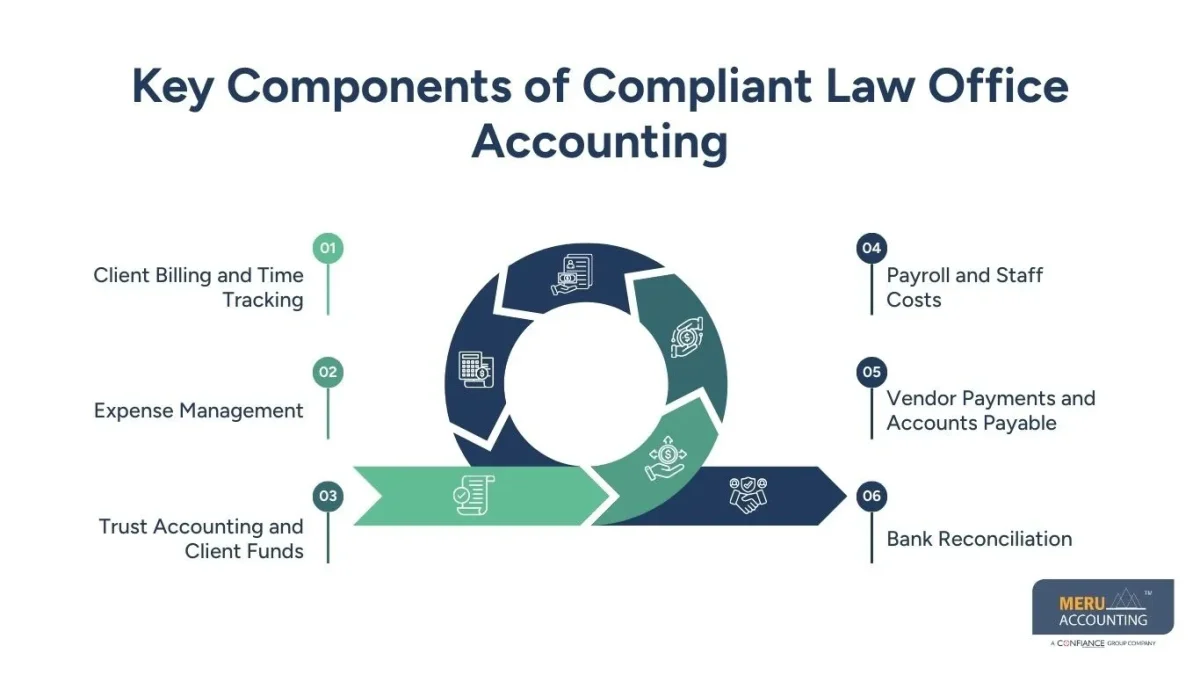
4. Payroll and Staff Costs
Payroll is often the largest expense for a law firm. Accounting must handle salaries, bonuses, taxes, and benefits accurately. This helps in measuring the true cost of running the firm.
5. Vendor Payments and Accounts Payable
Law firms work with many vendors, such as court reporters, consultants, and technology providers. Accounts payable need to be tracked carefully so bills are paid on time and cash flow is not strained.
6. Bank Reconciliation
Bank reconciliation is a simple but powerful control. It compares the firm’s accounting records to bank statements to catch errors or missing entries. This step is essential for clean MIS reports.
How Professional Accounting Enhances Transparency in Law Firms
Professional law office accounting brings transparency by creating clear records that everyone can trust. When partners and managers can see accurate numbers, they can discuss financial performance without confusion.
Transparency also builds confidence among clients, especially when trust funds are involved.
A law firm that uses professional accounting can clearly show:
- How much revenue was earned by each practice area
- Which clients are profitable and which are not
- Where expenses are rising and why
- Whether cash flow is stable or needs attention
Transparency is not only about sharing numbers. It is also about having a process that ensures the numbers are correct. Professional accounting creates that process, including checks, reviews, and controls.
When the accounting is strong, MIS reports become a reliable tool rather than a set of numbers that no one trusts.
Law Office Solutions for Accurate Trust Accounting and Client Funds
Law office solutions are tools and systems designed to support law firms with accounting, trust management, and reporting. These solutions help law firms track client funds accurately and avoid common trust accounting errors.
Key features include:
- Matter-wise fund tracking
- Automated trust ledgers
- Alerts for low balances or overdue reconciliations
- Client statement generation
- Secure handling of client deposits and withdrawals
When a firm uses strong law office accounting solutions, trust accounting becomes easier to manage. The system can flag mismatches early, reducing the risk of compliance issues. This also saves time for the accounting team, allowing them to focus on analysis rather than manual work.
Building Clear & Actionable MIS Reports for Better Decision Making
MIS reports are only useful when they are clear, accurate, and easy to act on. Accounting provides the data needed to build these reports. Here are the key steps to create actionable MIS reports:
1. Define the Report Purpose
Each MIS report should have a clear purpose. For example, a report might show matter profitability, cash flow, or billing performance. Knowing the purpose helps decide what data to include.
2. Use Consistent Categories
Expenses and revenue should be categorized consistently across the firm. This makes it easier to compare performance month to month and identify trends.
3. Include Key Metrics
Actionable MIS reports include key metrics such as:
- Revenue by practice area
- Realization and collection rates
- Matter profitability
- Cash flow forecast
- Trust account balances
- Overdue invoices
4. Use Visuals and Summaries
Charts and summaries help partners quickly understand the numbers. A short summary at the top of the report can highlight the main issues and next steps.
5. Review and Clean Data Regularly
MIS reports are only as good as the data. Regular review and clean-up of accounting entries is essential. This includes correcting misclassified expenses and ensuring all invoices are recorded.
Common Law Office Accounting Challenges and How to Solve Them
Law firms often face common accounting challenges that can affect MIS report quality. Here are some typical issues and practical solutions:
1. Incorrect Time Tracking
If time is not recorded correctly, billing becomes inaccurate. The solution is to standardize time entry practices and review time entries weekly. Practice management tools can also automate time tracking reminders.
2. Trust Account Errors
Trust accounting errors can cause compliance issues. The solution is to reconcile trust accounts frequently and use systems that enforce controls and provide alerts.
3. Unclear Matter Costing
When expenses are not linked to the correct matter, profitability reports are unreliable. The solution is to ensure every expense is assigned to a matter and reviewed monthly.
4. Slow Invoice Collections
Delayed collections affect cash flow and reporting. The solution is to set clear payment terms, send reminders, and track aging reports. Professional accounting can also identify clients with repeated delays.
5. Manual Data Entry
Manual entry increases errors and slows reporting. The solution is to use software that automates invoicing, bank feeds, and expense capture.
Benefits of Outsourcing Law Office Accounting to Experts
Outsourcing law office accounting brings several benefits, especially for firms that want clean MIS reports without adding staff. Outsourcing provides access to experienced accountants who understand law firm finance and compliance. Key benefits include:
- Accurate and timely essential bookkeeping
- Expert handling of trust accounts
- Faster MIS report preparation
- Reduced risk of compliance issues
- Better cash flow monitoring
- More time for lawyers to focus on clients
When a law firm outsources accounting, the firm can also benefit from standardized processes and a structured review system. This helps ensure that the MIS reports are consistent and useful each month.
Best Practices for Law Office Accounting and MIS Report Accuracy
To keep accounting and MIS reports accurate, law firms should follow best practices:
1. Separate Client Funds from Firm Funds
Trust accounts must be separate from firm operating accounts. This is a key compliance requirement and a best practice for clean accounting.
2. Reconcile Accounts Regularly
Bank reconciliation should be done monthly, and trust reconciliations should be done more often. Regular reconciliation helps catch errors early.
3. Keep Matter Records Updated
Each matter should have clear records of billable hours, expenses, and payments. This supports accurate matter profitability reports.
4. Standardize Chart of Accounts
A consistent chart of accounts makes reporting easier and more accurate. It also helps when the firm grows or adds new practice areas.
5. Review Reports with Partners
MIS reports should be reviewed with partners or practice heads monthly. This ensures that the reports are used for decision-making, not just filed away.
A simple review checklist can also help. Each month, confirm that all invoices are posted, expenses are matched to matters, and bank entries are cleared.
Check for any old client balances and follow up promptly. A short meeting with the finance team and partners can turn the report into a clear action plan for the next month.
How Law Office Solutions Ensure Regulatory Compliance
Law office solutions help firms stay compliant by enforcing rules and providing controls. For example, trust accounting rules often require separate ledgers for each client. Systems can automate these ledgers and produce audit-ready reports.
Audit Trails for All Transactions
Every transaction is recorded with a clear audit trail, making it easy to track and review activity.
Secure Access Controls
Access is restricted based on roles, ensuring only authorized staff can view or manage trust accounts.
Automatic Interest Calculation on Trust Funds
Systems can automatically calculate and apply interest on trust funds when needed, ensuring accuracy and compliance.
Compliance Checks for Fee Agreements and Retainers
The solution verifies fee agreements and retainer terms to ensure they comply with legal and regulatory requirements.
Reporting for Regulators and Internal Review
The system generates comprehensive reports for regulatory submissions and internal audits.
With the right tools, compliance becomes part of the daily process rather than a yearly task. This reduces the risk of penalties and improves trust with clients.
How Meru Accounting Helps with Professional Law Office Accounting
At Meru Accounting, we provide law office accounting services designed to deliver clear and actionable MIS reports. Our team understands law firm finance, trust accounting rules, and the need for accurate reporting.
We work with law firms to set up compliant accounting systems, handle day-to-day bookkeeping, and prepare monthly MIS reports that support better decisions.
Accounting Setup and Chart of Accounts
A structured chart of accounts is designed and set up specifically for law firms to ensure accurate financial tracking and reporting.
Trust Accounting and Client Fund Management
Trust accounts and client funds are managed in full compliance with regulatory requirements, ensuring transparency and accuracy.
Billing Support and Invoice Management
Billing processes, invoice generation, and payment tracking are handled efficiently to ensure timely collections.
Expense Tracking and Matter Costing
Expenses are tracked and allocated by matter to help law firms understand profitability and control spending.
Monthly MIS Report Preparation and Review
Monthly management information system (MIS) reports are prepared and reviewed to support informed decision-making.
Compliance Support and Audit-Ready Reporting
Ongoing compliance support is provided along with audit-ready reporting to reduce risk and ensure transparency.
With Meru Accounting, law firms can focus on serving clients while we ensure their financial records are accurate and compliant. Our goal is to make accounting simple, clear, and reliable
Key Takeaways
- Law office accounting is essential for accurate billing, trust accounting, and MIS reporting.
- Compliant accounting supports clear financial reports and reduces risk.
- Law office solutions help manage trust accounts and client funds accurately.
- Actionable MIS reports guide better decision-making and planning.
- Outsourcing law office accounting to experts can improve accuracy and save time.
- Regular reconciliation and standardized processes keep MIS reports reliable.
FAQs
Law office accounting is the process of recording and tracking all financial activity in a law firm, including billing, expenses, payroll, and trust accounts.
MIS reports show the firm’s financial performance, cash flow, and matter profitability. They help partners make better decisions.
Law office solutions track client funds separately, create trust ledgers, and alert the team to any mismatches or low balances.
Yes. Outsourcing gives law firms access to experienced accountants who handle bookkeeping, trust accounting, and report preparation, freeing lawyers to focus on clients.
Law firms should reconcile bank accounts monthly and trust accounts more often, depending on the volume of client funds.


