




Construction accounting plays a major role in keeping construction businesses financially stable, especially when projects start and end at different times. Many contractors face serious cash flow problems, not because they lack work, but because money does not come in when it is needed. Expenses continue, payroll must be paid, and overhead costs never stop. Without proper accounting, these gaps can quietly grow into financial stress.
Unlike regular bookkeeping, accounting for construction projects focuses on project-based income and expenses. It helps contractors track costs, control billing, and plan cash movement between projects. When done correctly, it allows businesses to avoid cash shortages and stay prepared for upcoming jobs.
This blog explains how project-based accounting helps prevent cash flow gaps between projects and why using the right accounting methods is important for long-term success.
What You Will Learn From This Blog
In this blog, you will learn:
- What construction accounting is and how it differs from general accounting
- Why do cash flow gaps occur between construction projects
- How project-based accounting supports steady cash flow
- Which construction accounting methods help control project finances
- How billing, retentions, and receivables affect cash flow
- How overhead costs are managed using construction project accounting
- The importance of work-in-progress reports
Common cash flow mistakes contractors make
What Is Construction Accounting and How Does It Differ From General Accounting?
Construction accounting is a specialized accounting system designed for construction businesses that work on projects rather than selling products or services daily. Each project has its own budget, timeline, costs, and payment schedule.
General accounting focuses on monthly income and expenses. Construction bookkeeping and accounting focuses on job-level tracking, where every cost and payment is linked to a specific project.
Difference Between Construction Accounting and General Accounting
Basis of Comparison | Construction Accounting | General Accounting |
Business Type | Used by construction businesses that work on projects | Used by businesses selling products or regular services |
Focus Area | Focuses on individual projects | Focuses on overall business performance |
Income Recording | Income is recorded based on project progress | Income is recorded monthly or when sales occur |
Cost Tracking | Costs are tracked by job, phase, or task | Costs are tracked by category (rent, payroll, utilities) |
Billing Method | Payments depend on progress billing and client approvals | Payments are usually received at the time of sale |
Cash Flow Pattern | Cash flow changes based on project timelines | Cash flow is more regular and predictable |
Budgeting | Each project has its own budget | One general business budget is used |
Financial Reporting | Reports are project-based | Reports are company-wide |
Because of these factors, construction accounting methods are required to manage complex financial movements across multiple projects.
Why Cash Flow Gaps Occur Between Construction Projects
Cash flow gaps are common in construction. Below are the main reasons why they happen:
Delayed Payments From Clients
Payments often depend on approval cycles. Even after work is completed, payment may take weeks or months.
Retention Amounts Held Back
A portion of the payment is retained until project completion. This limits cash availability during the project.
High Upfront Costs
Materials, labor, and equipment costs are paid before receiving client payments.
Poor Project Cost Tracking
Without construction project accounting, contractors may not know their real project costs.
Overlapping Project Timelines
When one project ends, and another has not started billing, income drops suddenly.
Lack of Cash Planning
Many contractors focus on profit but ignore timing, which is where construction project accounting becomes essential.
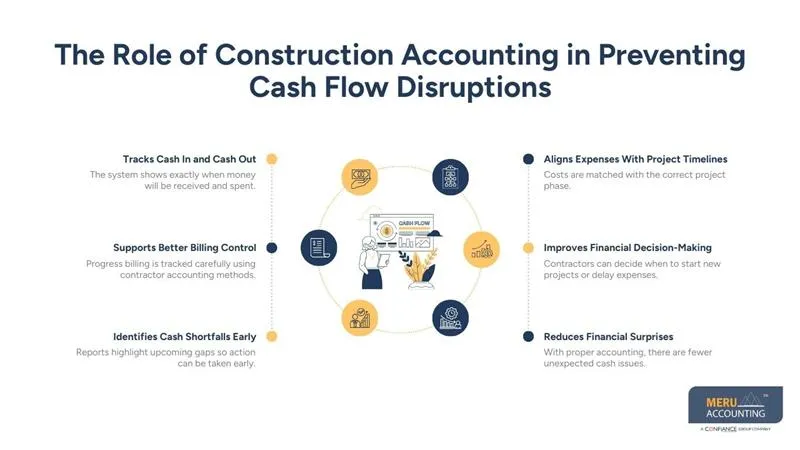
The Role of Construction Accounting in Preventing Cash Flow Disruptions
Contractors stay prepared for cash flow changes by maintaining clear financial visibility.
Tracks Cash In and Cash Out
The system shows exactly when money will be received and spent.
Supports Better Billing Control
Progress billing is tracked carefully using contractor accounting methods.
Identifies Cash Shortfalls Early
Reports highlight upcoming gaps so action can be taken early.
Aligns Expenses With Project Timelines
Costs are matched with the correct project phase.
Improves Financial Decision-Making
Contractors can decide when to start new projects or delay expenses.
Reduces Financial Surprises
With proper accounting, there are fewer unexpected cash issues.
How Construction Accounting Improves Project-Based Cash Flow Planning
Project-based planning is one of the strongest benefits of construction bookkeeping and accounting.
Project-Specific Budgets
Each job has a defined budget tracked through project-based accounting.
Phase-Wise Cost Control
Costs are reviewed at each stage of the project.
Forecasting Future Cash Needs
Construction accounting methods help predict cash requirements.
Better Labor Cost Management
Payroll is planned based on project timelines.
Controlled Vendor Payments
Vendor bills are scheduled without affecting cash flow.
Smooth Project Transitions
Cash planning ensures funds are available between projects.
Key Construction Accounting Methods That Help Manage Cash Flow
Choosing the right construction accounting methods is critical for managing cash.
Percentage of Completion Method
Revenue is recognized based on work completed.
Completed Contract Method
Income is recorded after project completion.
Job Costing
Tracks labor, materials, and overhead per project.
Cash Basis Accounting
Income is recorded when cash is received.
Accrual Accounting
Income and expenses are recorded when earned.
Hybrid Construction Accounting Methods
Many contractors use a mix based on business size.
These construction accounting methods help contractors control income timing and avoid cash gaps.
How Construction Accounting Tracks Retentions, Progress Billing, and Receivables
Billing plays a major role in cash flow.
Progress Billing Tracking
Construction bookkeeping and accounting ensures invoices always match completed project work.
Retention Monitoring
Construction bookkeeping tracks retained amounts separately for clear financial visibility.
Receivable Aging Reports
Receivable aging reports help identify late client payments quickly.
Dispute Management
Proper records help resolve billing disputes faster and more accurately.
Payment Follow-Ups
Construction bookkeeping and accounting systems support timely payment reminders and follow-ups.
Accurate Revenue Reporting
Accurate revenue reporting records only include income from projects.
Managing Overheads and Fixed Costs With Construction Accounting Systems
Overheads continue even when projects pause.
Rent and Office Expenses
Project-based accounting allocates rent and office overheads correctly.
Insurance and Licenses
Fixed insurance and license costs are planned across projects.
Equipment Costs
Equipment depreciation and rental costs are tracked accurately.
Administrative Salaries
Administrative payroll is planned using construction accounting systems.
Cost Allocation
Expenses are divided fairly across all active construction projects.
Cash Reserves Planning
Project-based accounting helps maintain cash reserves for stability.
How Construction Accounting Supports Better Budgeting Across Multiple Projects
Handling multiple projects increases financial pressure.
Combined Cash Flow View
Construction accounting shows the combined cash flow for all projects together.
Budget Comparisons
Planned versus actual project costs are reviewed regularly for accuracy.
Resource Planning
Labor and equipment resources are allocated wisely across multiple projects.
Avoids Overcommitment
New projects are accepted only when available cash clearly allows.
Improves Profit Forecasts
Project-based accounting methods support more accurate long-term profit forecasts.
Reduces Financial Risk
Better budgeting helps prevent unexpected cash shortages between projects.
The Importance of Work-in-Progress Reports in Construction Bookkeeping and Accounting
Work-in-progress (WIP) reports are essential tools.
They show:
- Completed work value
- Billed amounts
- Unbilled revenue
- Cost overruns
Construction project accounting uses WIP reports to:
- Measure project health
- Avoid underbilling
- Improve cash flow planning
- Prevent sudden losses
Without WIP reports, contractors operate blindly.
Common Cash Flow Mistakes Contractors Make Without Proper Construction Accounting
Overestimating Available Cash
Contractors often assume more cash is available than reality. This leads to payment delays and unexpected financial pressure.
Ignoring Retention Impact
Retention amounts are often ignored during cash flow planning. This reduces available funds during active construction phases.
Poor Billing Schedules
Invoices are not aligned properly with completed project work. Delayed billing causes slow payments and cash flow gaps.
No Project-Level Tracking
Expenses are tracked broadly instead of by individual projects. This hides cost overruns and weakens financial control.
Mixing Personal and Business Funds
Personal expenses are mixed with construction business finances. This creates confusion and inaccurate cash flow records.
Late Financial Reporting
Financial reports are prepared too late for timely decisions. Delayed reporting prevents early identification of cash issues.
All these mistakes can be avoided with proper construction bookkeeping and accounting and the right construction accounting methods.
Choosing the Right Construction Accounting Methods for Your Business Size
Small Contractors
Cash basis accounting with job costing works well. It helps control daily expenses and simple project tracking.
Growing Businesses
Accrual accounting with progress billing offers better financial control. This method improves billing accuracy and payment timing.
Large Contractors
Advanced construction accounting methods with WIP reports are required. These reports support detailed tracking across complex construction projects.
Number of Projects
Managing more projects requires stronger accounting systems. Multiple projects increase the need for accurate financial reporting.
Payment Terms
Longer payment cycles need careful cash flow planning. Planning helps avoid cash shortages between project milestones.
Software and Support
The right software tools make construction accounting easier. Professional support improves accuracy and financial decision-making.
When to Seek Professional Help for Construction Accounting and Cash Flow Management
Professional help is needed when:
- Cash gaps keep repeating
- Projects show profits, but the bank balance stays low
- Billing and receivables are hard to manage
- Reports are delayed or inaccurate
- Business is growing fast
Expert construction bookkeeping and accounting support helps stabilize finances and improve planning.
How Meru Accounting Helps Construction Businesses Manage Cash Flow
At Meru Accounting, we specialize in construction accounting for contractors, builders, and developers. Our team understands project-based challenges and uses proven accounting methods to control cash flow and improve project profitability.
Our project accounting services include:
Job Costing and Project Tracking
Every cost and expense is tracked per project to keep budgets accurate. Our system helps you identify cost overruns early and reduce losses.
Progress Billing and Retention Tracking
Progress invoices are managed, and retention amounts are monitored for smoother cash flow. We ensure billing matches work progress and avoid delayed payments.
Cash Flow Forecasting
Future cash needs are predicted to help plan for gaps between projects. Our forecasts support better planning for labor, materials, and overhead.
Work-in-Progress (WIP) Reporting
WIP reports are generated to track project progress and financial status. This helps you know the real profit and project health at any time.
Overhead Allocation
Overhead costs are allocated correctly across projects to avoid misreporting. Our approach prevents overhead from eating into project profits.
Software Support and Reporting
Accounting software is supported, and clear financial reports are provided. We help you use the right tools for better cash management.
With Meru Accounting, construction businesses gain clarity, control, and confidence in managing cash between projects.
Contact Meru Accounting today to strengthen your financial control and protect your project profits.
Key Takeaways
- Construction accounting helps prevent cash flow gaps
- Project-based tracking improves financial control
- The right construction accounting methods support a steady income
- WIP reports are essential for cash planning
- Professional support improves long-term stability
FAQs
Construction bookkeeping and accounting tracks project costs and payments, helping contractors avoid running out of cash between projects.
Delayed payments, retentions, and high upfront costs often create cash flow gaps.
The best accounting methods depend on project size, payment terms, and business growth.
It ensures that progress billing is accurate and that payments are followed up on time.
When cash flow issues repeat or projects increase, expert help becomes necessary.


