



Construction accounting becomes harder with each new project because no two jobs are the same. Every project has different costs, timelines, labor needs, and payment terms. As projects increase, the effort needed to track money, control costs, and measure profit also increases. This is why many construction businesses feel their accounting work becomes confusing over time.
Unlike regular businesses, construction companies must track finances by project. This project-based approach makes construction bookkeeping and accounting more detailed and demanding. When jobs overlap and changes happen often, the level of complexity grows even more.
This blog explains why construction accounting becomes more complex with every new project and how better systems and support can help reduce that burden.
What You Will Learn From This Blog
- This blog explains how construction accounting works and why it is different from standard accounting methods used in other businesses.
- You will learn how each new project increases the amount of financial tracking, records, and reviews needed in construction work.
- The blog explains why managing cash flow is more difficult in construction due to delayed payments, upfront costs, and retention amounts.
- You will understand the most common accounting mistakes that increase confusion, errors, and financial pressure for construction businesses.
- You will learn why tracking job costs correctly is important to understand whether a project is making profit or loss.
- The blog explains how better financial reports help construction business owners make clear and confident decisions.
Construction Accounting: What Makes It Different From Traditional Accounting
Construction accounting is a specialized form of accounting used by construction businesses to track income, expenses, and profit for each individual project. Instead of looking at finances on a monthly or departmental basis, it focuses on job-level costs such as labor, materials, equipment, and subcontractor expenses. This method helps contractors understand how each project is performing financially and where money is being spent.
Below is a table showing how construction accounting differs from traditional accounting:
Basis of Comparison | Construction Accounting | Traditional Accounting |
Cost Tracking Method | Costs are tracked for each project separately | Costs are tracked by department or time period |
Billing Style | Billing is based on work completed or project progress | Billing is usually done on fixed dates |
Retention Handling | A portion of payment is held until the project is completed | Retention payments are usually not involved |
Labor Cost Tracking | Labor hours are tracked daily and assigned to specific jobs | Labor costs are recorded as regular payroll expenses |
Contract Types | Multiple contract types require different accounting treatment | Mostly standard pricing or service contracts |
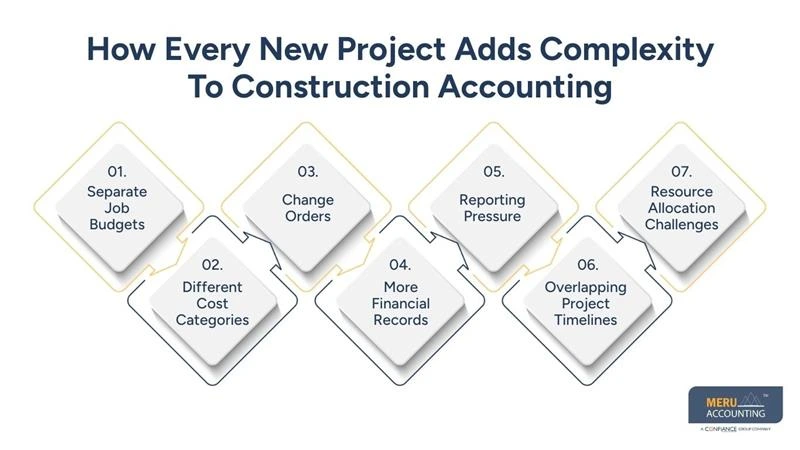
How Every New Project Adds Complexity To Construction Accounting
Separate Job Budgets
Each project requires a separate budget with clearly defined cost limits. Managing multiple budgets increases tracking efforts within construction accounting processes.
Different Cost Categories
Materials, labor, equipment, and overhead costs vary across every project. Accurate classification is necessary to avoid cost confusion and reporting errors.
Change Orders
Client-driven changes force updates to costs, billing, and profit estimates. Frequent revisions make budget control harder throughout active construction projects.
More Financial Records
Invoices, receipts, payroll, and expenses increase as projects continue growing. Handling large volumes of records raises the risk of accounting mistakes.
Reporting Pressure
More active projects create a higher demand for accurate financial reporting. Regular reporting becomes time-consuming when multiple jobs run simultaneously.
Overlapping Project Timelines
Multiple projects running together complicate cost tracking and budget control. Shared timelines make financial monitoring more difficult for accounting teams.
Resource Allocation Challenges
Shared labor and equipment must be tracked carefully across different projects. Incorrect allocation can distort job costs and reduce overall profitability.
Why Cash Flow Management Is Harder In Construction Accounting
Delayed Customer Payments
Clients often take longer to pay construction invoices. This delay can create gaps between outgoing expenses and incoming cash.
Upfront Expenses
Labor and materials must be paid before payments are received. This puts pressure on working capital, especially at the start of a project.
Retention Holdbacks
Held payments reduce available cash during projects. Businesses must continue operations without access to the full contract amount.
Irregular Billing Schedules
Billing depends on job progress, not regular dates. This makes it harder to predict when money will arrive.
Overlapping Jobs
Multiple projects running together complicate cash planning. Costs from one project may rise while payments from another are still pending.
Common Mistakes That Increase Construction Accounting Complexity
Poor Job Cost Tracking
Mixing costs between multiple jobs leads to unclear profit results and inaccurate financial reports. This makes it difficult to understand which projects are earning money or losing money.
Missing Small Expenses
Small costs that go untracked over time slowly reduce overall project profit margins. These expenses often seem minor but create serious financial gaps when added together.
Manual Record Keeping
Using spreadsheets for records increases errors, delays updates, and creates confusion across projects. Manual systems make it harder to maintain accurate and timely construction accounting records.
Late Financial Reviews
Delayed financial reviews hide cost issues until projects are finished and profits are already affected. By then, businesses have limited options to correct mistakes or recover losses.
Weak Cost Controls
Lack of regular monitoring allows project costs to grow unchecked and exceed planned budgets. Without controls, managers cannot react quickly to rising expenses or inefficiencies.
How Accounting Construction Software Brings Clarity To Complex Projects
Centralized Job Records
Accounting construction software keeps all job data organized within one secure system. This reduces confusion by preventing scattered records across spreadsheets and manual files.
Real-Time Cost Updates
Costs are recorded as they happen, improving accuracy across ongoing construction projects. This allows managers to track spending without waiting for delayed financial updates.
Automated Billing
Progress billing becomes easier and more consistent using accounting construction software tools. Invoices are created faster and match completed work more accurately.
Expense Matching
Expenses are linked directly to the right project, preventing misallocation of costs. This improves job costing accuracy and supports better profit analysis.
Clear Job Reports
Managers can see job performance at any time through detailed financial reports. These reports support informed decisions and stronger construction accounting control.
How Accounting Construction Software Helps You Stay Profitable Project By Project
Accurate Job Costing
Accounting construction software tracks real project costs against approved budgets accurately. This helps businesses understand actual profit levels for every completed construction project.
Early Budget Alerts
Overspending is noticed early, before it affects overall project profit margins. Timely alerts allow managers to correct issues before costs rise further.
Better Cash Planning
Clear financial data helps plan payments and customer collections more effectively. This reduces cash shortages during active construction project phases.
Reduced Manual Errors
Automation lowers data entry mistakes caused by repetitive manual accounting tasks. Fewer errors lead to more reliable construction accounting reports and insights.
Smarter Project Decisions
Clear numbers support better bidding, scheduling, and future project planning decisions. Accurate data helps businesses choose projects that match their financial goals.
Improved Labor Cost Control
Accounting construction software tracks labor hours accurately across multiple construction projects. This prevents payroll overruns and supports stronger construction accounting accuracy.
Consistent Profit Tracking
Project profits are tracked consistently from start to completion without missing data. This gives managers confidence in reported results and future financial planning.
Faster Financial Reporting
Reports are generated faster, helping teams review performance without long waiting periods. Quick access to data supports timely actions when project costs change.
Why Construction Accounting Needs Expert Support As Projects Grow
Increased Data Volume
More projects mean more financial data to manage. Handling this volume without errors becomes difficult as records increase across jobs.
Complex Compliance Needs
Taxes and reporting rules must be followed carefully. Missing requirements can lead to penalties and delayed financial filings.
Time Pressure On Owners
Owners often lack time to manage detailed accounting. Daily project demands leave little room for reviewing financial records.
Risk Of Cost Overruns
Without expert review, issues go unnoticed. Costs can exceed budgets before managers realize there is a problem.
Need For Accurate Forecasts
Future planning depends on reliable financial data. Expert support ensures forecasts are based on correct and complete information.
How Meru Accounting Supports Construction Businesses
Construction Accounting Specialists
Meru Accounting understands the daily challenges involved in managing construction accounting processes. Our team applies industry-specific knowledge to ensure accurate and compliant financial records.
Accurate Job Cost Management
We help track project costs clearly and consistently across all active construction jobs. This allows businesses to measure profitability accurately and control expenses effectively.
Software-Based Processes
We work with accounting construction software to improve accuracy and operational efficiency. Our structured approach reduces manual errors and supports reliable financial reporting.
Scalable Accounting Support
Our accounting services grow in line with your project volume and business expansion. This ensures consistent financial management without disruption as operations increase.
Clear Financial Guidance
We help you understand financial data and translate it into practical business decisions. Our guidance supports better planning, cost control, and long-term financial stability.
Managing construction finances becomes easier with the right accounting partner by your side. Contact Meru Accounting to simplify construction accounting and gain better control over your projects.
Key Takeaways
- Construction accounting becomes more complex as each new project adds additional financial tracking work.
- Cash flow requires constant attention because delayed payments and upfront costs increase financial pressure.
- Small accounting mistakes can grow into large losses and significantly reduce overall project profit.
- Accounting construction software helps organize complex project data and improves financial clarity.
- Professional accounting support keeps financial records accurate, reliable, and useful for decision-making.
FAQs
Construction accounting becomes more complex because every project has its own costs, timeline, and billing method. As projects increase, tracking expenses, income, and profit separately becomes harder.
Construction bookkeeping and accounting focus on tracking costs by project instead of monthly totals. It also includes progress billing, retention payments, and job-based cost tracking.
When multiple projects run at the same time, it becomes harder to manage cash flow, payroll, and job costs. This adds more pressure to construction accounting systems.
Accounting construction software helps by keeping all job costs, invoices, and reports in one place. It reduces manual work and improves cost accuracy for each project.
A construction business should improve its accounting system when projects increase, cash flow becomes hard to track, or job costs are no longer clear.


