



In the construction industry, profitability is not determined only by winning bids or completing projects on time. It is deeply tied to how well finances are planned, tracked, controlled, and analyzed throughout the lifecycle of a project. This is where construction accounting services play a critical role.
Unlike traditional accounting, construction-focused financial management aligns costs, revenues, and cash flow with the dynamic phases of a build.
From pre-construction planning to project closeout, construction accounting services provide the financial clarity needed to protect margins, reduce risks, and improve decision-making. Let’s explore how these services drive profitability across every phase of a construction project.
What You Will Learn From This Blog
- Construction accounting services help track income and expenses at the project level rather than only at the company level. This gives builders a clear view of where money is being spent on each job.
- Accounting for construction projects uses job costing methods that make it easier to measure profit for every site, contract, and phase of work.
- Construction accounting services support budgeting, cost tracking, and expense monitoring across all stages of a build, from planning to completion.
- Construction businesses have financial needs that are different from other industries, which is why general accounting often fails to provide accurate insights.
- Accurate and well-maintained financial records help construction companies plan better, manage risks, and grow steadily over time.
Understanding Construction Accounting Services
Construction accounting services are specialized financial solutions designed to manage the complexities of construction projects. These services go beyond basic bookkeeping and focus on job costing, progress billing, cost allocation, revenue recognition, and cash flow forecasting.
Because construction projects are long-term, location-based, and cost-intensive, construction accounting ensures that every dollar spent or earned is tracked against the right project, phase, and cost code. This structured financial approach helps contractors stay profitable even in unpredictable conditions.
Construction accounting also provides regular financial reports that show project performance in real time. These reports help identify cost overruns, delayed billings, and cash flow gaps early, allowing construction businesses to take corrective action before small issues turn into major losses.
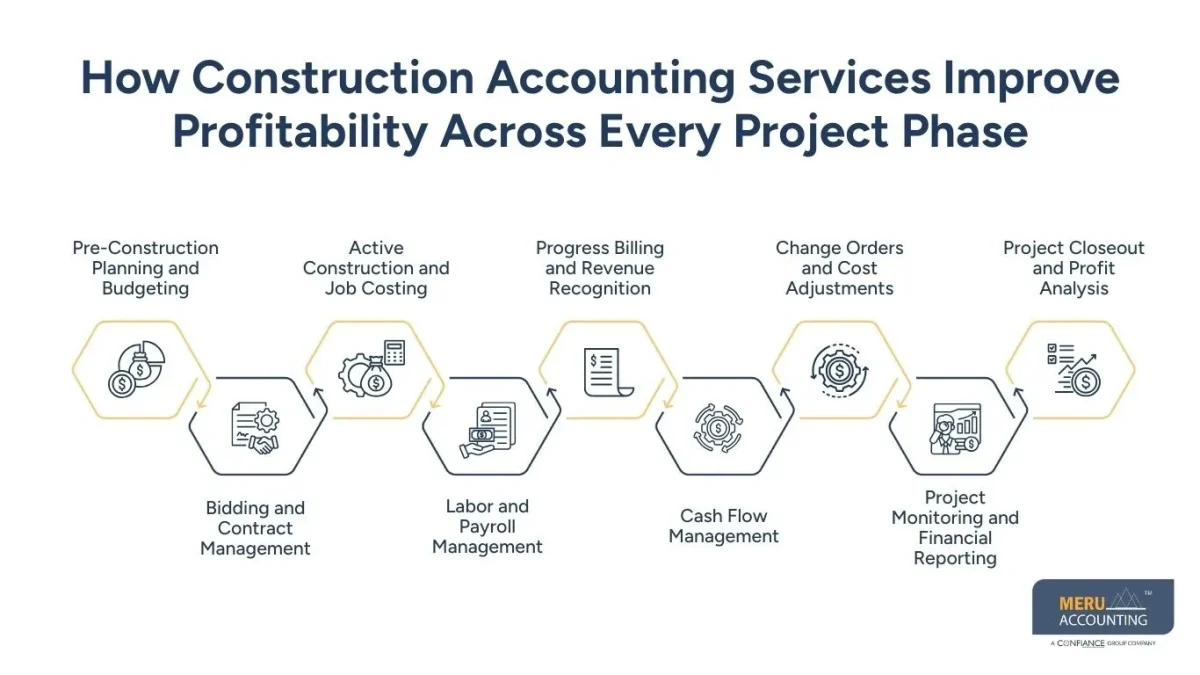
How Construction Accounting Services Improve Profitability Across Every Project Phase
Phase 1: Pre-Construction Planning and Budgeting
Accurate Cost Estimation
Profitability starts before the first brick is laid. Construction accounting services support detailed cost estimation by analyzing historical project data, labor rates, material costs, and subcontractor expenses. This helps contractors prepare realistic budgets and avoid underbidding.
Budget Structuring by Cost Codes
Well-defined cost codes allow expenses to be categorized by labor, materials, equipment, and overhead.
Construction accounting services ensure budgets are structured in a way that allows precise tracking once the project begins.
Financial Feasibility Analysis
Before committing resources, construction accounting helps assess project feasibility by evaluating projected margins, cash flow requirements, and risk exposure.
This allows contractors to pursue only those projects that align with their profitability goals.
Phase 2: Bidding and Contract Management
Competitive Yet Profitable Bidding
Construction accounting services provide insights into past job performance, enabling contractors to price bids competitively without sacrificing profit margins.
Understanding true job costs ensures bids are neither too aggressive nor overly conservative.
Contract Value and Cost Alignment
Construction accountants help align contract terms with financial expectations, including retainage, billing schedules, and escalation clauses. This alignment ensures revenue timelines support healthy cash flow.
Risk Identification
By reviewing contracts from a financial perspective, accounting services for construction companies help identify risks such as fixed-price contracts with volatile material costs or unfavorable payment terms that could impact profitability.
Phase 3: Active Construction and Job Costing
Real-Time Job Cost Tracking
One of the biggest advantages of construction accounting services is real-time job costing. Every expense, including labor, materials, and equipment, is tracked by project and phase for clear cost visibility.
Variance Analysis
Construction accounting compares actual costs with budgeted amounts to identify variances early. Detecting overruns in labor or materials allows corrective action before profitability is compromised.
Subcontractor Cost Control
Managing subcontractor payments is critical. Accounting services for construction companies ensure subcontractor invoices are matched with completed work, approved budgets, and lien waivers, preventing overpayments and disputes.
Phase 4: Labor and Payroll Management
Accurate Labor Cost Allocation
Labor is one of the largest construction expenses. Construction accounting services allocate payroll costs accurately across jobs, phases, and cost codes, ensuring true job profitability is reflected in financial reports.
Overtime and Productivity Monitoring
Tracking overtime trends and labor productivity helps identify inefficiencies. Construction accounting data supports management decisions such as workforce optimization and schedule adjustments.
Compliance and Reporting
Accounting services for construction companies ensure payroll compliance with labor laws, union requirements, and tax regulations, reducing the risk of penalties that can erode profits.
Phase 5: Progress Billing and Revenue Recognition
Percentage-of-Completion Accounting
Construction accounting solutions apply appropriate revenue recognition methods, such as percentage-of-completion, to match revenue with project progress.
This provides an accurate picture of financial performance at any stage.
Timely and Accurate Invoicing
Progress billing ensures contractors bill clients based on completed work. Construction accounting services help prepare accurate invoices, reducing delays and disputes that impact cash flow.
Managing Retainage
Retainage can strain cash flow if not tracked properly. Construction accounting solutions monitor retainage balances and ensure timely recovery at project milestones or completion.
Phase 6: Cash Flow Management
Cash Flow Forecasting
Construction accounting solutions forecast incoming and outgoing cash, helping contractors plan for payroll, material purchases, and equipment expenses without financial strain.
Payment Cycle Optimization
By analyzing receivables and payables, construction accounting helps optimize payment cycles. Faster collections and controlled disbursements improve liquidity and reduce reliance on credit.
Avoiding Cash Shortfalls
Even profitable projects can fail due to poor cash flow. Construction accounting services provide visibility that prevents cash crunches during critical phases of a build.
Phase 7: Change Orders and Cost Adjustments
Financial Impact Assessment
Change orders are inevitable in construction. Construction accounting services evaluate the financial impact of changes before approval, ensuring added work remains profitable.
Cost and Revenue Updates
Approved change orders are immediately reflected in updated budgets and forecasts. This ensures job cost reports remain accurate and profitability projections stay reliable.
Dispute Reduction
Clear financial documentation provided by construction accounting solutions helps reduce disputes related to scope changes, pricing, and billing.
Phase 8: Project Monitoring and Financial Reporting
Project-Level Financial Dashboards
Construction accounting services deliver detailed reports showing job costs, gross margins, committed costs, and forecasted profitability. These insights support informed decision-making.
Multi-Project Performance Analysis
For contractors managing multiple projects, construction accounting enables performance comparisons across jobs, identifying high-margin projects and areas for improvement.
Early Warning Indicators
Consistent financial reporting highlights warning signs such as cost overruns, declining margins, or delayed payments, allowing proactive management.
Phase 9: Project Closeout and Profit Analysis
Final Cost Reconciliation
At project completion, accounting services for construction companies reconcile all costs, revenues, retainage, and change orders to determine true profitability.
Lessons Learned for Future Projects
Post-project financial analysis helps contractors understand what worked and what didn’t. These insights improve estimating accuracy and cost control on future builds.
Tax Planning and Compliance
Construction accounting services ensure proper tax treatment of completed projects, depreciation of assets, and recognition of income, protecting net profits.
Long-Term Benefits Of Construction Accounting Services
Improved Cash Flow Control
Construction accounting services track incoming and outgoing cash accurately, helping businesses stay liquid.
Better Financial Forecasting
Accounting for construction projects supports forecasting based on real project data.
Reduced Financial Errors
Construction accounting solutions reduce mistakes caused by manual tracking or incomplete records.
Stronger Client Trust
Clear and accurate billing builds trust with clients and avoids disputes.
Sustainable Business Growth
Accounting for construction projects provides insights that support long-term planning and expansion.
Why Construction Businesses Need Specialized Accounting Support
Complex Project Structures
Accounting services for construction companies handle multiple projects running at the same time.
Variable Costs And Timelines
Accounting for construction projects adapts to changing labor, material, and schedule costs.
Retention And Holdbacks
Construction accounting solutions track retain payments that are released later.
Subcontractor Payment Tracking
Accounting for construction projects ensures subcontractors are paid accurately and on time.
Audit And Review Readiness
Construction accounting services keep records ready for audits, reviews, and lender checks.
How Meru Accounting Supports Construction Businesses
Meru Accounting understands the financial challenges faced by construction businesses at every stage of a project. Our services are designed to support accurate cost tracking, better financial control, and steady business growth.
Industry-Focused Expertise
Meru Accounting provides construction accounting solutions designed for contractors and builders.
Accurate Job Costing Support
Our team focuses on accounting for construction projects with clear cost allocation and reporting.
Software-Based Accounting Systems
We work with construction-friendly accounting tools to improve accuracy and visibility.
Cash Flow And Budget Control
Meru Accounting helps track project cash flow and control expenses across all phases.
Compliance And Reporting Support
Our construction accounting services ensure proper tax reporting and financial compliance.
Scalable Accounting Solutions
We support small contractors and growing construction firms with flexible accounting for construction projects.
Contact Meru Accounting to gain accurate cost tracking, clear reporting, and better financial control at every stage.
Key Takeaways
- Construction accounting services help track costs, income, and profit at the project level, giving better financial control.
- Accounting for construction projects provides accurate financial records that support informed and timely business decisions.
- Proper cost tracking through construction accounting services helps reduce losses and improve overall profit margins.
- General accounting methods often fail to address construction-specific financial needs, making specialized support essential.
- Accounting for construction projects supports long-term stability by improving financial planning and business growth.
FAQs
Construction accounting tracks all project-related financial activities like labor, materials, and equipment. It is important because it keeps projects on budget and ensures profitability.
It monitors expenses for each project individually, helping control costs and prevent overspending. It ensures timely project delivery by keeping finances organized.
Construction financial management focuses on project-specific costs and long-term projects. Regular accounting tracks overall company finances and general expenses.
Detailed financial records help pay subcontractors and suppliers on time. It avoids cash flow issues that could slow down the project.
Professionals ensure precise cost tracking and compliance with tax rules. This leads to smoother project delivery and better profitability.


