
The hospitality industry is one of the most dynamic and fast-evolving sectors in the global economy. As hotel groups expand across cities, regions, and even countries, managing finances becomes increasingly complex. Growth brings opportunity, but it also introduces operational challenges—especially when it comes to tracking costs, optimizing revenue, and maintaining financial accuracy across multiple properties. This is where hospitality bookkeeping services play a critical role. Unlike general bookkeeping, these services are tailored specifically to the unique needs of hotels, resorts, and other hospitality businesses. They help hotel groups maintain clarity over financial data, streamline operations, and make informed decisions that support sustainable growth.
At the same time, businesses are realizing that relying only on basic accounting practices is no longer enough. Modern hotel groups need structured systems, real-time reporting, and industry-specific expertise—often provided through professional hotel accounting services. In this blog, we will explore why expanding hotel groups increasingly depend on specialized financial support and how it directly impacts their cost and revenue control.
What You Will Learn From This Blog
By the end of this blog, you will understand:
- What hospitality bookkeeping services include and why they matter
- The financial challenges faced by growing hotel groups
- How these services improve cost control and reduce inefficiencies
- The role of financial tracking in better revenue management
- The difference between traditional accounting and specialized hospitality solutions
- How professional hotel accounting services can support long-term scalability
What Are Hospitality Bookkeeping Services?
Hospitality bookkeeping services refer to financial management solutions designed specifically for businesses in the hospitality sector. These services go beyond basic bookkeeping tasks like recording transactions or preparing financial statements.
They include:
- Daily revenue tracking (room bookings, food & beverage, events, etc.)
- Expense categorization across departments
- Payroll management for large and seasonal staff
- Inventory tracking for food, beverages, and supplies
- Financial reporting tailored to hotel KPIs
- Integration with property management systems (PMS)
Hotels operate differently from most businesses. Revenue streams are diverse, costs are variable, and operations run 24/7. Because of this, hospitality bookkeeping services are structured to handle high transaction volumes and complex reporting requirements.
When paired with professional hotel accounting services, these bookkeeping processes become even more powerful, offering insights that go beyond numbers and into performance optimization.
Why Expanding Hotel Groups Face Financial Challenges
As hotel groups grow, financial management becomes significantly more complicated. What worked for a single property often fails when applied to multiple locations.
Here are some key challenges:
Multiple Revenue Streams
Hotels generate income from rooms, restaurants, events, spa services, and more. Tracking each stream accurately requires specialized systems and expertise. This complexity increases the chances of misreporting if systems are not properly integrated.
Decentralized Operations
Different properties may operate independently, leading to inconsistent financial practices and reporting structures. This lack of standardization can make it difficult to consolidate financial data at the group level.
High Operating Costs
Expenses such as staffing, utilities, maintenance, and inventory can vary widely across locations, making cost control difficult. Without proper monitoring, these costs can quickly reduce overall profitability.
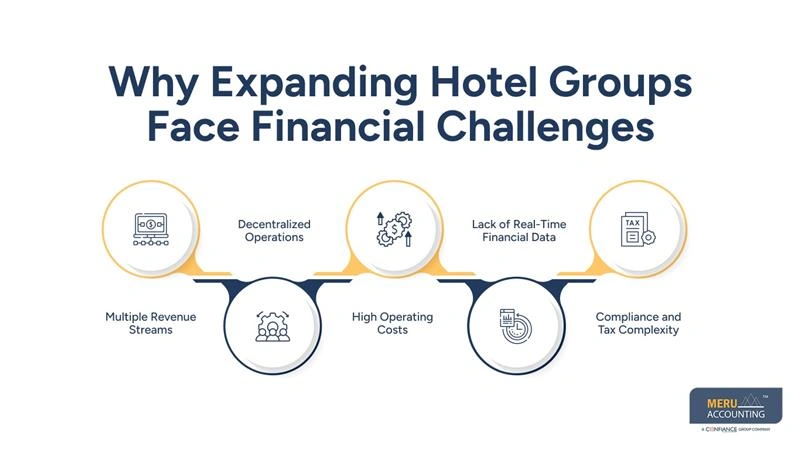
Lack of Real-Time Financial Data
Without proper systems, hotel groups often rely on delayed reports, which slows down decision-making. This delay can prevent management from responding quickly to financial issues or market changes.
Compliance and Tax Complexity
Operating in multiple regions means dealing with different tax regulations and compliance requirements. Failing to manage these properly can result in penalties and operational risks.
This is why expanding businesses turn to hospitality bookkeeping services. These services standardize processes, improve visibility, and ensure financial consistency across all properties.
Additionally, integrating hotel accounting services helps management teams interpret data and align financial strategies with business goals.
The Role of Hospitality Bookkeeping Services in Cost Control
Cost control is one of the biggest concerns for expanding hotel groups. Even small inefficiencies can lead to significant financial losses when multiplied across multiple locations.
Hospitality bookkeeping services help address this issue in several ways:
Detailed Expense Tracking
Every cost—whether it’s housekeeping supplies or kitchen inventory—is recorded and categorized. This allows management to identify areas where spending is excessive.
Department-Level Insights
Hotels operate through multiple departments. Bookkeeping services provide clear visibility into each department’s expenses, making it easier to manage budgets.
Inventory Management
Food and beverage costs are a major expense in hospitality. Accurate tracking reduces waste, prevents theft, and improves purchasing decisions.
Labor Cost Monitoring
Staffing is another significant cost. Bookkeeping systems help track wages, overtime, and productivity, ensuring optimal workforce management.
Budget vs. Actual Analysis
Regular comparisons between planned budgets and actual expenses highlight discrepancies early, allowing quick corrective action.
When combined with expert hotel accounting services, these insights turn into actionable strategies that improve operational efficiency and profitability.
How Hospitality Bookkeeping Services Improve Revenue Management
Revenue management is not just about increasing sales—it’s about maximizing profitability. For hotel groups, this requires precise data and strategic planning.
Hospitality bookkeeping services contribute to better revenue management in the following ways:
Real-Time Revenue Tracking
Accurate and up-to-date financial data allows hotel managers to monitor performance daily rather than waiting for monthly reports. This enables quicker adjustments to pricing, promotions, and operational strategies.
Identifying High-Performing Segments
By analyzing revenue streams, businesses can identify which services generate the most profit and focus on scaling them. This helps allocate resources more efficiently toward the most profitable areas.
Seasonal Trend Analysis
Hotels experience fluctuations based on seasons and events. Bookkeeping data helps predict trends and optimize pricing strategies. This also allows businesses to prepare in advance for peak and off-peak periods.
Improved Cash Flow Management
Understanding inflows and outflows ensures that businesses maintain healthy cash reserves, even during low seasons. It also helps in planning expenses and avoiding liquidity issues.
Data-Driven Decision Making
With reliable financial data, hotel groups can make informed decisions about expansion, pricing, and marketing. This reduces guesswork and improves overall business performance.
Professional hotel accounting services enhance these benefits by providing deeper financial analysis and forecasting, helping businesses stay ahead in a competitive market.
Hospitality Bookkeeping Services vs. Traditional Accounting
Many hotel groups initially rely on traditional accounting methods. However, as they expand, they quickly realize that generic systems are not sufficient.
Here’s how hospitality bookkeeping services differ:
Industry-Specific Approach
Traditional accounting is designed for general businesses, while hospitality bookkeeping services are tailored to hotel operations. This ensures that industry-specific metrics and workflows are accurately captured and analyzed.
Real-Time Data vs. Periodic Reports
Traditional accounting often focuses on monthly or quarterly reporting. In contrast, hospitality bookkeeping services provide real-time insights. This allows management to respond quickly to operational and financial changes.
Operational Integration
Hospitality systems integrate with tools like PMS and POS systems, ensuring seamless data flow. This reduces manual errors and improves overall efficiency in financial tracking.
Detailed Segmentation
Instead of broad financial categories, hospitality bookkeeping services break down data into specific departments and revenue streams. This level of detail helps identify performance gaps and opportunities more effectively.
Scalability
As hotel groups grow, these services adapt to increased complexity without compromising accuracy. This flexibility supports smooth expansion across multiple properties and locations.
While traditional accounting has its place, combining it with specialized hotel accounting services ensures a more comprehensive financial strategy.
How Meru Accounting Supports Expanding Hotel Groups
At Meru Accounting, we understand the complexities that come with managing multiple hotel properties. Our approach is designed to provide clarity, control, and confidence in your financial operations.
Our hotel accounting services are tailored to meet the unique needs of the hospitality industry. We focus on delivering accurate, timely, and actionable financial insights that support business growth.
Here’s how we help:
- Customized Financial Solutions: We design bookkeeping and accounting processes that align with your business structure and operational needs.
- Real-Time Reporting: Our systems ensure you always have access to up-to-date financial data for better decision-making.
- Cost Optimization Strategies: We identify inefficiencies and help you reduce unnecessary expenses.
- Revenue Analysis and Forecasting: Our team provides insights that help maximize profitability and plan future growth.
- Scalable Services: Whether you manage one property or multiple locations, our solutions grow with your business.
By combining hospitality bookkeeping services with expert-level support, Meru Accounting ensures that your financial management keeps pace with your expansion.
Our Expert Perspective
Based on industry experience, many ecommerce founders often underestimate how complex financial systems become as businesses grow. From platform fees to advertising costs, even small accounting errors can create larger profit gaps over time. Working with accountants for online businesses helps bring structure, improve reporting accuracy, and support stronger financial control.
Our experience also shows that businesses using ecommerce accounting services often make better pricing decisions and manage cash flow more effectively during growth. With proper financial systems in place, ecommerce and DTC brands can reduce risk, improve profitability visibility, and support long-term business stability.
Key Takeaways
- Expanding hotel groups face complex financial challenges that require specialized solutions
- Hospitality bookkeeping services provide detailed tracking, real-time insights, and operational efficiency
- Cost control improves through better expense management, inventory tracking, and labor monitoring
- Revenue management becomes more effective with accurate data and trend analysis
- Traditional accounting methods are not sufficient for growing hospitality businesses
- Professional hotel accounting services add strategic value through analysis and forecasting
- Partnering with experts like Meru Accounting helps ensure sustainable growth and financial stability
FAQs
They are tailored for hotels, handling multiple revenue streams, high transactions, and department-level tracking.
Growth increases complexity, and specialized services ensure accuracy, cost control, and better decisions.
They provide insights to identify profitable areas and improve pricing and revenue strategies.
Yes, they help build strong financial systems early and support smooth scaling.
Regularly—daily or weekly for operations and monthly for strategic planning.