



How Upcoming Changes to Instant Asset Write-Offs Affect Your Business
Instant asset write-offs help businesses cut tax fast. They let firms spend on key equipment and save money. Small businesses may gain the most from these rules. Planning purchases well can boost deductions and cash flow. Knowing thresholds and rules can stop costly mistakes.
Businesses need to adjust plans under new rules. Accounting teams may track assets more closely. Timing purchases can change the tax benefit. Expert advice can guide firms through the rules. Instant asset write-offs impact both tax and business strategy.
What Are Instant Asset Write-Offs?
Instant asset write-offs let firms claim assets fully at once. They may replace normal depreciation for some purchases. Firms can use these write-offs to lower taxable income. Careful planning ensures assets are claimed correctly.
Eligible Assets
Items like vehicles, office tools, and tech may qualify. Small and medium firms get short-term tax help. Assets must be categorized correctly to avoid errors. Proper classification prevents penalties.
Financial Advantages
Write-offs can improve cash flow quickly. Firms may reinvest saved funds in growth or operations. Timing purchases right increases short-term benefits. Proper accounting ensures deductions are claimed correctly.
Why Businesses Use Instant Asset Write-Offs
Reduce Tax Burden
Write-offs lower taxable income for small firms. They can pay less tax each year. Savings can go to investment or operations. Using write-offs may simplify accounting.
Encourage Timely Investment
Businesses may buy equipment when Instant Asset Write-Offs exist. They can replace old items or expand quickly. Timing purchases near fiscal deadlines saves money. Write-offs make high-cost items easier to afford.
Improve Cash Flow
Cash flow rises as taxes drop. Firms gain more funds for operations or unexpected costs. Planning ensures write-offs are used fully. Accounting teams track savings to spend wisely.
Upcoming Changes to Instant Asset Write-Offs
Threshold Adjustments
Higher Deduction Limits
Instant Asset Write-Off limits are rising for small and medium-sized firms. Bigger purchases can be claimed instantly. Firms can plan high-cost buys for tax benefits. Accounting systems need updates to track new limits.
Impact on Planning
New thresholds may change when firms buy assets. Planning purchases can boost tax and cash flow. Expert advice helps navigate rules correctly. Careful strategy reduces missed deductions.
Eligibility Criteria
Who Qualifies
Eligibility depends on size and business type. Firms must check which assets qualify. Tracking eligibility prevents costly mistakes. The strategy may need updates to claim properly.
Asset Categories
Some items may not qualify under the new rules. Businesses must reclassify or adjust claims. Proper categorization ensures maximum deductions. Expert guidance avoids errors in claims.
Depreciation Methods
Replacement of Depreciation
Write-offs may replace normal depreciation. Firms claim full cost at once, not over the years. Accounting needs updating to track changes. Correct use avoids financial mistakes.
Planning and Strategy
Depreciation still applies to non-eligible items. Firms may combine write-offs and depreciation for the best results. Accounting teams track both for proper reporting. Expert advice guides smart asset planning.
Impact on Cash Flow
Short-Term Benefits
Write-offs give fast tax savings. Funds are available quickly for operations and growth. Planning purchases can boost cash flow. Tracking ensures deductions are claimed fully.
Operational Flexibility
Extra funds may let businesses expand faster. Firms can cover growth or unexpected costs. Timing purchases ensures write-offs are claimed. Proper planning gives a competitive edge.
Strategic Planning Tips
Purchase Timing
Buy assets near year-end to get full tax gains. Good timing helps firms get strong value from set limits. Planned buys let accounts teams plan work with ease. Clear plans cut the risk of lost tax claims.
Track Assets
Track each asset with care and clean notes. Good records help staff avoid small or big slips. Simple tools can track assets and boost rule checks. Staff training helps keep files neat and right.
Consult Professionals
Accountants help firms claim full write-offs with ease. Their tips help avoid flaws in asset notes. Experts lift tax gains and help with cash flow. Firms get sound views on asset use and worth.
Align Spending
Match buys with needs and key rules or limits. Smart buys and good timing help firms grow fast. Strong plans lift value and raise work speed. Rule checks help firms avoid wrong claims.
Benefits of Instant Asset Write-Offs
Tax Savings
Write-offs help cut tax owed fast for firms. Saved cash can support core work and key needs. Good planning ensures all eligible assets are claimed.
Simplified Accounting
Write-offs reduce work when compared with long depreciation. Fewer entries help lower errors in daily records. Proper records help prevent checks or audits later.
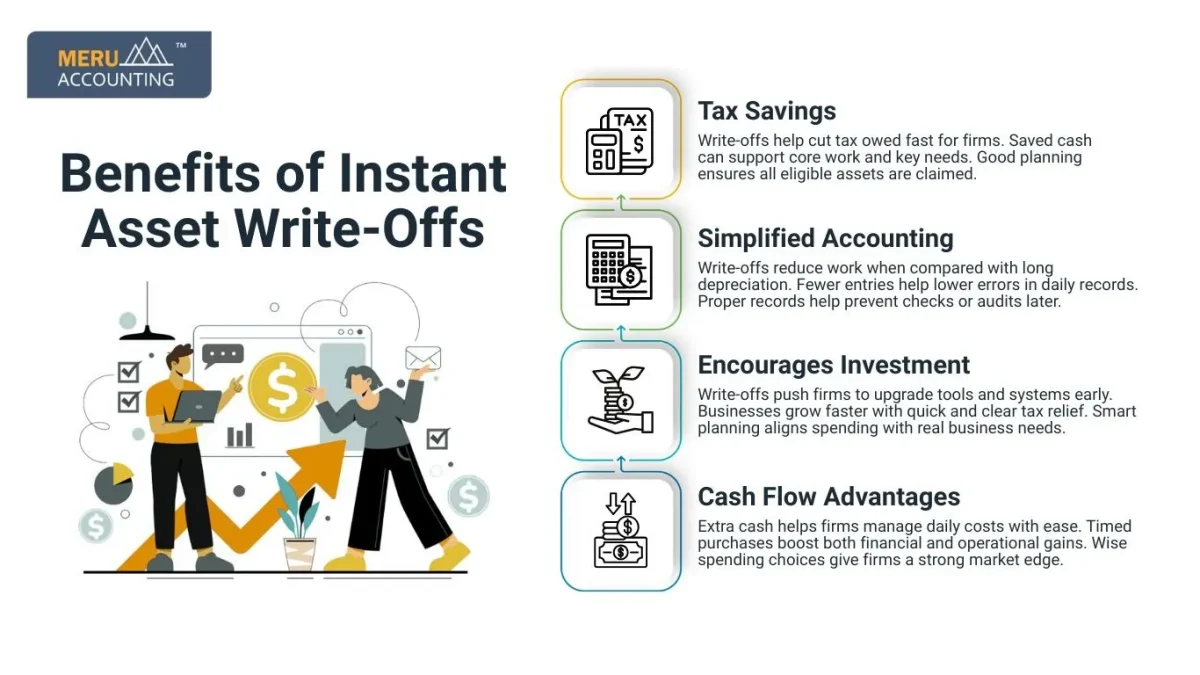
Encourages Investment
Write-offs push firms to upgrade tools and systems early. Businesses grow faster with quick and clear tax relief. Smart planning aligns spending with real business needs.
Cash Flow Advantages
Extra cash helps firms manage daily costs with ease. Timed purchases boost both financial and operational gains. Wise spending choices give firms a strong market edge.
Challenges with Instant Asset Write-Offs
Changing Rules
Rules change often and make planning hard for firms. Businesses must watch updates to stay fully compliant.
Asset Classification
The wrong asset class may cause claims to be denied. Proper tracking helps prevent mistakes and costly issues.
Threshold Limits
Low limits may block full instant claims for assets. Careful planning helps ensure each purchase meets the rules.
Accounting Complexity
Tracking many assets needs clear and structured books. Simple software tools help maintain clean asset records.
Timing Risks
Wrong timing may reduce key tax benefits greatly. Planned schedules help firms gain safe and full deductions.
How Businesses Can Prepare
Review Assets
Check current and planned assets for full Instant Asset Write-Offs rule fit. Identify assets that meet new rules with ease.
Update Systems
Update systems to track write-offs in real time. Staff training helps improve clear and accurate reports.
Strategic Planning
Plan purchases around key year-end dates and limits. Experts guide spending to gain the highest benefit.
Regular Monitoring
Monitor rule changes to keep your business fully compliant. Adjust plans when thresholds or key criteria change.
Internal Training
Train staff on asset rules and claim steps. Proper guidance helps reduce errors during claim work.
Key Considerations for Small Businesses
Maximize Thresholds
Small firms gain more from higher Instant Asset Write-Offs limits each year. Buying assets at the right time saves cash and taxes.
Plan Investments
Plan asset buys to match goals and business needs. Avoid extra spending while focusing on long-term benefits.
Track Eligibility
Check rules for each asset type before purchase. Keep clear records to stay compliant and avoid mistakes.
Professional Advice
Accountants can help claim the full allowed write-offs. Expert advice reduces errors and saves money for the business.
Instant asset write-offs give fast tax relief. Changes in limits and rules affect business plans. Firms can time purchases to get the most benefit. Careful tracking keeps cash flow and savings strong.
Meru Accounting provides specialised services to manage Instant Asset Write-Off requirements. Our firm provides accurate reporting, structured asset tracking, and compliance-focused solutions. Through our professional services, businesses can utilise Instant Asset Write-Offs effectively and improve overall financial outcomes.
FAQs
- What are instant asset write-offs in Australia?
They let small firms deduct the full cost of assets at once. This can cut tax bills in the same financial year. - Who is eligible for instant asset write-offs in Australia?
Small firms with a turnover below $10 million may claim them. It also depends on the asset type and how it is used. - What is the current threshold for instant asset write-offs in Australia?
The limit is $20,000 per asset for eligible firms. Assets above this may need to go into a depreciation pool. - When might the instant asset write-off threshold change in Australia?
It may drop to $1,000 from 1 July 2025 under the law. Firms may need to buy assets before this change occurs. - Is the proposed $30,000 cap confirmed in Australia?
No, this cap is only a proposal and not yet law. The government must approve it in future budget talks. - Can Australian businesses claim instant asset write-offs for second-hand assets?
Yes, new and used assets may qualify under limits. They must still meet cost and business-use rules. - Do I need proof of asset use for claims in Australia?
Yes, record when each asset is first used or installed. This helps support claims if the ATO checks them. - Which Australian businesses benefit most from instant asset write-offs?
Small firms, sole traders, and new start-ups gain the most cash flow. The benefit is best when buying more than one asset. - Do instant asset write-offs affect Australian tax planning?
Yes, they can lower taxable income and improve cash flow. Buying assets at the right time can save more tax. - Can I claim instant asset write-offs for vehicles in Australia?
Yes, business vehicles may qualify under ATO rules. Any personal use must be kept separate in the claim. - How do changes in thresholds affect Australian small businesses?
Assets over the limit may need to be depreciated slowly. This can reduce cash flow and tax savings in the short term. - Can instant asset write-offs be used alongside other Australian deductions?
Yes, but all claims must follow ATO rules. A tax professional can ensure the claim is done correctly. - Should Australian businesses buy assets before the threshold changes?
Yes, buying before June 2025 may get full write-off benefits. Waiting may mean deductions are spread across multiple years. - Will instant asset write-offs in Australia affect small business pools?
The low-value pool write-off may be removed in the new rules. Firms should track pool balances to plan depreciation properly. - Do instant asset write-offs apply to partially business-used assets in Australia?
Only the business-use portion may be claimed as a deduction. Any personal use cannot be included in the write-off. - Are start-ups in Australia eligible for instant asset write-offs?
Yes, new firms with a turnover under $10 million may claim them. They can use it to cut taxes in early cash-strapped years. - Is the $20,000 extension to June 2026 law in Australia?
Not yet — it is still under consideration in parliament. Firms should plan for both possible outcomes to stay ready. - How should Australian businesses track assets for write-offs?
Keep invoices, installation dates, and first-use records for assets. Good records lower the risk of errors and support claims. - Can instant asset write-offs improve Australian business cash flow?
Yes, they cut taxable income and free cash quickly. This allows reinvestment in new assets or daily business costs. - Will the Australian government likely change the instant asset write-off rules again?
Possibly, thresholds and rules may change in future budgets. Firms should stay updated to plan purchases and taxes well.
