

Imagine running a law firm where every payment, each client fee, and every small transaction is tracked with care. Now think about not having a system to manage these funds. One small mistake could cause missed deadlines, lost client money, or rule breaks. Many law firms face this risk without proper law firm bookkeeping. Trust accounts are hard to manage. They hold client money that cannot be used until the work is done. Mishandling them, even by chance, can lead to fines, audits, or harm to your firm’s name. Good law firm bookkeeping keeps these funds safe. It tracks and checks all transactions. It proves that every client dollar is where it should be.
Bookkeeping is not just about following rules. It also gives a clear view of the firm’s money. Many firms now use outsourced bookkeeping for law firms. Expert teams manage daily entries, check balances, and make clear reports. This lowers errors and lets lawyers focus on clients, cases, and growth. Outsourced help also gives a second check to catch mistakes before they grow.
In today’s legal world, good law firm bookkeeping is not optional. It is a key tool to protect clients, stay compliant, and run a firm that can grow safely. Clear records, careful checks, and expert help make the difference between a firm that struggles with money and a firm that thrives.
What You Will Learn From This Blog
This blog is for lawyers, managers, and staff who manage finances. It explains law firm bookkeeping step by step. Each section adds details so you understand the full process.
By reading this guide, you will learn how to:
- Track funds accurately and safely
- Avoid common mistakes with trust accounts
- Reconcile accounts correctly every month
- Maintain detailed records for audits and reports
- Follow best practices to stay compliant
- Understand how outsourced bookkeeping for law firms can help
Following this guide helps prevent errors, saves time, and improves your firm’s credibility.
What is Law Firm Bookkeeping
Law firm bookkeeping is the process of tracking all money in a law practice. This includes client funds, firm income, operating costs, and payroll. Unlike regular business bookkeeping, it has stricter rules because client money is involved.
Each transaction must be recorded. Each dollar must be accounted for. This includes retainers, client payments, and settlements.
Key areas of law firm bookkeeping:
- Client retainers and case fees – Funds received from clients must be logged carefully.
- Trust account management – Client funds are kept in trust and must be reconciled regularly.
- Operating account management – Money for office expenses and salaries is tracked separately.
- Payroll tracking – Staff salaries, benefits, and taxes are recorded accurately.
- Financial reporting – Reports show cash flow, profit, and compliance.
Many firms use outsourced bookkeeping for law firms. This service ensures all areas are managed correctly. It saves time and reduces the risk of errors.
Common Challenges in Managing Trust Accounts
Trust accounts are one of the hardest parts of law firm bookkeeping. They hold client money. Using the money incorrectly can have serious consequences.
Common challenges include:
- Mixing funds – Accidentally using client money for firm expenses. This is a serious compliance issue.
- Taking fees too soon – Funds should only be taken after work is billed and earned.
- Incomplete client tracking – Each client must have a clear ledger showing deposits, payments, and balances.
- Delayed reconciliations – Not reconciling accounts every month can cause mistakes.
- Poor documentation – Every deposit, withdrawal, and transfer should have supporting documents.
Using outsourced bookkeeping for law firms helps solve these challenges. Experts track funds carefully. They reconcile accounts regularly. They keep records organized and compliant.
Step-by-Step Guide to Law Firm Bookkeeping
A clear process makes law firm bookkeeping easier. Following steps reduces mistakes and stress. Below is a step-by-step guide.
1. Recording Transactions Accurately
Recording transactions is the base of good law firm bookkeeping. Every payment, fee, or expense should be entered right away. Waiting too long can lead to mistakes or missing data. Clear and timely records keep your firm safe and make audits easier.
Best Practices:
- Record transactions daily or weekly to avoid a backlog. Enter them as soon as you receive or spend money.
- Include client name, date, and purpose for each entry. This helps track every dollar correctly.
- Keep trust and operating accounts separate at all times. Do not mix client funds with firm funds.
- Save receipts, invoices, and proof for every payment. These support your records in case of audits.
- Review entries weekly to make sure all data is correct and complete. Small checks prevent big mistakes.
Using outsourced bookkeeping for law firms ensures all entries are correct and consistent. Professionals follow rules, reduce errors, and keep records clear. This frees lawyers to focus on clients and cases while keeping your finances safe.
2. Reconciling Trust Accounts and Operating Accounts
Reconciliation means matching records with bank statements. It confirms that all balances are correct. Trust accounts need special care because client money is involved.
Steps to reconcile:
- Compare bank statements with internal ledgers.
- Verify each client’s trust balance against the total account.
- Investigate discrepancies immediately.
- Check previous adjustments to ensure nothing is missed.
- Document the reconciliation process for audits.
Regular reconciliation reduces errors and prevents compliance issues. Outsourced bookkeeping for law firms can handle this efficiently.
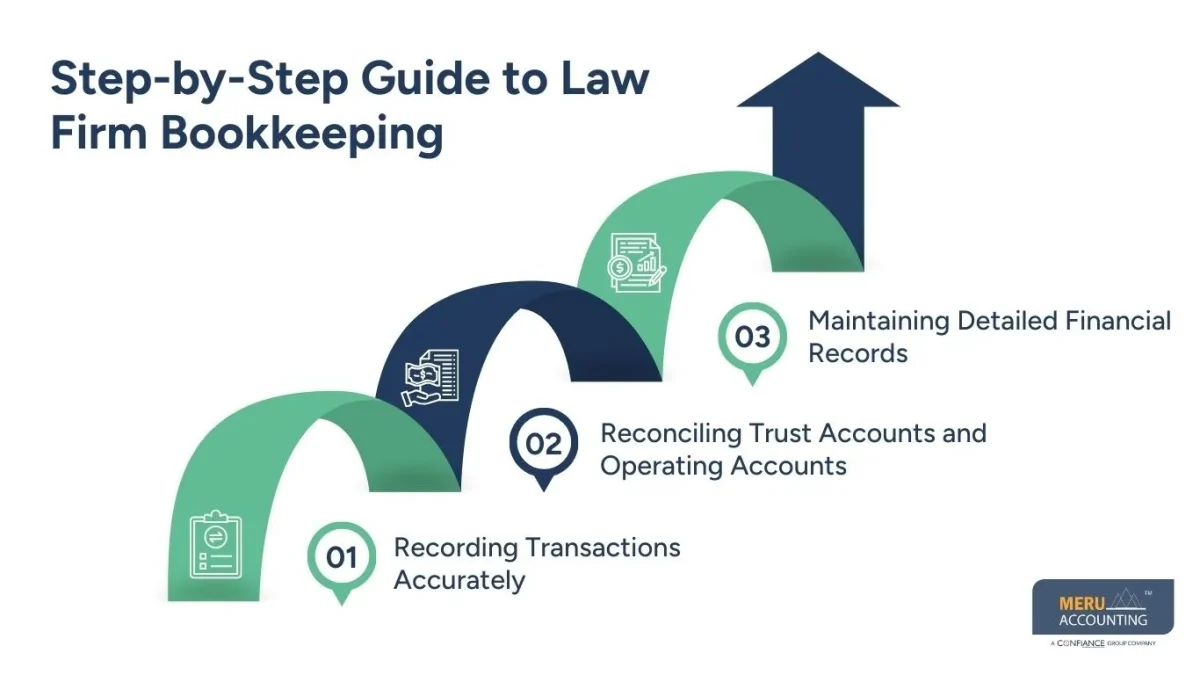
3. Maintaining Detailed Financial Records
Maintaining organized records is critical in law firm bookkeeping. Detailed records help during audits and client inquiries. They also help plan finances better.
Records to keep:
- Client trust ledgers – Show all deposits, withdrawals, and balances.
- Bank statements – Confirm all transactions.
- Invoices and receipts – Provide proof of payments.
- Payroll records – Track staff salaries and benefits.
- Expense reports – Show firm costs and allocations.
Outsourced bookkeeping for law firms ensures records are accurate, complete, and stored safely.
Best Practices for Staying Compliant
Compliance is a key part of law firm bookkeeping. Following best practices reduces risk and improves trust.
Recommended practices:
- Keep trust and operating accounts separate.
- Reconcile accounts monthly to catch errors early.
- Document all fund movements clearly.
- Stay updated on bar rules and regulations.
- Fix errors immediately to maintain compliance.
Using outsourced bookkeeping for law firms adds an extra layer of accuracy and oversight.
Avoiding Common Trust Account Mistakes
Most mistakes are avoidable. Law firm bookkeeping focuses on precision and accountability.
Mistakes to avoid:
- Paying firm expenses from trust accounts.
- Moving funds without documentation.
- Skipping client ledger updates.
- Ignoring small discrepancies.
- Failing to reconcile accounts regularly.
Professional outsourced bookkeeping for law firms can catch mistakes early and prevent serious problems.
Regular Audits and Financial Reviews
Audits verify accuracy and compliance in law firm bookkeeping. They show what works and what needs attention.
Benefits of audits:
- Detect errors early.
- Strengthen internal controls.
- Improve cash flow and planning.
- Simplify external audits.
- Build client trust.
Firms that use outsourced bookkeeping for law firms can get regular reports and help with audits.
Legal and Ethical Considerations
Handling client money carries responsibility. Law firm bookkeeping ensures legal and ethical standards are met.
Duties include:
- Protect client funds at all times.
- Keep complete, accurate records.
- Share records when clients request them.
- Correct mistakes promptly.
Outsourced bookkeeping for law firms ensures these duties are met consistently.
How Meru Accounting Supports Law Firms
Meru Accounting offers outsourced bookkeeping for law firms. We help manage records and trust accounts efficiently. Our services reduce stress and ensure compliance.
Services include:
- Trust account setup and monitoring
- Monthly reconciliation
- Accurate transaction recording
- Detailed reporting for management and audits
- Compliance oversight for all accounts
With our help, law firm bookkeeping becomes easy. Lawyers can focus on clients while we handle the books.
Key Takeaways
- Law firm bookkeeping protects client funds and ensures compliance.
- Trust accounts require careful monitoring and documentation.
- Accurate recording, reconciliation, and reporting prevent mistakes.
- Following best practices keeps the firm safe.
- Outsourced bookkeeping for law firms provides expertise, efficiency, and peace of mind.
FAQs
It keeps client funds safe. It helps the firm stay within the rules. It also gives a clear view of all money.
Trust accounts should be checked every month. This makes sure the records match the bank.
Yes. Even small mistakes can lead to fines, audits, or trouble with clients.
Yes. Experts keep records correct. They make sure the firm follows all rules.
Yes. It cuts admin work. Lawyers can spend more time on clients and cases.


